UEG's content platform for gastroenterology education bringing recordings, courses, guidelines, and more together in one place.
Trending on Gutflix
Rate for better recommendations!
Your feedback helps us show you more of what you like and less of what you dislike!
Log in to continue.
This content is part of Gutflix. Log in with your myUEG account, or create one free, to watch it.
Not sure what you can access? Learn more about account types.
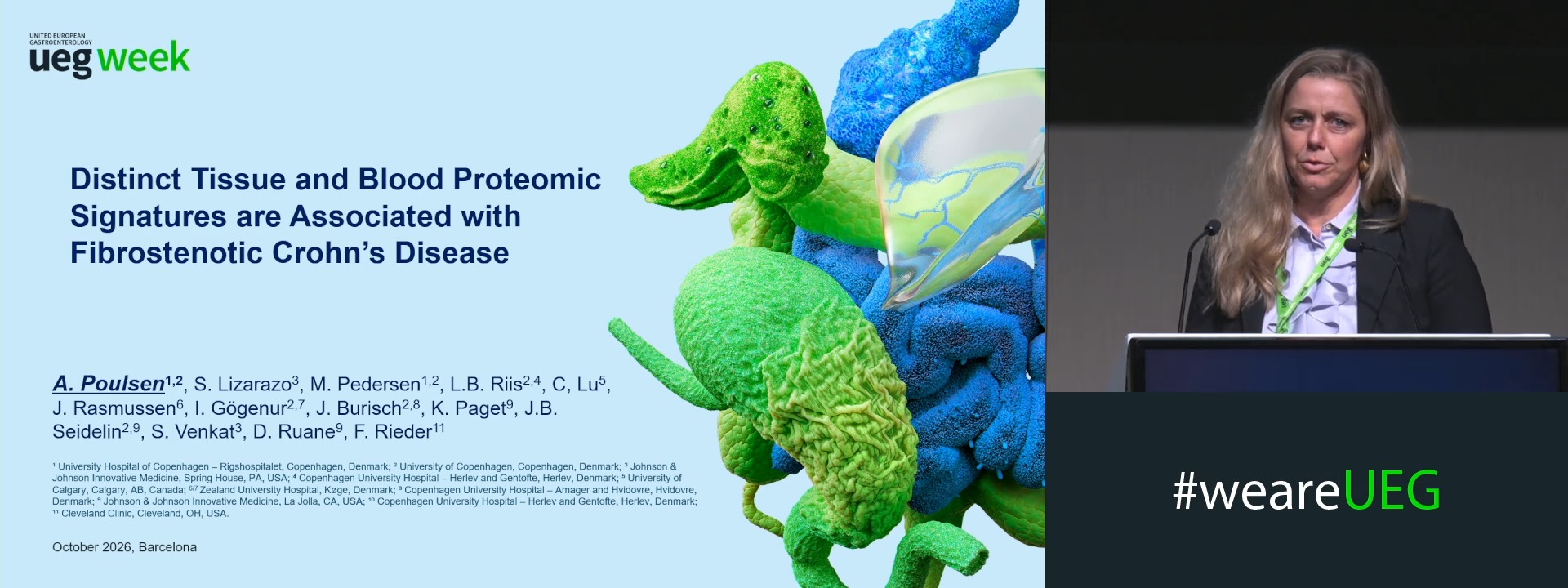
DISTINCT TISSUE AND BLOOD PROTEOMIC SIGNATURES ARE ASSOCIATED WITH FIBROSTENOTIC CROHN’S DISEASE
Anja Poulsen 1,2, Simon Lizarazo 3, Maria Am Pedersen 1,2, Lene Buhl Riis 4,2, Cathy Lu 5, Julie Rasmussen 6, Ismail Gögenur 7,2, Johan Burisch 8,2, Kate Paget 9, Jacob Seidelin 4,2, Swati Venkat 3, Darren Ruane 9, Florian Rieder 10
Affiliations
1 Rigshospitalet, Copenhagen Ø, Denmark
2 University of Copenhagen, Copenhagen, Denmark
3 Johnson & Johnson Innovative Medicine, Springhouse, United States
4 Herlev Hospital, Herlev, Denmark
5 University Of Calgary, Calgary, Canada
6 Køge Hospital, Køge, Denmark
7 Zealand University Hospital, Køge, Denmark
8 Hvidovre University Hospital, Hvidovre, Denmark
9 Johnson & Johnson Innovative Medicine, La Jolla, United States
10 Cleveland Clinic Foundation, Cleveland, United States
Log in to continue.
This content is part of Gutflix. Log in with your myUEG account, or create one free, to watch it.
Not sure what you can access? Learn more about account types.
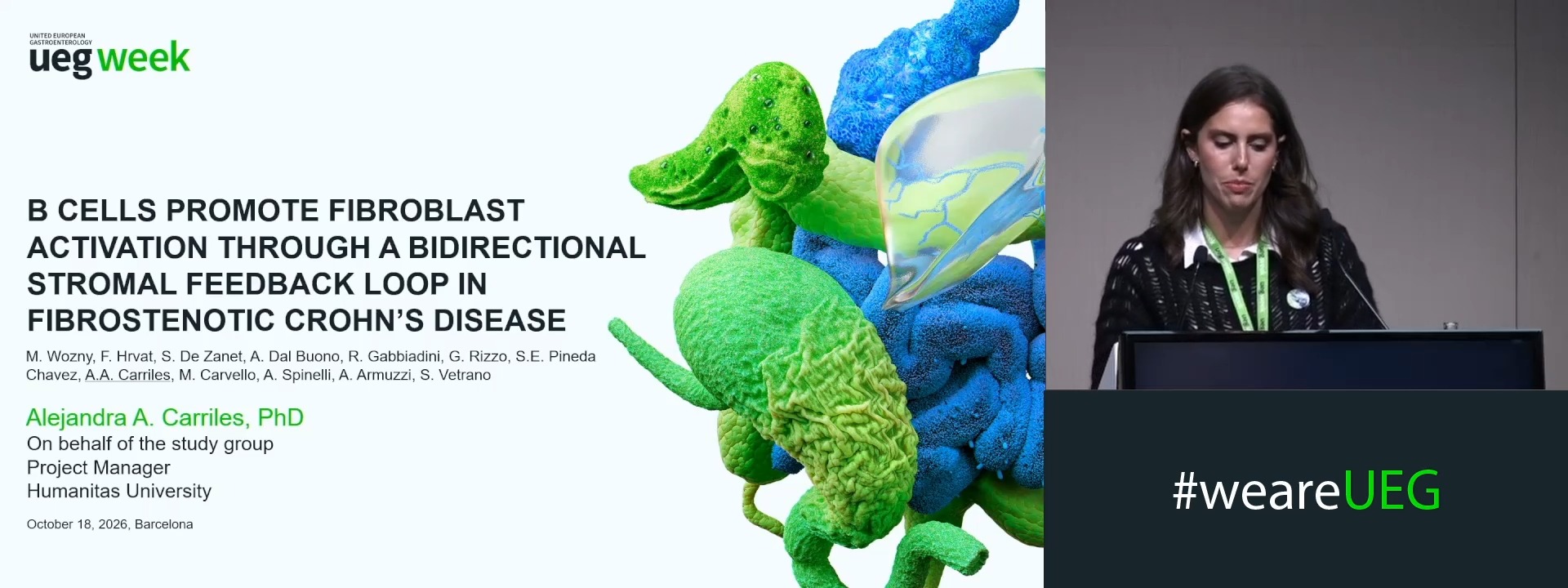
B CELLS PROMOTE FIBROBLAST ACTIVATION THROUGH A BIDIRECTIONAL STROMAL FEEDBACK LOOP IN FIBROSTENOTIC CROHN’S DISEASE
Marek Wozny 1, Faris Hrvat 1, Stefano De Zanet 2, Arianna Dal Buono 3, Roberto Gabbiadini 3, Giulia Rizzo 4, Samuel Elias Pineda Chavez 5, Alejandra Angela Carriles Linares 1, Michele Carvello 2, Antonino Spinelli 6, Alessandro Armuzzi 7, Stefania Vetrano 8
Affiliations
1 Humanitas University, Pieve Emanuele, Italy
2 IRCCS Humanitas Research Hospital, Rozzano, Italy
3 Humanitas University, Milan, Italy
4 Humanitas Research Hospital, Rozzano, Italy
5 Humanitas University, Rozzano, Italy
6 Humanitas University, Rozzano Milano, Italy
7 IBD Center, IRCCS Humanitas Research Hospital, Rozzano, Milan, Italy
8 Istituto Clinico Humanitas Dept. of Gastroenterology, Rozzano, Italy
Log in to continue.
This content is part of Gutflix. Log in with your myUEG account, or create one free, to watch it.
Not sure what you can access? Learn more about account types.
Panel discussion: The ultimate guide to colorectal cancer staging surgery adjuvant treatment

Log in to continue.
This content is part of Gutflix. Log in with your myUEG account, or create one free, to watch it.
Not sure what you can access? Learn more about account types.
Detection and management of dysplasia in UC
Affiliations
1 University College Cork, Cork, Ireland