UEG's educational platform for gastroenterology education bringing recordings, courses, guidelines, and more together in one place.
Most popular content
Rate for better recommendations!
Your feedback helps us show you more of what you like and less of what you dislike!
Log in to access this content.
Free for all myUEG account holders. Your access level is set automatically based on your occupation. Medical professionals get full access to all content. If you are a non-medical user, you can only access UEG Week content from congresses you attended.
Not sure what you can access? Learn more about account types.

PREVALENCE AND RISK FACTORS FOR RECURRENT PRIMARY BILIARY CHOLANGITIS AFTER LIVER TRANSPLANTATION: A SYSTEMATIC REVIEW AND META-ANALYSIS
Pedro Robson Costa Passos 1, Valbert Oliveira Costa Filho 1, Mariana Macambira Noronha 1, Yohanna Idsabella Rossi 2, Isabelle Castro Vitor 3, Milena Tomé 4, Wellgner Fernandes Oliveira Amador 4, Igor Boechat Silveira 5, Marina de Assis Bezerra Cavalcanti Leite 6, Rodrigo Motta 7, Guilherme Cançado 8
1 Federal University of Ceará, Fortaleza, Brazil
2 Federal University of Health Sciences of Porto Alegre, Porto Alegre, Brazil
3 Federal University of Rio de Janeiro, Rio de Janeiro, Brazil
4 Federal University of Campina Grande, Cajazeiras, Brazil
5 Federal University of Juiz de Fora, Juiz de Fora, Brazil
6 Federal University of Paraíba, João Pessoa, Brazil
7 University of Oxford, Oxford, United Kingdom
8 Federal University of Minas Gerais, Belo Horizonte, Brazil
Conference
Topics
Submission format
Session
Citation
Published
Log in to access this content.
Free for all myUEG account holders. Your access level is set automatically based on your occupation. Medical professionals get full access to all content. If you are a non-medical user, you can only access UEG Week content from congresses you attended.
Not sure what you can access? Learn more about account types.
Nurse Programme (Complete Session)
Event
Session
Citation
Published
Log in to access this content.
Free for all myUEG account holders. Your access level is set automatically based on your occupation. Medical professionals get full access to all content. If you are a non-medical user, you can only access UEG Week content from congresses you attended.
Not sure what you can access? Learn more about account types.
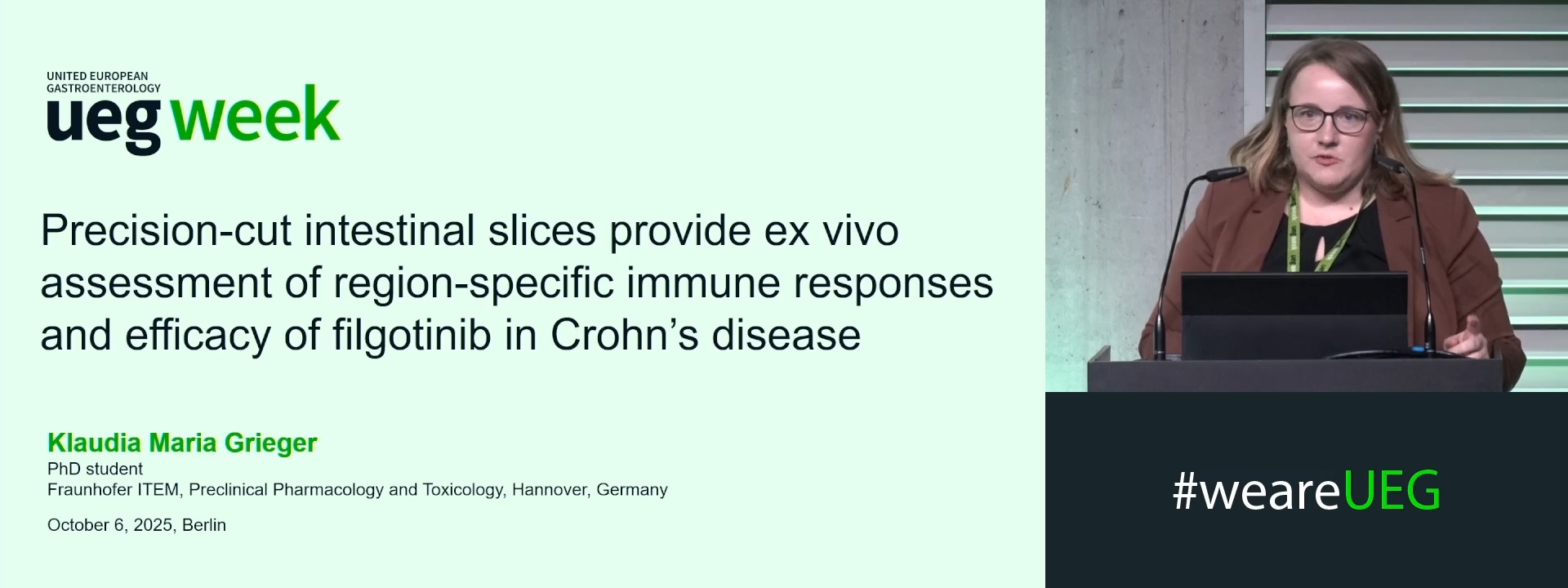
PRECISION-CUT INTESTINAL SLICES PROVIDE EX VIVO ASSESSMENT OF REGION-SPECIFIC IMMUNE RESPONSES AND EFFICACY OF FILGOTINIB IN CROHN'S DISEASE
Klaudia Maria Grieger 1, Valerie Beneke 1, Vanessa Neuhaus 1, Ulf Kulik 2, Heiko Aselmann 3, Benjamin Gundert 3, Armin Braun 1, Christina Hesse 1, Susann Dehmel 1, Katherina Sewald 1
1 Fraunhofer Institute for Toxicology and Experimental Medicine, Hannover, Germany
2 Hannover Medical school (MHH), Hannover, Germany
3 KRH Klinikum Region Hannover, Hannover, Germany
Event
Submission format
Citation
Published
Log in to access this content.
Free for all myUEG account holders. Your access level is set automatically based on your occupation. Medical professionals get full access to all content. If you are a non-medical user, you can only access UEG Week content from congresses you attended.
Not sure what you can access? Learn more about account types.
EP300/H3K27AC/IDO1 SIGNALING AXIS REGULATES THE CROSSTALK BETWEEN TOLDCS AND T<SUB >REG</SUB> CELLS TO PROMOTE LIVER REGENERATION IN ACETAMINOPHEN-INDUCED LIVER FAILURE
1 Tongji Hospital, School Of Medicine, Tongji University, Shanghai, China
2 Tongji University Tongji Hospital Dept. of Gastroenterology, Shanghai, China
Conference
Topics
Submission format
Citation
Published
Log in to access this content.
Free for all myUEG account holders. Your access level is set automatically based on your occupation. Medical professionals get full access to all content. If you are a non-medical user, you can only access UEG Week content from congresses you attended.
Not sure what you can access? Learn more about account types.
KLF4 ORCHESTRATES MYELOID-ENDOTHELIAL CROSSTALK VIA CXCL2/CXCL3-CXCR2 AXIS TO DRIVE NEUTROPHIL EXTRACELLULAR TRAPS AND INFLAMMATORY CASCADES IN ACETAMINOPHEN-INDUCED LIVER INJURY
1 Tongji University, Shanghai, China
2 Tongji University Tongji Hospital, Shanghai, China
Conference
Topics
Submission format
Citation
Published
Log in to access this content.
Free for all myUEG account holders. Your access level is set automatically based on your occupation. Medical professionals get full access to all content. If you are a non-medical user, you can only access UEG Week content from congresses you attended.
Not sure what you can access? Learn more about account types.
SAFETY AND EFFICACY OF COLD VS. HOT SNARE ENDOSCOPIC MUCOSAL RESECTION FOR COLORECTAL POLYPS: A SYSTEMATIC REVIEW AND META-ANALYSIS OF RANDOMIZED CONTROLLED TRIALS
Ahmed Farag 1, Amro Bani-Hani 2, Rihab Kherroubi 3, Alaa Mohamed Elsayed Abbas 4, Ahmed Ayman Shawky 5, Mohamed Hamouda Elkasaby 6
1 Ain Shams University, Cairo, Egypt
2 Faculty of Medicine, The Hashemite University, Zarqa, Jordan
3 Faculty of Medicine, University of Algiers Benyoucef Benkhedda, Algiers, Algeria
4 Faculty of Medicine, Menofia University, Menofia, Egypt
5 Faculty of Medicine, Mansoura University, Mansoura, Egypt
6 Faculty of Medicine, Al-Azhar University, Cairo, Egypt
Conference
Topics
Submission format
Session
Citation
Published
Log in to access this content.
Free for all myUEG account holders. Your access level is set automatically based on your occupation. Medical professionals get full access to all content. If you are a non-medical user, you can only access UEG Week content from congresses you attended.
Not sure what you can access? Learn more about account types.
GASTRIC PARTITIONING COMPARED TO CONVENTIONAL GASTROJEJUNOSTOMY AS PALLIATIVE SURGERIES IN PATIENTS WITH GASTRIC OUTLET OBSTRUCTION DUE TO UNRESECTABLE GASTRIC OR PANCREATIC CANCERS: A PAIR-WISE AND INDIVIDUAL PATIENT DATA META-ANALYSIS
1 Faculty of Medicine, Al-Azhar University, Cairo, Egypt
2 Faculty of Medicine, Mansoura University, Mansoura, Egypt
Conference
Topics