UEG's educational platform for gastroenterology education bringing recordings, courses, guidelines, and more together in one place.
Most popular content
Rate for better recommendations!
Your feedback helps us show you more of what you like and less of what you dislike!
Log in to access this content.
Free for all myUEG account holders. Your access level is set automatically based on your occupation. Medical professionals get full access to all content. If you are a non-medical user, you can only access UEG Week content from congresses you attended.
Not sure what you can access? Learn more about account types.

PREDICTIVE FACTORS FOR NON CURATIVE RESECTION FOLLOWING GASTRIC ENDOSCOPIC SUBMUCOSAL DISSECTION
Ana Clara Vasconcelos 1, Nuno Gonçalves 1, Ângela Domingues 2, Catarina Lopes Brandão 3, Pedro Pimentel-Nunes 4, Mario Dinis-Ribeiro 5, Diogo Libânio 5
1 Portuguese Oncology Institute of Porto, Porto, Portugal
2 Unidade Local de Saúde de Viseu Dão-Lafões, E.P.E., Viseu, Portugal
3 RISE@CI-IPO (Health Research Network), Porto, Portugal|||Portuguese Oncology Institute of Porto, Porto, Portugal
4 RISE@CI-IPO (Health Research Network), Porto, Portugal
5 Portuguese Oncology Institute of Porto, Porto, Portugal|||RISE@CI-IPO (Health Research Network), Porto, Portugal
Conference
Topics
Submission format
Citation
Published
Log in to access this content.
Free for all myUEG account holders. Your access level is set automatically based on your occupation. Medical professionals get full access to all content. If you are a non-medical user, you can only access UEG Week content from congresses you attended.
Not sure what you can access? Learn more about account types.
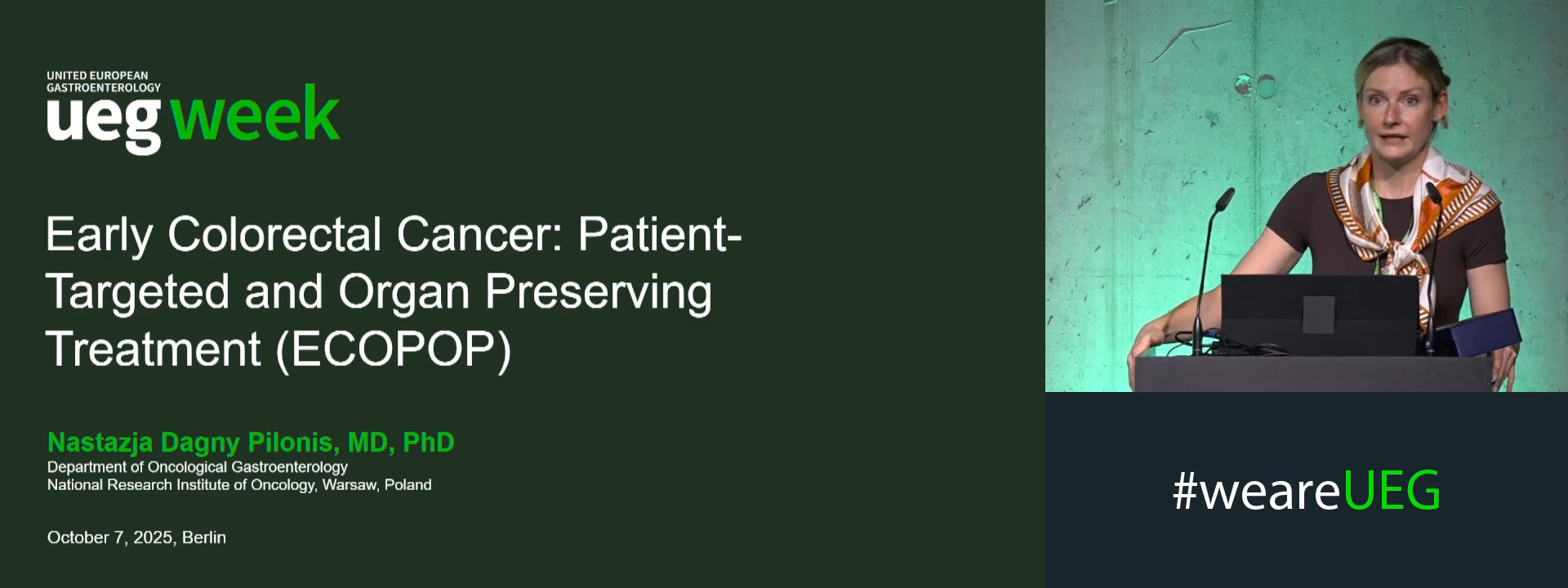
Early colorectal cancer: Patient-targeted and organ preserving treatment (ECOPOP Project)
1 The Maria Sklodowska-Curie Institute - Oncology Institute, Warsaw, Poland
Event
Session
Citation
Published
Log in to access this content.
Free for all myUEG account holders. Your access level is set automatically based on your occupation. Medical professionals get full access to all content. If you are a non-medical user, you can only access UEG Week content from congresses you attended.
Not sure what you can access? Learn more about account types.
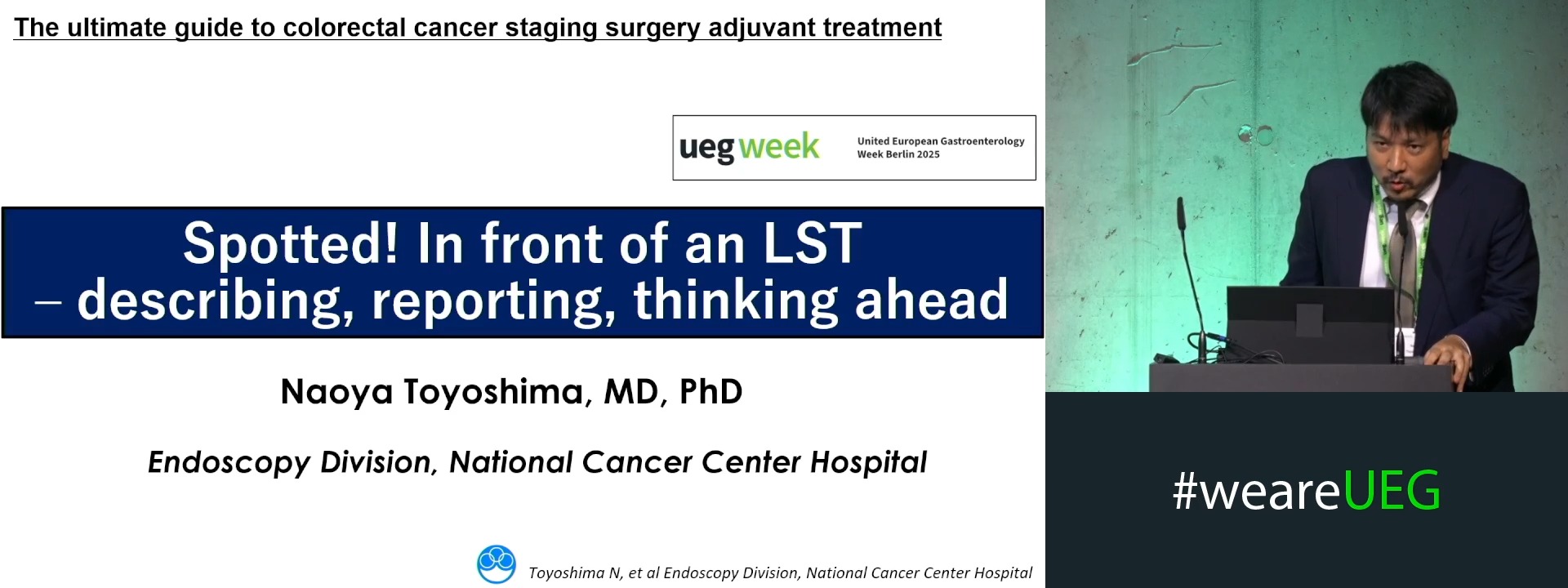
Spotted! In front of an LST– describing, reporting, thinking ahead
1 Showa University Nothern Yokohama Hospital Digestive Disease Center, Yokohama, Japan
Event
Topics
Citation
Published
Log in to access this content.
Free for all myUEG account holders. Your access level is set automatically based on your occupation. Medical professionals get full access to all content. If you are a non-medical user, you can only access UEG Week content from congresses you attended.
Not sure what you can access? Learn more about account types.
Panel discussion: Hereditary GI cancer syndromes - Surveillance strategies
Event
Citation
Published
Log in to access this content.
Free for all myUEG account holders. Your access level is set automatically based on your occupation. Medical professionals get full access to all content. If you are a non-medical user, you can only access UEG Week content from congresses you attended.
Not sure what you can access? Learn more about account types.
SIGNIFICANTLY HIGHER DIAGNOSTIC YIELD OF GASTROINTESTINAL ENDOSCOPY IN ASYMPTOMATIC PATIENTS WITH IRON-DEFICIENCY ANEMIA COMPARED TO ASYMPTOMATIC PATIENTS WITH OTHER TYPES OF ANEMIA
Eleni Trypaki 1, Adonis Protopapas 1, Vaia Kyritsi 1, Athanasios Filippidis 1, Maria Mauridou 1, Nikos Perchanidis 1, Georgia Kaiafa 1, Christos Savopoulos 1, Andreas Protopapas 1
1 Aristotle University of Thessaloniki, AHEPA University Hospital, Thessaloniki, Greece
Conference
Topics
Submission format
Citation
Published
Log in to access this content.
Free for all myUEG account holders. Your access level is set automatically based on your occupation. Medical professionals get full access to all content. If you are a non-medical user, you can only access UEG Week content from congresses you attended.
Not sure what you can access? Learn more about account types.
SAFETY AND OUTCOMES OF ENDOSCOPIC SUBMUCOSAL DISSECTION AFTER TRANSANAL ENDOSCOPIC SURGERY IN LESIONS INVOLVING THE ANAL CANAL: A RETROSPECTIVE ANALYSIS
Livio Enrico Del Vecchio 1, GIULIA Piccirilli 1, Luigi Giovanni Papparella 1, Rossella Maresca 1, Tommaso Schepis 1, Federico Barbaro 1, Lucio Petruzziello 1, Cristiano Spada 1, Silvia Pecere 1
1 Policlinico Universitario Agostino Gemelli, Rome, Italy
Conference
Topics
Submission format
Citation
Published
Log in to access this content.
Free for all myUEG account holders. Your access level is set automatically based on your occupation. Medical professionals get full access to all content. If you are a non-medical user, you can only access UEG Week content from congresses you attended.
Not sure what you can access? Learn more about account types.
Panel discussion: Early colorectal cancer
Event
Session