UEG's educational platform for gastroenterology education bringing recordings, courses, guidelines, and more together in one place.
Most popular content
Rate for better recommendations!
Your feedback helps us show you more of what you like and less of what you dislike!
Log in to access this content.
Free for all myUEG account holders. Your access level is set automatically based on your occupation. Medical professionals get full access to all content. If you are a non-medical user, you can only access UEG Week content from congresses you attended.
Not sure what you can access? Learn more about account types.

NALOXEGOL RESTORES CODEINE-INDUCED INHIBITION OF HIGH-AMPLITUDE PROPAGATING CONTRACTIONS AND INCREASE OF RETROGRADE CONTRACTIONS IN A RANDOMIZED, THREE-WAY CROSSOVER COLONIC HIGH-RESOLUTION MANOMETRY STUDY IN HEALTHY VOLUNTEERS
1 KU Leuven, Leuven, Belgium
2 KU Leuven, University Hospital Gasthuisberg, Leuven, Belgium
Conference
Topics
Submission format
Citation
Published
Log in to access this content.
Free for all myUEG account holders. Your access level is set automatically based on your occupation. Medical professionals get full access to all content. If you are a non-medical user, you can only access UEG Week content from congresses you attended.
Not sure what you can access? Learn more about account types.
COLONIC MOTOR PATTERNS AFTER INTRACOLONIC INFUSION OF FRUCTANS, FRUCTOSE AND MANNITOL IN HEALTHY VOLUNTEERS ASSESSED WITH HIGH-RESOLUTION COLONIC MANOMETRY
1 KU Leuven, University Hospital Gasthuisberg, Leuven, Belgium
Conference
Topics
Submission format
Citation
Published
Log in to access this content.
Free for all myUEG account holders. Your access level is set automatically based on your occupation. Medical professionals get full access to all content. If you are a non-medical user, you can only access UEG Week content from congresses you attended.
Not sure what you can access? Learn more about account types.
MRI ASSESSMENT OF ACUTE COLONIC VOLUME RESPONSES TO OPIOIDS AND NALOXEGOL IN HEALTHY SUBJECTS: INTERIM RESULTS FROM A RANDOMISED, DOUBLE-BLIND CROSSOVER STUDY
Annelies Verheyden 1, Živa Makovec 2, Amy Saliën 1, Esben Bolvig Mark 3, Iyad Naim 4, Alex Menys 5, Jan Tack 6
1 KU Leuven, University Hospital Gasthuisberg, Leuven, Belgium
2 University clinical centre Ljubljana, Ljubljana, Slovenia
3 Aalborg University Hospital, Aalborg, Denmark
4 Centre for Medical Imaging, University College London, London, United Kingdom
5 UCL, London, United Kingdom
6 University of Leuven, University Hospital Gasthuisberg, Leuven, Belgium
Conference
Topics
Submission format
Session
Citation
Published
Log in to access this content.
Free for all myUEG account holders. Your access level is set automatically based on your occupation. Medical professionals get full access to all content. If you are a non-medical user, you can only access UEG Week content from congresses you attended.
Not sure what you can access? Learn more about account types.
EFFECTS OF INTRACOLONIC FRUCTANS, FRUCTOSE, AND MANNITOL INFUSION ON COLONIC MOTILITY WITH HIGH-RESOLUTION COLONIC MANOMETRY IN HEALTHY SUBJECTS
1 KU Leuven, University Hospital Gasthuisberg, Leuven, Belgium
2 University clinical centre Ljubljana, Ljubljana, Slovenia
3 Flinders University, Adelaide, Australia
4 KU Leuven, Leuven, Belgium
5 University of Leuven, University Hospital Gasthuisberg, Leuven, Belgium
Conference
Topics
Submission format
Citation
Published
Log in to access this content.
Free for all myUEG account holders. Your access level is set automatically based on your occupation. Medical professionals get full access to all content. If you are a non-medical user, you can only access UEG Week content from congresses you attended.
Not sure what you can access? Learn more about account types.
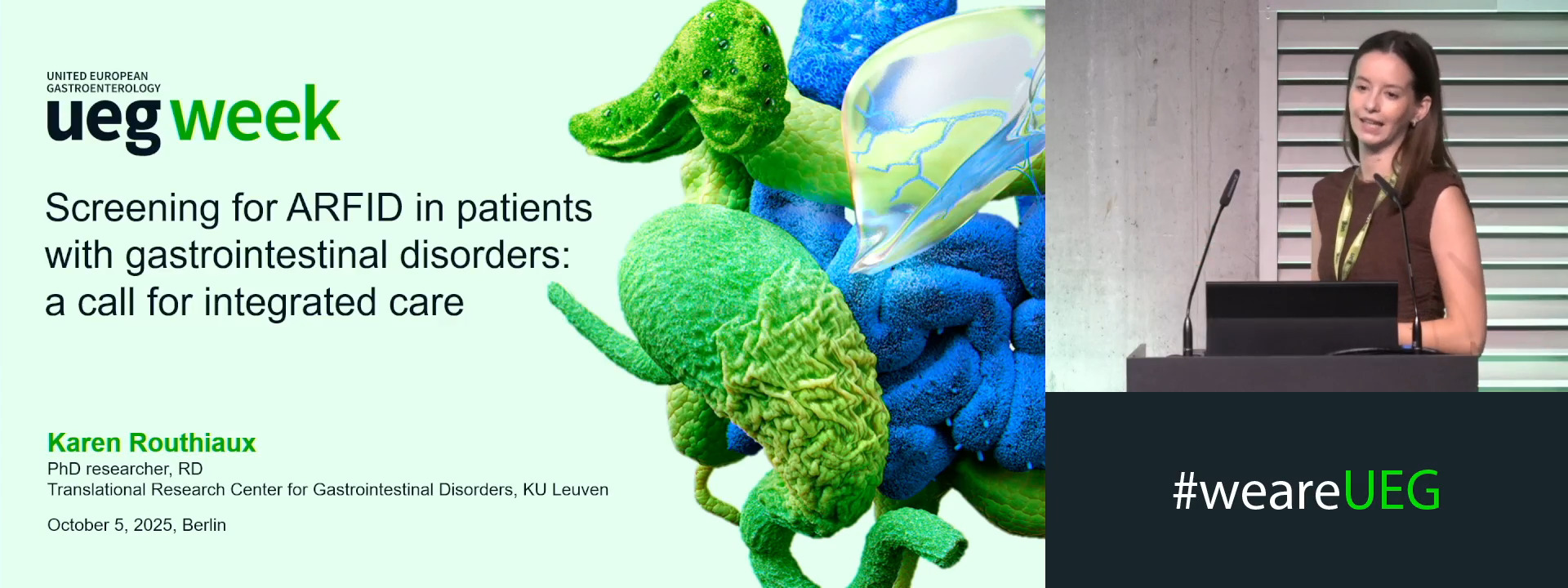
SCREENING FOR ARFID IN PATIENTS WITH GASTROINTESTINAL DISORDERS: A CALL FOR INTEGRATED CARE
Karen Routhiaux 1, Karen Van den Houte 1, Lukas Balsiger 2, Michael P. Jones 3, Karlien Raymenants 1, Cedric Van de Bruaene 1, Bert Broeders 1, Annelies Verheyden 1, Helen Burton Murray 4, Tim Vanuytsel 5, Jan Tack 5
1 KU Leuven, Leuven, Belgium
2 KU Leuven, Leuven, Belgium|||University of Bern, Bern, Switzerland
3 Macquarie University, North Ryde, Australia
4 Massachusetts General Hospital/Harvard Medical School, Boston, United States
5 KU Leuven, Leuven, Belgium|||UZ Leuven, Leuven, Belgium
Event
Topics
Submission format
Citation
Published
Log in to access this content.
Free for all myUEG account holders. Your access level is set automatically based on your occupation. Medical professionals get full access to all content. If you are a non-medical user, you can only access UEG Week content from congresses you attended.
Not sure what you can access? Learn more about account types.
A FOLLOW-UP SURVEY OF MEDICALLY REFRACTORY CONSTIPATION PATIENTS MANAGED WITH SUBTOTAL COLECTOMY OR CONSERVATIVELY, ON AVERAGE 4 YEARS AFTER HIGH-RESOLUTION COLONIC MANOMETRY
Annelies Verheyden 1, Amanda Blomsten 2, Jasper Pannemans 1, Wout Verbeure 1, Hans Törnblom 2, Tim Vanuytsel 3, Jan Tack 3
1 KU Leuven, Leuven, Belgium
2 Inst of Medicine, Gothenburg, Sweden
3 KU Leuven, University Hospital Gasthuisberg, Leuven, Belgium
Conference
Topics
Submission format
Citation
Published
Log in to access this content.
Free for all myUEG account holders. Your access level is set automatically based on your occupation. Medical professionals get full access to all content. If you are a non-medical user, you can only access UEG Week content from congresses you attended.
Not sure what you can access? Learn more about account types.
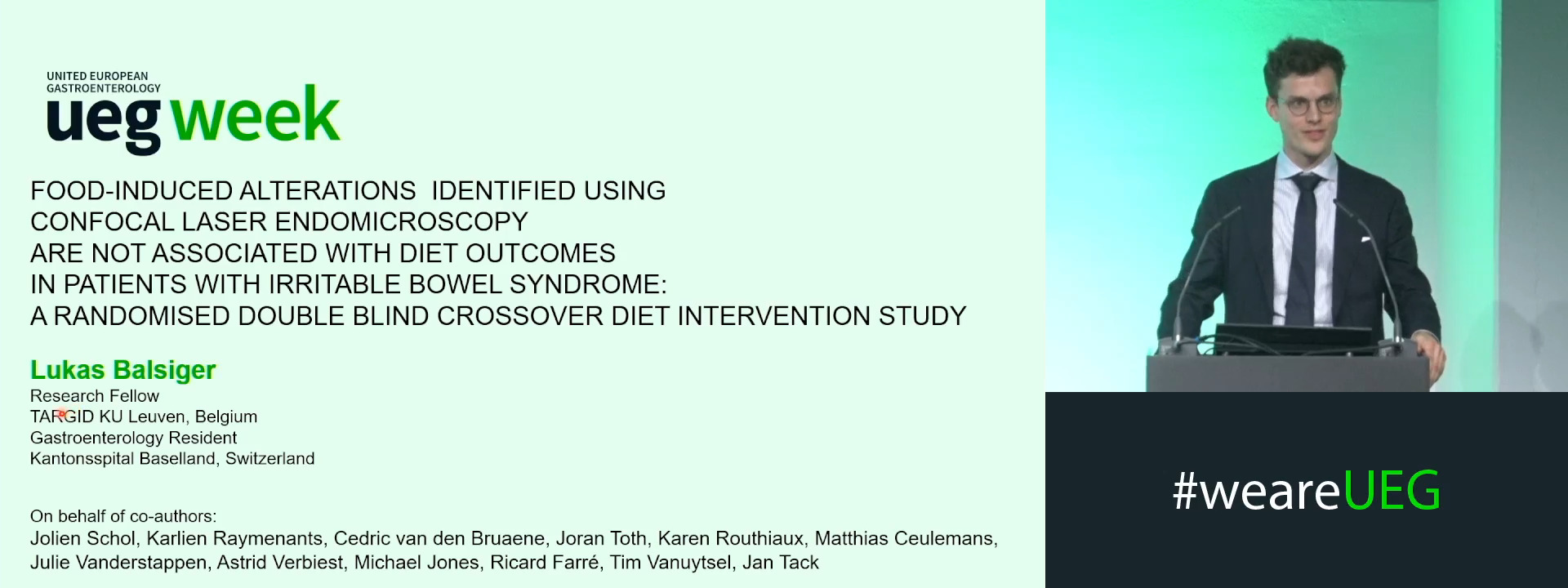
FOOD-INDUCED ALTERATIONS IDENTIFIED USING CONFOCAL LASER ENDOMICROSCOPY ARE NOT ASSOCIATED WITH DIET OUTCOMES IN PATIENTS WITH IRRITABLE BOWEL SYNDROME: A RANDOMISED DOUBLE BLIND CROSSOVER DIET INTERVENTION STUDY
Lukas Balsiger 1, Jolien Schol 2, Karlien Raymenants 2, Cedric Van de Bruaene 2, Joran Toth 1, Karen Routhiaux 1, Matthias Ceulemans 3, Julie Vanderstappen 4, Astrid Verbiest 1, Michael P. Jones 5, Ricard Farré 1, Tim Vanuytsel 6, Jan Tack 2
1 TARGID KU Leuven, Leuven, Belgium
2 TARGID KU Leuven, Leuven, Belgium|||University Hospitals Leuven, Leuven, Belgium
3 Icahn School of Medicine at Mount Sinai, New York, United States
4 University Hospitals Leuven, Leuven, Belgium
5 Macquarie University, North Ryde, Australia
6 University Hospitals Leuven, Leuven, Belgium|||TARGID KU Leuven, Leuven, Belgium
Event
Submission format
Session