UEG's content platform for gastroenterology education bringing recordings, courses, guidelines, and more together in one place.
Trending on Gutflix
Rate for better recommendations!
Your feedback helps us show you more of what you like and less of what you dislike!

Log in to continue.
This content is part of Gutflix. Log in with your myUEG account, or create one free, to watch it.
Not sure what you can access? Learn more about account types.
NOVEL BLOOD-BASED PROTEIN BIOMARKER SIGNATURE FOR EARLY DETECTION OF COLORECTAL CANCER AND ADVANCED ADENOMAS
Ioannis S Papanikolaou 1, Eleni Koukoulioti 1, Christos Fotis 2,3, Nikolaos Tsolakos 2,3, Pinelopi Antonopoulou 1, Aliki Stamou 1, Georgia Anagnostou 1, Elli Karatza 1, Kristalina Kapantai 1, Ioannis Vezakis 4, Athanasios Stamogiannos 2,3, Vaia Pliaka 2,3, Ioannis Temponeras 2,3, Stavros Miloulis 5, Mario Tadic 6, Konstantinos Triantafyllou 1, Zheshen Jiang 7, Georgios Matsopoulos 5, Leonidas Alexopoulos 2,3
Affiliations
1 Attikon University Hospital, National and Kapodistrian University of Athens, Chaidari Attikis, Greece
2 Protavio Ltd, Dimokritos Science Park, Athens, Greece
3 Biomedical Systems Laboratory, National Technical University of Athens, Athens, Greece
4 Tecreando B.V., Amsterdam, Netherlands
5 Institute of Communication and Computer Systems, School of Electrical and Computer Engineering, National Technical University of Athens, Athens, Greece
6 Department of Gastroenterology, Dubrava University Hospital, Zagreb, Croatia
7 Centre Hospitalier Universitaire de Liege, Liege, Belgium
Log in to continue.
This content is part of Gutflix. Log in with your myUEG account, or create one free, to watch it.
Not sure what you can access? Learn more about account types.
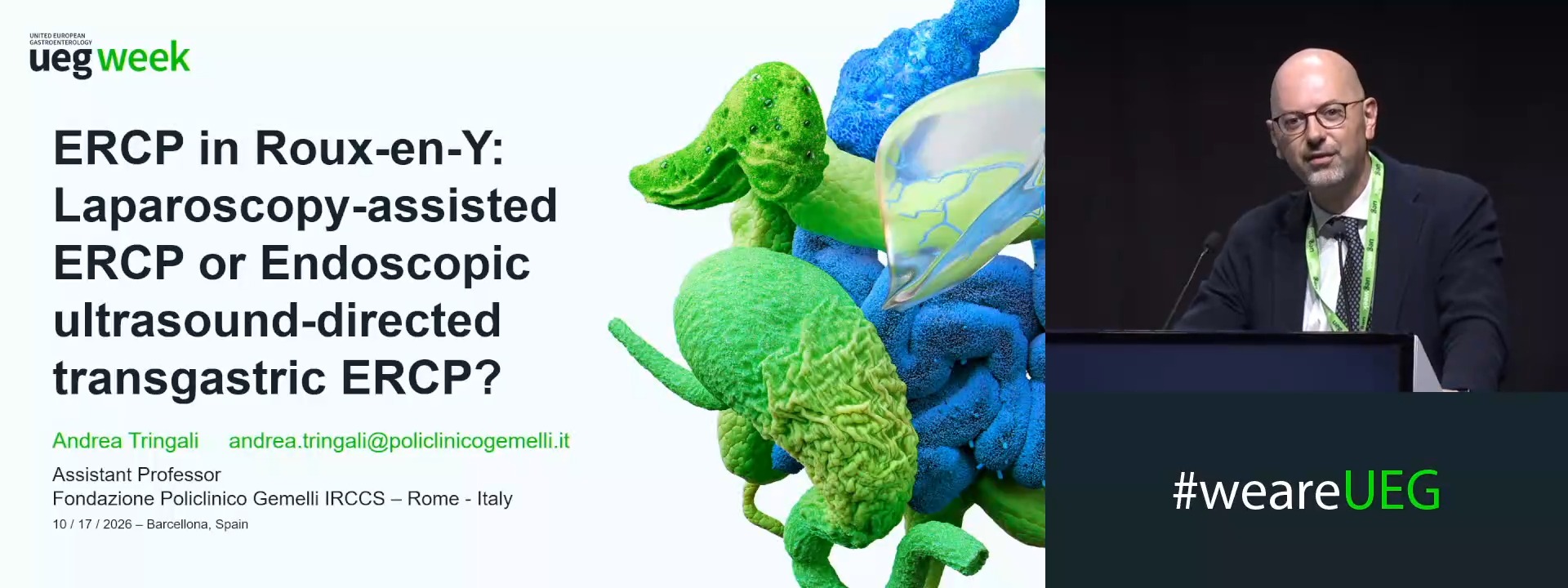
Video case: ERCP in Roux-en-Y: Laparoscopy-assisted ERCP or endoscopic ultrasound-directed transgastric ERCP?
Affiliations
1 Catholic University of the Sacred Heart, Rome, Italy
Log in to continue.
This content is part of Gutflix. Log in with your myUEG account, or create one free, to watch it.
Not sure what you can access? Learn more about account types.
Q&A: Chronic constipation: How to diagnose and treat this frequent condition in clinical practice

Log in to continue.
This content is part of Gutflix. Log in with your myUEG account, or create one free, to watch it.
Not sure what you can access? Learn more about account types.
Summary: H. pylori and precancerous conditions
Affiliations
1 University of Latvia, Riga, Latvia
Log in to continue.
This content is part of Gutflix. Log in with your myUEG account, or create one free, to watch it.
Not sure what you can access? Learn more about account types.
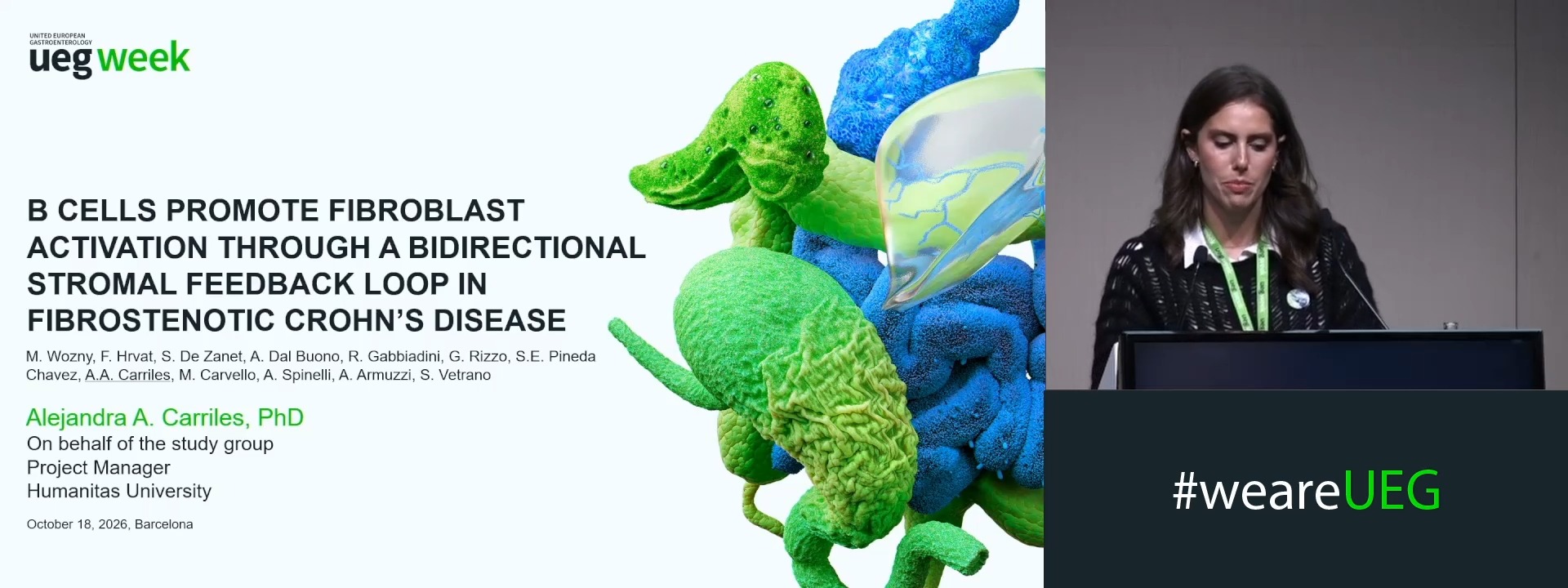
B CELLS PROMOTE FIBROBLAST ACTIVATION THROUGH A BIDIRECTIONAL STROMAL FEEDBACK LOOP IN FIBROSTENOTIC CROHN’S DISEASE
Marek Wozny 1, Faris Hrvat 1, Stefano De Zanet 2, Arianna Dal Buono 3, Roberto Gabbiadini 3, Giulia Rizzo 4, Samuel Elias Pineda Chavez 5, Alejandra Angela Carriles Linares 1, Michele Carvello 2, Antonino Spinelli 6, Alessandro Armuzzi 7, Stefania Vetrano 8
Affiliations
1 Humanitas University, Pieve Emanuele, Italy
2 IRCCS Humanitas Research Hospital, Rozzano, Italy
3 Humanitas University, Milan, Italy
4 Humanitas Research Hospital, Rozzano, Italy
5 Humanitas University, Rozzano, Italy
6 Humanitas University, Rozzano Milano, Italy
7 IBD Center, IRCCS Humanitas Research Hospital, Rozzano, Milan, Italy
8 Istituto Clinico Humanitas Dept. of Gastroenterology, Rozzano, Italy
Log in to continue.
This content is part of Gutflix. Log in with your myUEG account, or create one free, to watch it.
Not sure what you can access? Learn more about account types.
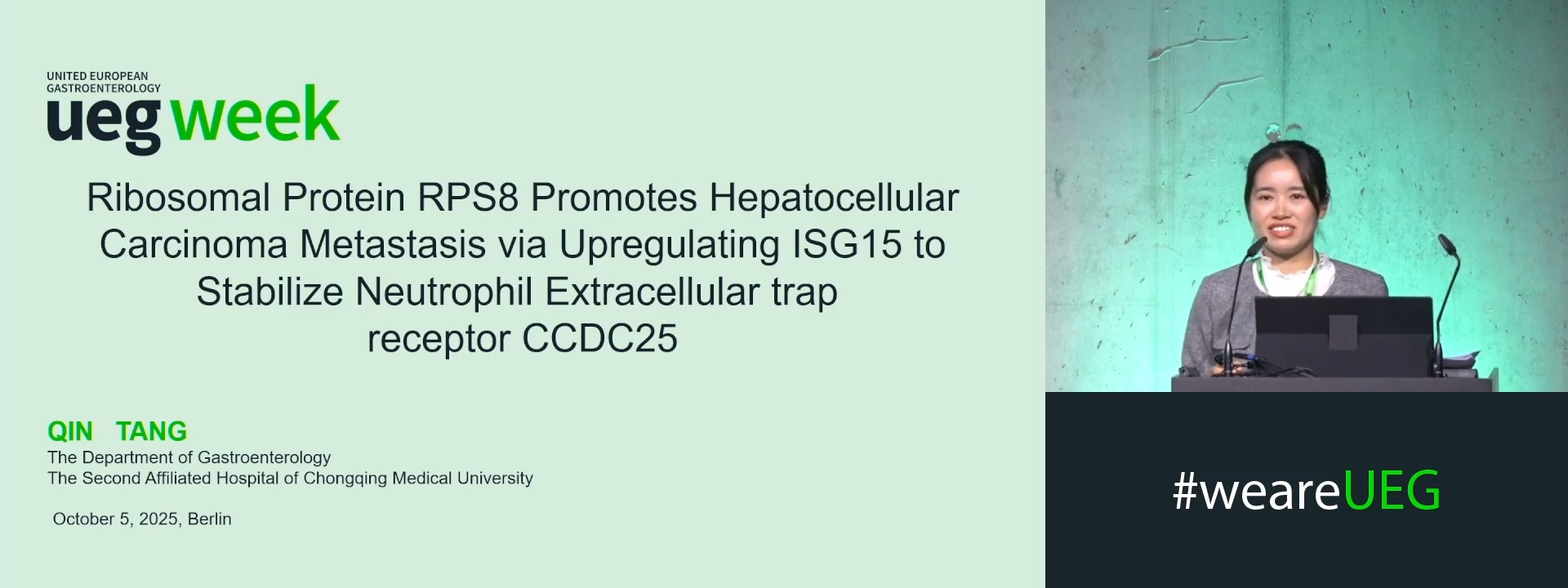
RIBOSOMAL PROTEIN RPS8 PROMOTES HEPATOCELLULAR CARCINOMA METASTASIS VIA UPREGULATING ISG15 TO STABILIZE NEUTROPHIL EXTRACELLULAR TRAP RECEPTOR CCDC25
Affiliations
1 The Second Affiliated Hospital of Chongqing Medical University, Chongqing, China
Log in to continue.
This content is part of Gutflix. Log in with your myUEG account, or create one free, to watch it.
Not sure what you can access? Learn more about account types.
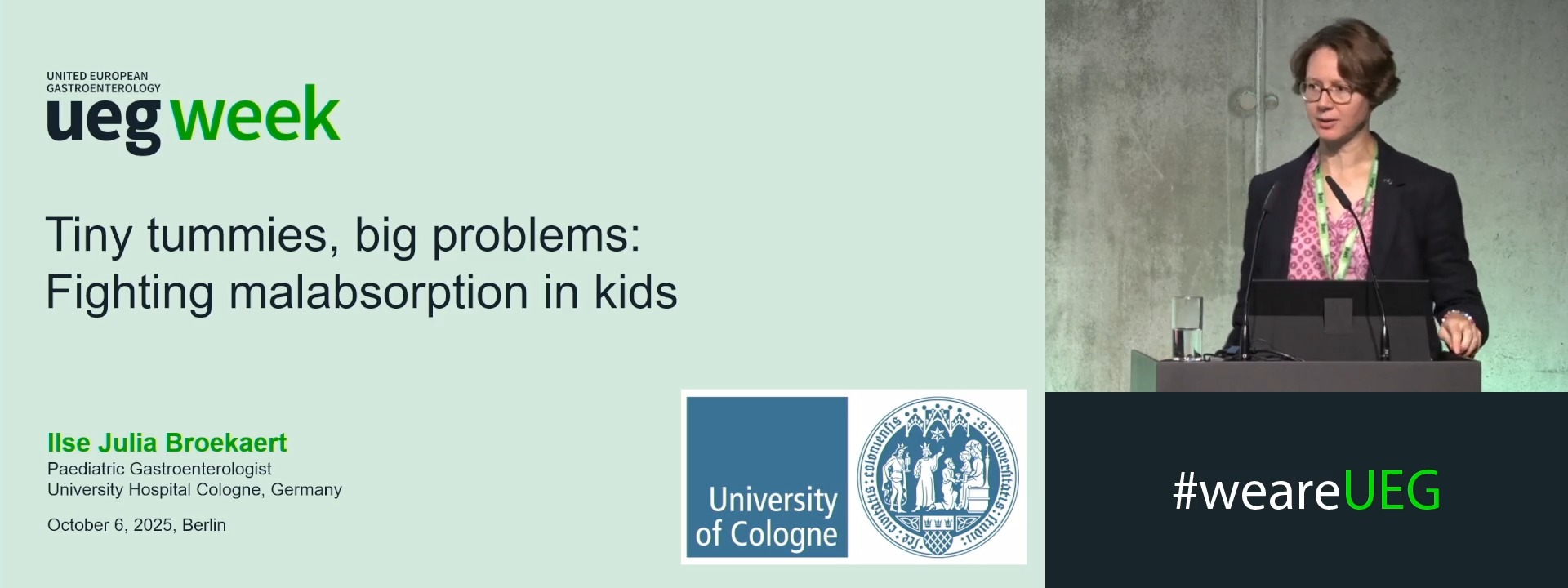
Tiny tummies, big problems: Fighting malabsorption in kids
Affiliations
1 University Childrens Hospital Cologne, Cologne, Germany