UEG's educational platform for gastroenterology education bringing recordings, courses, guidelines, and more together in one place.
Most popular content
Rate for better recommendations!
Your feedback helps us show you more of what you like and less of what you dislike!
Log in to access this content.
Free for all myUEG account holders. Your access level is set automatically based on your occupation. Medical professionals get full access to all content. If you are a non-medical user, you can only access UEG Week content from congresses you attended.
Not sure what you can access? Learn more about account types.

UPADACITINIB-INDUCED REMISSION OF SEVERE LEUKOCYTOCLASTIC VASCULITIS IN A YOUNG PATIENT WITH VERY EARLY-ONSET CROHN’S DISEASE
Livio Bonacci 1, Olga Maria Nardone 1, Camilla Leo 1, Flavia Palumbo 1, Martina Petolicchio 1, Francesca Wanda Rossi 1, Fabiana Castiglione 1
1 University of Naples Federico II, Naples, Italy
Conference
Topics
Submission format
Session
Published
Log in to access this content.
Free for all myUEG account holders. Your access level is set automatically based on your occupation. Medical professionals get full access to all content. If you are a non-medical user, you can only access UEG Week content from congresses you attended.
Not sure what you can access? Learn more about account types.
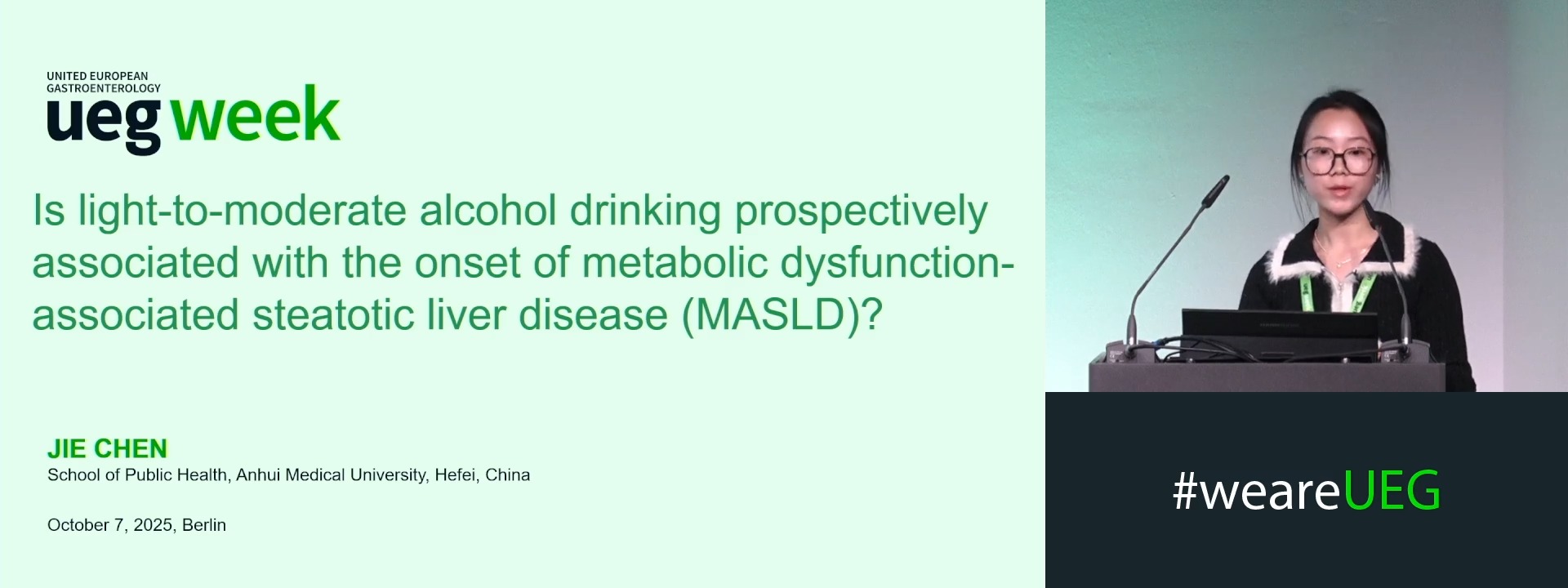
IS LIGHT TO MODERATE ALCOHOL DRINKING PROSPECTIVELY ASSOCIATED WITH THE ONSET OF METABOLIC DYSFUNCTION-ASSOCIATED STEATOTIC LIVER DISEASE?
Jie Chen 1, Yangxin Xu 1, Yu Chang 1, Qin Xinsheng 1, Hongjuan Cao 2, Zhuang Zhang 1, Wanshui Yang 1
1 Anhui Medical University, Hefei, China
2 Lu'an Municipal Center for Disease Control and Prevention, Lu'an, China
Event
Topics
Submission format
Citation
Published
Log in to access this content.
Free for all myUEG account holders. Your access level is set automatically based on your occupation. Medical professionals get full access to all content. If you are a non-medical user, you can only access UEG Week content from congresses you attended.
Not sure what you can access? Learn more about account types.
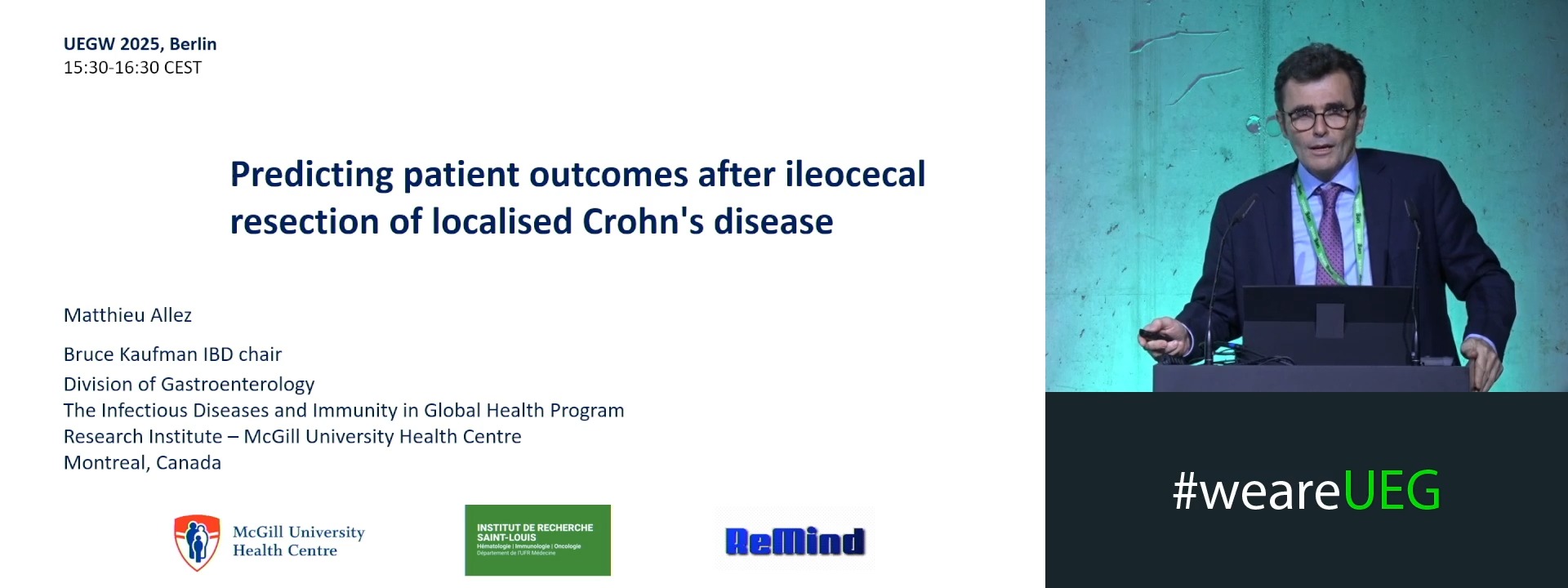
… after ileocecal resection of localised Crohn's disease
1 Saint-Louis Hospital, AP-HP, Université Paris Cité, Paris, France
Event
Topics
Session
Citation
Published
Log in to access this content.
Free for all myUEG account holders. Your access level is set automatically based on your occupation. Medical professionals get full access to all content. If you are a non-medical user, you can only access UEG Week content from congresses you attended.
Not sure what you can access? Learn more about account types.
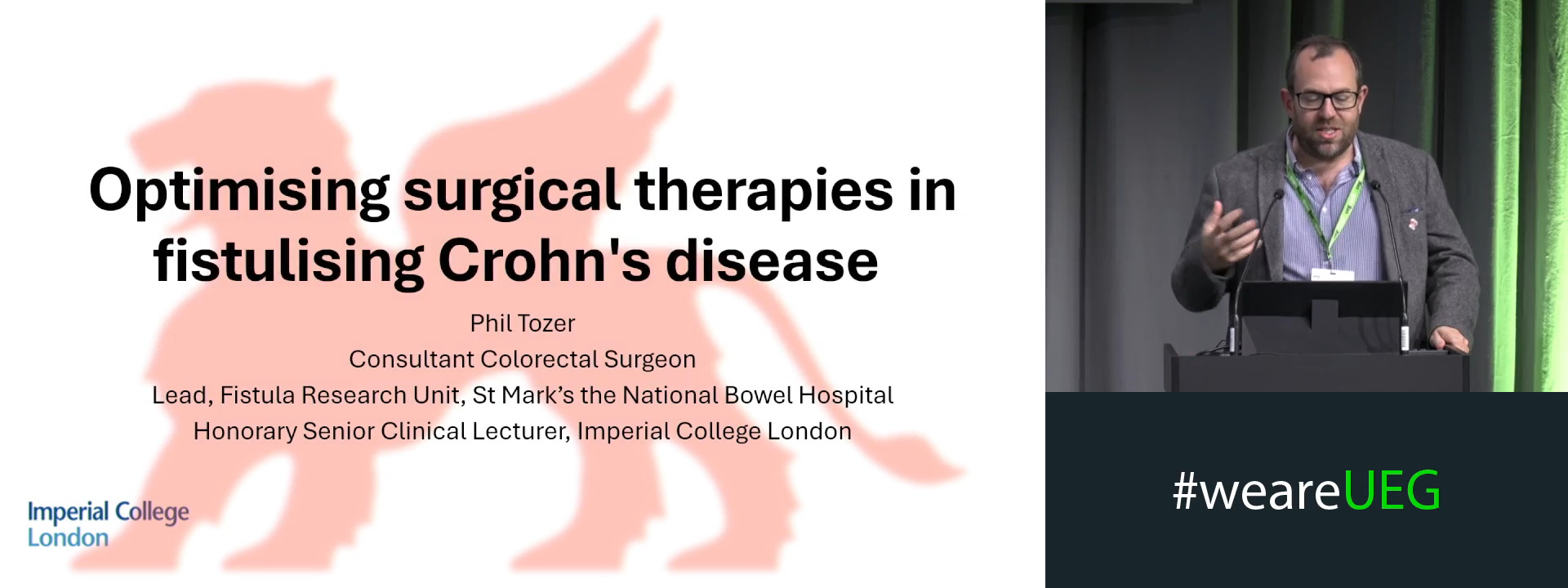
Optimising surgical therapies in fistulising Crohn's disease
1 St Marks Hospital, London, United Kingdom
Event
Citation
Published
Log in to access this content.
Free for all myUEG account holders. Your access level is set automatically based on your occupation. Medical professionals get full access to all content. If you are a non-medical user, you can only access UEG Week content from congresses you attended.
Not sure what you can access? Learn more about account types.
THERAPEUTIC DRUG LEVEL MONITORING OF ANTI-TNF(INFLIXIMAB) IN IBD; ASSOCIATION WITH BIOCHEMICAL AND CLINICAL PARAMETERS
Mert Berke Gur 1, oguz bakkaloglu 1, Tugce Eskazan 1, Atilla Akpinar 1, Ali Ibrahim Hatemi 1, Yusuf Ziya Erzin 1, Aykut Ferhat Çelik 1
1 Istanbul University-Cerrahpasa, Cerrahpasa Medical Faculty, Istanbul, Türkiye
Conference
Topics
Submission format
Session
Citation
Published
Log in to access this content.
Free for all myUEG account holders. Your access level is set automatically based on your occupation. Medical professionals get full access to all content. If you are a non-medical user, you can only access UEG Week content from congresses you attended.
Not sure what you can access? Learn more about account types.
REAL-WORLD EFFECTIVENESS AND SAFETY OF UPADACITINIB IN DIFFICULT-TO-TREAT CROHN’S DISEASE: A MULTICENTER STUDY FROM CHINA
Zile Zhang 1, Shuowen Zhang 1, Wensong Ge 2, Yue Li 3, Wen Tang 4, Qunying Wang 5, Yihong Fan 6, Feng Tian 7, Chunxiao Chen 8, Yubei Gu 1, Duowu Zou 1
1 Ruijin Hospital, Shanghai Jiao Tong University School of Medicine, Shanghai, China
2 Xinhua Hospital Affiliated to Shanghai Jiao Tong University School of Medicine, Shanghai, China
3 Peking Union Medical College Hospital, Chinese Academy of Medical Sciences & Peking Union Medical College, Beijing, China
4 The Second Affiliated Hospital of Soochow University, Suzhou, China
5 Jinhua Hospital of Zhejiang University, Jinhua, China
6 The First Affiliated Hospital of Zhejiang Chinese Medical University, Hangzhou, China
7 Shengjing Hospital of China Medical University, Shenyang, China
8 The First Affiliated Hospital, Zhejiang University School of Medicine, Hangzhou, China
Conference
Topics
Submission format
Citation
Published
Log in to access this content.
Free for all myUEG account holders. Your access level is set automatically based on your occupation. Medical professionals get full access to all content. If you are a non-medical user, you can only access UEG Week content from congresses you attended.
Not sure what you can access? Learn more about account types.
EOSINOPHILIC ENTERITIS WITH SEROSAL INVOLVEMENT: AN UNUSUAL CAUSE OF ASCITES
Gonzalo Aranda 1, Belén Andreo 1, Jose Xavier Segarra Ortega 1, Rocío Gómez Hidalgo 1, Marta Caballero Hernandez 1, Víctor Escribano de la Torre 1, Manuel García Redero 1, Beatriz Jimenez Hernández 1, Laura Tejerizo García 1, Concepcion Piñero 1, Jose Fernando Muñoz Nuñez 1, Fernando Geijo Martínez 1
1 Hospital Universitario de Salamanca, Salamanca, Spain
Conference
Topics
Submission format
Session