UEG's educational platform for gastroenterology education bringing recordings, courses, guidelines, and more together in one place.
Most popular content
Rate for better recommendations!
Your feedback helps us show you more of what you like and less of what you dislike!
Log in to access this content.
Free for all myUEG account holders. Your access level is set automatically based on your occupation. Medical professionals get full access to all content. If you are a non-medical user, you can only access UEG Week content from congresses you attended.
Not sure what you can access? Learn more about account types.

REMIMAZOLAM IN ENDOSCOPY: A GAME-CHANGER FOR SAFE AND EFFECTIVE SEDATION IN REAL-WORLD PRACTICE
Alba Sparacino 1, Pietro Graceffa 1, Ivan Alberto Salerno 1, Fabio Cartabellotta 1, Fabio Cipolletta 2, Luigi Pasquale 2, Rosa Gallo 1, Luciano Calderone 1, Antonino Granata 1
1 Buccheri La Ferla Hospital, Palermo, Italy
2 Monaldi Hospital, Napoli, Italy
Conference
Topics
Submission format
Session
Citation
Published
Log in to access this content.
Free for all myUEG account holders. Your access level is set automatically based on your occupation. Medical professionals get full access to all content. If you are a non-medical user, you can only access UEG Week content from congresses you attended.
Not sure what you can access? Learn more about account types.
N-TERMINAL MYRISTOYLATION PREVENTS DEGRADATION OF SRC-FAMILY KINASES VIA DUAL N-DEGRON PATHWAYS TARGETING FREE AND ACETYLATED GLYCINE RESIDUES
1 University Hospital, LMU Munich, Munich, Germany
2 Max-Planck Instiute of Molecular Oncology, Dortmund, Germany
Conference
Topics
Submission format
Session
Citation
Published
Log in to access this content.
Free for all myUEG account holders. Your access level is set automatically based on your occupation. Medical professionals get full access to all content. If you are a non-medical user, you can only access UEG Week content from congresses you attended.
Not sure what you can access? Learn more about account types.
THE NF-ΚB/YAP1/COL12A1 AXIS DRIVES THE AGGRESSIVENESS OF CANCER-ASSOCIATED FIBROBLASTS AND PROMOTES GASTRIC CANCER PROGRESSION
1 The Chinese University Of Hong Kong, Hong Kong, Hong Kong
2 The Chinese University of Hong Kong, Hong Kong, Hong Kong
Conference
Topics
Submission format
Session
Citation
Published
Log in to access this content.
Free for all myUEG account holders. Your access level is set automatically based on your occupation. Medical professionals get full access to all content. If you are a non-medical user, you can only access UEG Week content from congresses you attended.
Not sure what you can access? Learn more about account types.
TARGETING CKIΑ AND MAPK PATHWAYS AS A “CHEMICAL POLYPECTOMY” IN FAMILIAL ADENOMATOUS POLYPOSIS
1 Hadassah Medical Center, Jerusalem, Israel
2 The Hebrew University, Jerusalem, Israel
Conference
Topics
Submission format
Session
Citation
Published
Log in to access this content.
Free for all myUEG account holders. Your access level is set automatically based on your occupation. Medical professionals get full access to all content. If you are a non-medical user, you can only access UEG Week content from congresses you attended.
Not sure what you can access? Learn more about account types.
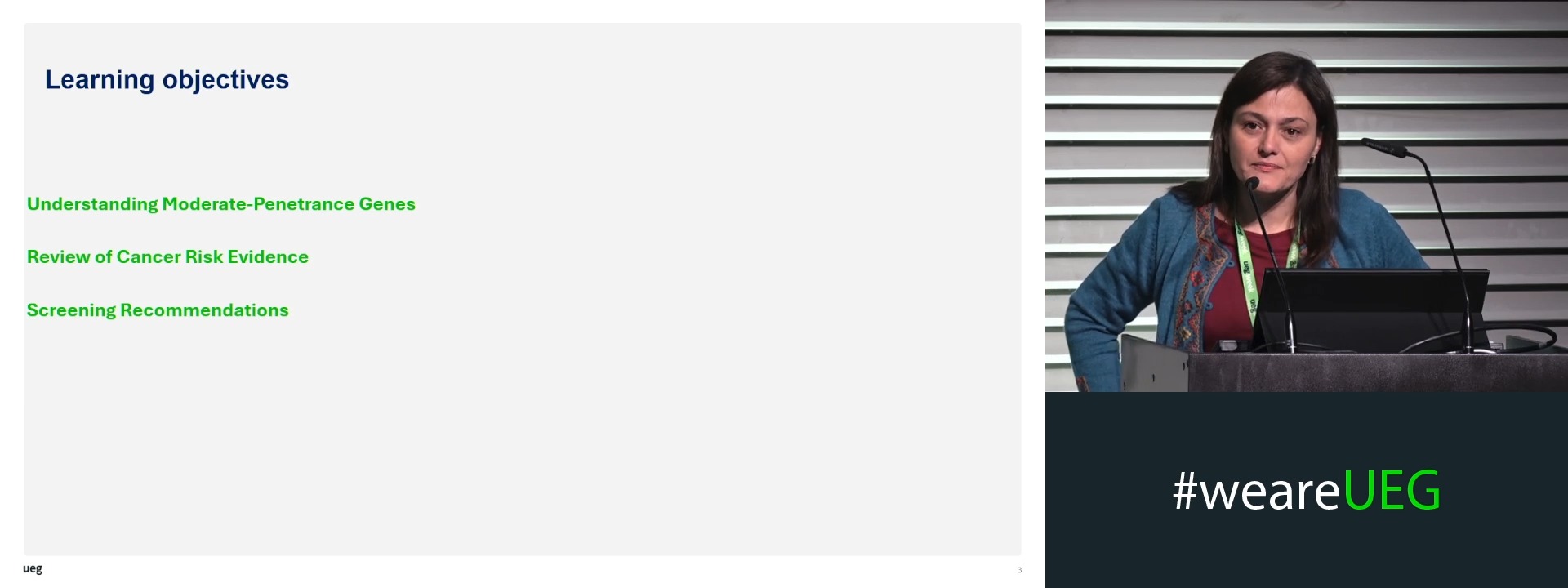
Management of moderate-penetrance colorectal cancer susceptibility genes. Should we do screening?
1 Hospital Clinic de Barcelona, Gava, Spain
Event
Citation
Published
Log in to access this content.
Free for all myUEG account holders. Your access level is set automatically based on your occupation. Medical professionals get full access to all content. If you are a non-medical user, you can only access UEG Week content from congresses you attended.
Not sure what you can access? Learn more about account types.
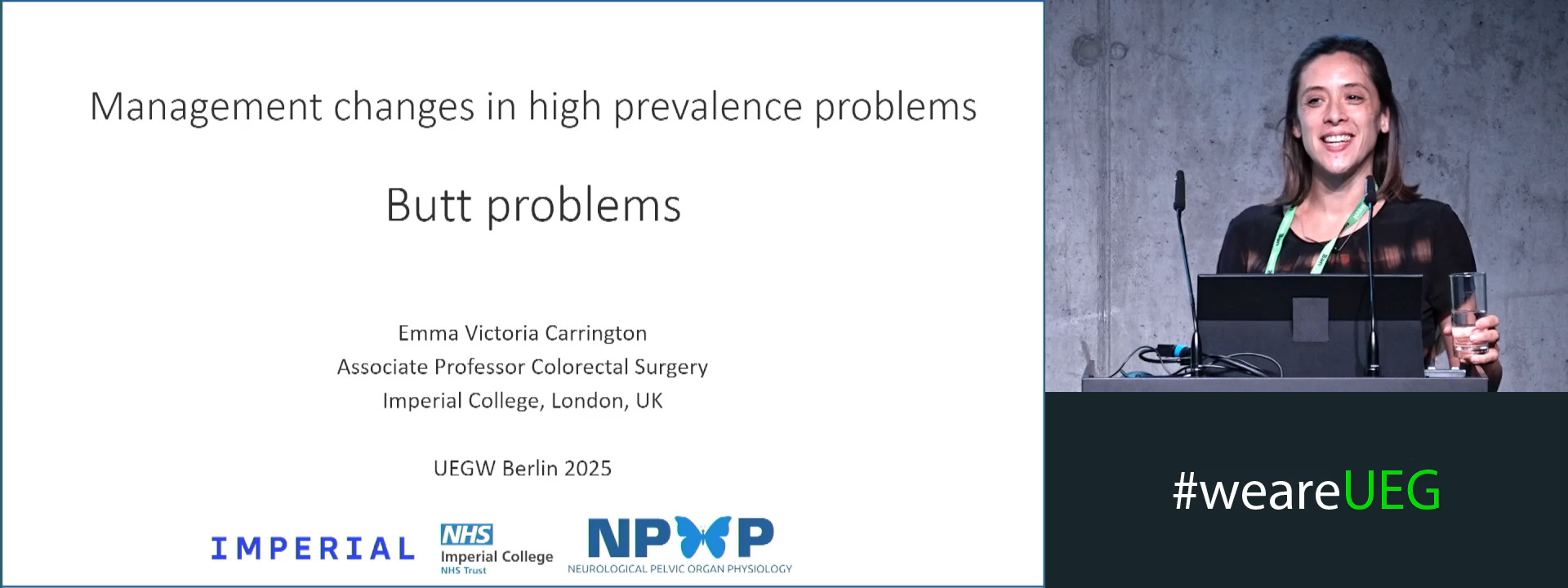
Butt problems
1 University of North Carolina / NCRBSI, London, United Kingdom
Event
Topics
Citation
Published
Log in to access this content.
Free for all myUEG account holders. Your access level is set automatically based on your occupation. Medical professionals get full access to all content. If you are a non-medical user, you can only access UEG Week content from congresses you attended.
Not sure what you can access? Learn more about account types.
LACTIC ACID-PRODUCING BACTERIA ARE ENRICHED IN TWO HIGH-RISK GASTRIC CANCER POPULATIONS GEOGRAPHICALLY AND ETHNICALLY DIVERSE
1 University of New South Wales, Sydney, Australia
Conference
Topics
Submission format
Session