UEG's educational platform for gastroenterology education bringing recordings, courses, guidelines, and more together in one place.
Most popular content
Rate for better recommendations!
Your feedback helps us show you more of what you like and less of what you dislike!
Log in to access this content.
Free for all myUEG account holders. Your access level is set automatically based on your occupation. Medical professionals get full access to all content. If you are a non-medical user, you can only access UEG Week content from congresses you attended.
Not sure what you can access? Learn more about account types.

PROTECTIVE EFFECTS OF STW 5 AGAINST CHANGES IN THE MICROBIOME IN AN EXPERIMENTAL MODEL OF FUNCTIONAL DYSPEPSIA
1 Faculty of Pharmacy, Cairo University, Cairo, Egypt
2 Steigerwald Arzneimittelwerk GmbH, Darmstadt, Germany
Conference
Topics
Submission format
Citation
Published
Log in to access this content.
Free for all myUEG account holders. Your access level is set automatically based on your occupation. Medical professionals get full access to all content. If you are a non-medical user, you can only access UEG Week content from congresses you attended.
Not sure what you can access? Learn more about account types.
Panel discussion: Best of Barrett’s oesophagus
Event
Session
Citation
Published

Log in to access this content.
Free for all myUEG account holders. Your access level is set automatically based on your occupation. Medical professionals get full access to all content. If you are a non-medical user, you can only access UEG Week content from congresses you attended.
Not sure what you can access? Learn more about account types.
Chronic constipation (Complete Session)
Event
Topics
Session
Citation
Published
Log in to access this content.
Free for all myUEG account holders. Your access level is set automatically based on your occupation. Medical professionals get full access to all content. If you are a non-medical user, you can only access UEG Week content from congresses you attended.
Not sure what you can access? Learn more about account types.
UNRAVELING GI SYMPTOMS IN HYPERMOBILITY EHLERS–DANLOS SYNDROME: A FUNCTIONAL AND STRUCTURAL DIAGNOSTIC PERSPECTIVE
1 Chaim Sheba Medical Center, Ramat Gan, Israel
2 Sheba Medical Center, Ramat Gan, Israel
Conference
Topics
Submission format
Citation
Published
Log in to access this content.
Free for all myUEG account holders. Your access level is set automatically based on your occupation. Medical professionals get full access to all content. If you are a non-medical user, you can only access UEG Week content from congresses you attended.
Not sure what you can access? Learn more about account types.
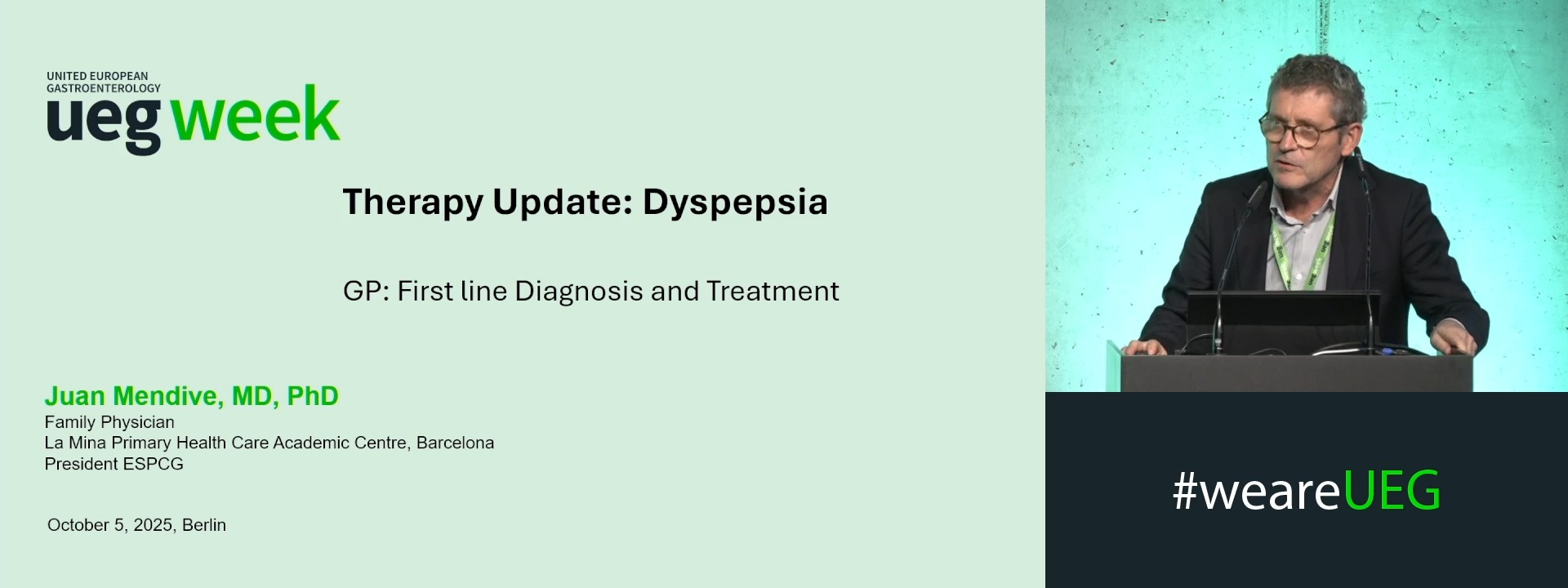
GP: First line diagnosis and treatment
1 European Society for Primary Care Gastroenterology (ESPCG), Sant Adrià de Besòs ( Barcelona), Spain
Event
Session
Citation
Published
Log in to access this content.
Free for all myUEG account holders. Your access level is set automatically based on your occupation. Medical professionals get full access to all content. If you are a non-medical user, you can only access UEG Week content from congresses you attended.
Not sure what you can access? Learn more about account types.
OUTCOMES OF ACUTE SEVERE ULCERATIVE COLITIS AT INITIAL PRESENTATION
Diogo Couto Sousa 1, Samuel Raimundo Fernandes 1, Sofia Saraiva 1, Ana Isabel Valente 1, Ana Rita Gonçalves 1, Luis Correia 1
1 ULS Santa Maria, Lisboa, Portugal
Conference
Topics
Submission format
Citation
Published
Log in to access this content.
Free for all myUEG account holders. Your access level is set automatically based on your occupation. Medical professionals get full access to all content. If you are a non-medical user, you can only access UEG Week content from congresses you attended.
Not sure what you can access? Learn more about account types.
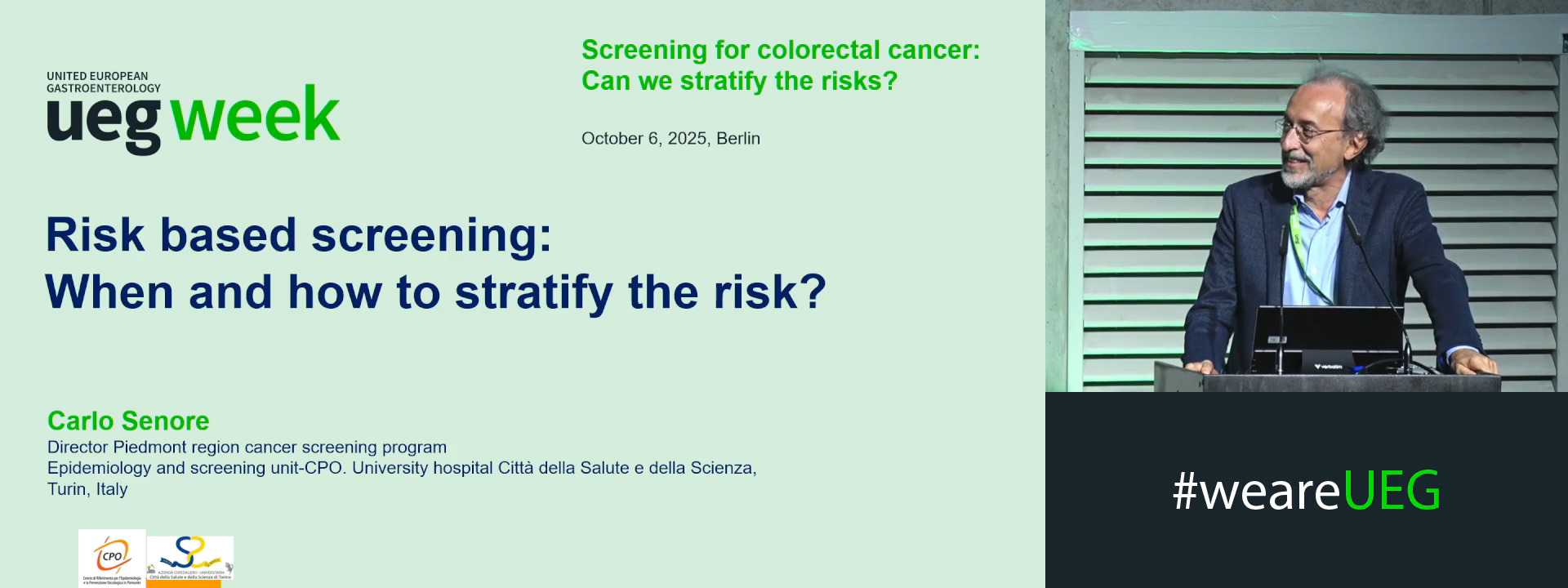
Risk based screening: When and how to stratify the risk?
1 University Hospital Città della Salute e della Scienza, Torino, Italy