UEG's educational platform for gastroenterology education bringing recordings, courses, guidelines, and more together in one place.
Most popular content
Rate for better recommendations!
Your feedback helps us show you more of what you like and less of what you dislike!
Log in to access this content.
Free for all myUEG account holders. Your access level is set automatically based on your occupation. Medical professionals get full access to all content. If you are a non-medical user, you can only access UEG Week content from congresses you attended.
Not sure what you can access? Learn more about account types.

REAL WORLD EXPERIENCE WITH MIRIKIZUMAB IN THE TREATMENT OF HIGHLY REFRACTORY AND PRETREATED ULCERATIVE COLITIS. FIRST INTERIM-ANALYSIS FROM A LARGE EUROPEAN TERTIARY CENTER POPULATION
Thomas Ochsenkühn 1, Cornelia Tillack-Schreiber 1, Daniel Szokodi 1, Fabian Schnitzler 2, Constanze Waggershauser 1
1 IBD Center Munich, München, Germany
2 Praxisklinik München-Pasing, München, Germany
Conference
Topics
Submission format
Citation
Published
Log in to access this content.
Free for all myUEG account holders. Your access level is set automatically based on your occupation. Medical professionals get full access to all content. If you are a non-medical user, you can only access UEG Week content from congresses you attended.
Not sure what you can access? Learn more about account types.
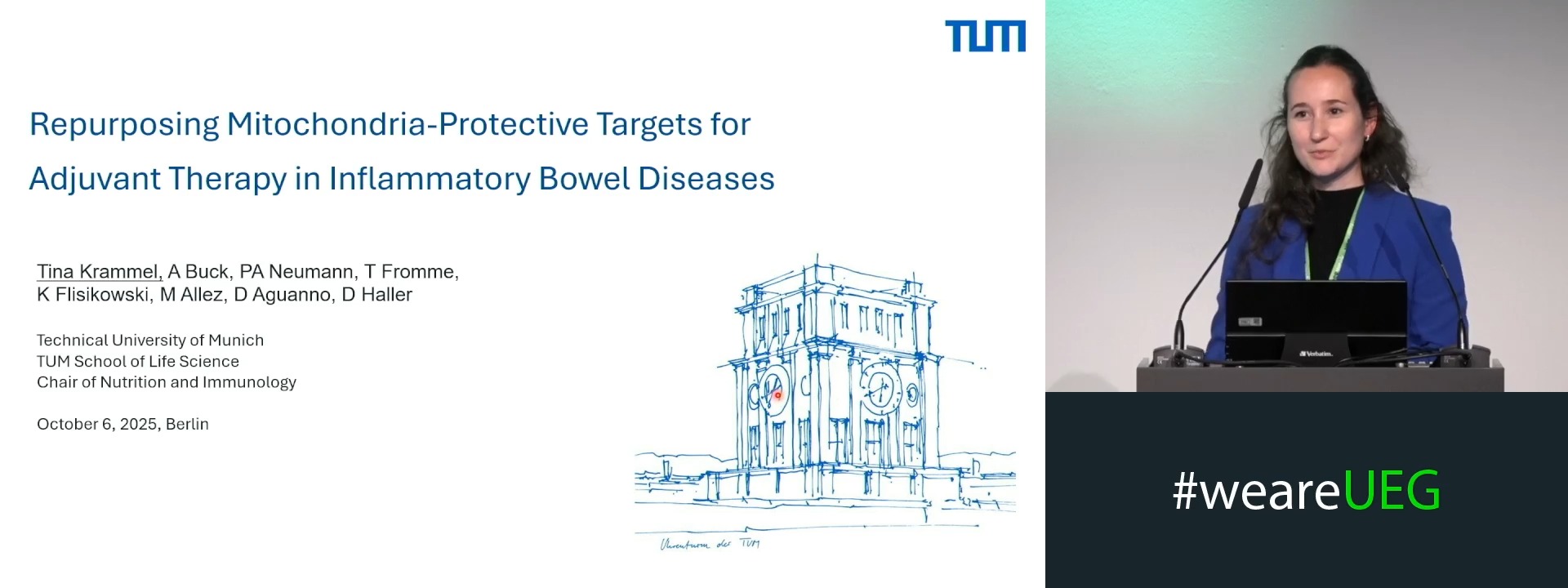
REPURPOSING MITOCHONDRIA PROTECTIVE TARGETS FOR ADJUVANT THERAPY IN INFLAMMATORY BOWEL DISEASES
Tina Krammel 1, Annalisa Buck 2, Philipp-alexander Neumann 2, Tobias Fromme 1, Krzysztof Flisikowski 1, Matthieu Allez 3, Doriane Aguanno 1, Dirk Haller 1
1 Technical University of Munich, Freising, Germany
2 Klinikum Rechts Der Isar, Munich, Germany
3 Hopital Saint-Louis APHP, Université Denis Diderot Paris 7, Paris, France
Event
Submission format
Citation
Published
Log in to access this content.
Free for all myUEG account holders. Your access level is set automatically based on your occupation. Medical professionals get full access to all content. If you are a non-medical user, you can only access UEG Week content from congresses you attended.
Not sure what you can access? Learn more about account types.
NETWORK META-ANALYSIS COMPARING SHORT AND LONG-TERMS EFFICACY OF JAK INHIBITORS IN MODERATE-TO-SEVERE ULCERATIVE COLITIS
1 CHU Estaing Clermont-Ferrand, Clermont-ferrand, France
2 CHU de Grenoble, Grenoble, France
Conference
Topics
Submission format
Citation
Published
Log in to access this content.
Free for all myUEG account holders. Your access level is set automatically based on your occupation. Medical professionals get full access to all content. If you are a non-medical user, you can only access UEG Week content from congresses you attended.
Not sure what you can access? Learn more about account types.
BASELINE MRI WALL RECTAL THICKENING AS A PREDICTOR OF THERAPEUTIC FAILURE IN COMPLEX PERIANAL FISTULIZING CROHN’S DISEASE
Amal Ghamougui 1, Sarra Laabidi 1, DONIA GOUIAA 1, sahar chtioui 1, Nadia Ben Mustapha 1, Meriem Serghini Ep Ghachem 1, Asma Labidi 1, Monia Fekih 1
1 Rabta Hospital, Tunis, Tunisia
Conference
Topics
Submission format
Citation
Published
Log in to access this content.
Free for all myUEG account holders. Your access level is set automatically based on your occupation. Medical professionals get full access to all content. If you are a non-medical user, you can only access UEG Week content from congresses you attended.
Not sure what you can access? Learn more about account types.
DETECTION OF DYSPLASTIC LESIONS IN PATIENTS WITH IBD IS CORRELATED WITH ENDOSCOPISTS’ ADENOMA DETECTION RATE IN PATIENTS WITHOUT IBD: DEVELOPMENT OF QUALITY INDICATORS FOR IBD ENDOSCOPY
Daniel Saitta 1, Gloria Sepe 2, Unknown Unknown 3, Akhilesh Swaminathan 3, Anna Mitchell 3, Peter de Cruz 4, Ethan Tan 4, Abhinav Vasudevan 5, Myo Jin Tang 5, Grace Feng 5, Krishnal Dutt 5, Lena Thin 6, Zhi Tan 6, Melissa Chew 2, Mani Suleiman 2, Andrew Metz 7, Gareth Walker 8, Cathal McGowan 8, David Edwards 8, Nazneen Irani 9, James Chen 9, Linda Yang 10, Alexandra Louey 10, Craig Haifer 11, Judit Rueda i Collell 12, Thomas Skinner 12, Elizabeth Chow 13, Angus Ferguson 13, Mayur Garg 2
1 Launceston General Hospital, Launceston, Australia
2 Northern Health, Epping, Melbourne, Australia
3 Alfred Health, Melbourne, Australia
4 Austin Health, Heidelberg, Australia
5 Eastern Health, Box Hill, Australia
6 Fiona Stanley Hospital, Perth, Australia
7 Royal Melbourne Hospital, Melbourne, Australia
8 Royal Brisbane and Women's Hospital, Herston, Australia
9 Sir Charles Gairdner Hospital, South Perth, Australia
10 St Vincent's Hospital, Fitzroy, Australia
11 St Vincent's Hospital Sydney, Sydney, Australia|||University of New South Wales, Sydney, Australia
12 St Vincent's Hospital Sydney, Sydney, Australia
13 Western Health, Footscray, Australia
Conference
Topics
Submission format
Session
Citation
Published
Log in to access this content.
Free for all myUEG account holders. Your access level is set automatically based on your occupation. Medical professionals get full access to all content. If you are a non-medical user, you can only access UEG Week content from congresses you attended.
Not sure what you can access? Learn more about account types.
COMPARATIVE EFFECTIVENESS AND SAFETY OF TOFACITINIB AND FILGOTINIB IN PATIENTS WITH ULCERATIVE COLITIS: A PROPENSITY SCORE-WEIGHTED COHORT STUDY
Fabio Salvatore Macaluso 1, Walter Fries 2, Anna Viola 2, clara de francesco 2, Nunzio Belluardo 3, Emiliano Giangreco 3, Maria Cappello 4, Roberto Ajovalasit 4, Filippo Mocciaro 5, Barbara Scrivo 5, ANTONINO CARLO Privitera 6, Maria Emanuela Distefano 6, Alessandro Vitello 7, Concetta Ferracane 8, Stefano Muscarella 9, Raffaele Li Voti 1, Giuseppe Mistretta 1, Sara Renna 1, Angelo Casà 1, Marco Ventimiglia 10, Ambrogio Orlando 1
1 “Villa Sofia-Cervello” Hospital, Palermo, Italy
2 "G. Martino” Hospital, Messina, Italy
3 “Guzzardi” Hospital, Vittoria, Italy
4 University of Palermo, Palermo, Italy
5 Arnas Civico-Di Cristina-Benfratelli Hospital, Palermo, Italy
6 A.O. “Cannizzaro”, Catania, Italy
7 “S. Elia- M. Raimondi”, Caltanissetta, Italy
8 “Vittorio Emanuele” Hospital, Catania, Italy
9 “S. Antonio Abate” Hospital, Trapani, Italy
10 Italian Ministry of Health, Rome, Italy
Conference
Topics
Submission format
Session
Citation
Published
Log in to access this content.
Free for all myUEG account holders. Your access level is set automatically based on your occupation. Medical professionals get full access to all content. If you are a non-medical user, you can only access UEG Week content from congresses you attended.
Not sure what you can access? Learn more about account types.
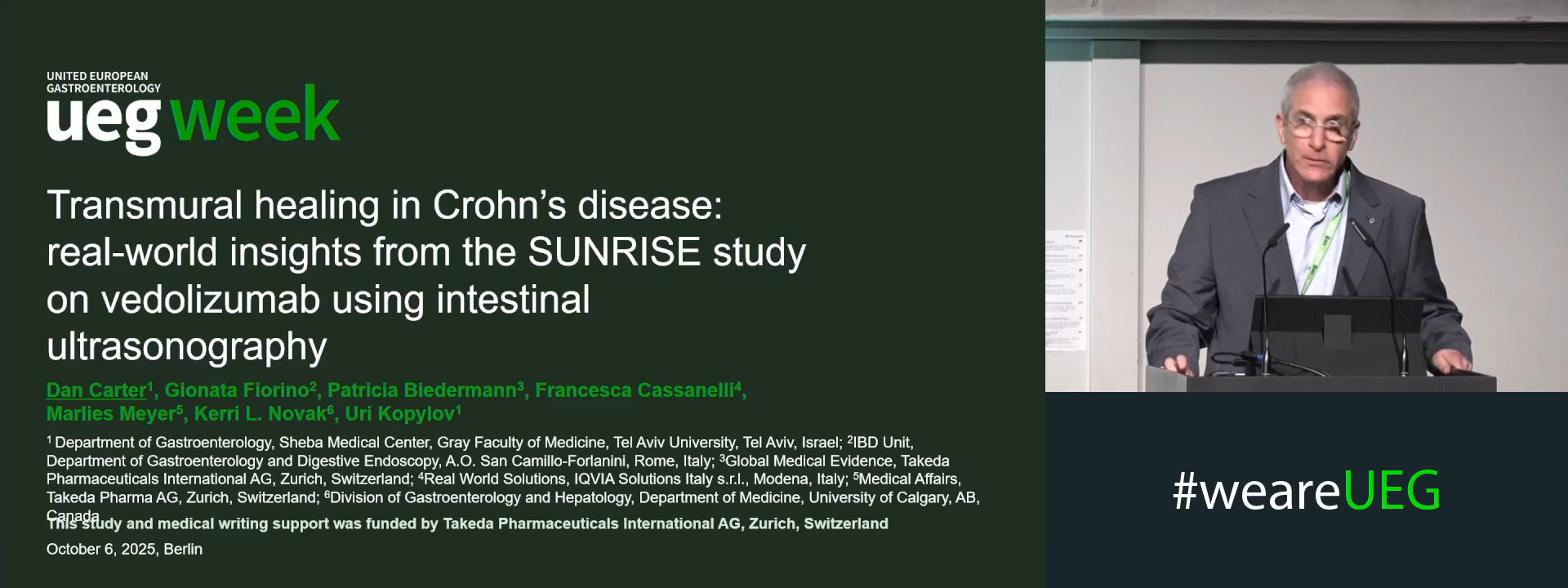
TRANSMURAL HEALING IN CROHN’S DISEASE: REAL-WORLD INSIGHTS FROM THE SUNRISE STUDY ON VEDOLIZUMAB USING INTESTINAL ULTRASONOGRAPHY
Dan Carter 1, Gionata Fiorino 2, Patricia Biedermann 3, Francesca Cassanelli 4, Marlies Meyer 5, Kerri L. Novak 6, Uri Kopylov 1
1 Sheba Medical Center, School of Medicine, Tel Aviv University, Tel Aviv, Israel
2 A.O. San Camillo-Forlanini, Rome, Italy
3 Takeda Pharmaceuticals International AG, Zurich, Switzerland
4 IQVIA Solutions Italy s.r.l., Modena, Italy
5 Takeda Pharma AG, Zurich, Switzerland
6 University of Calgary, Calgary, Canada
Event
Topics
Submission format
Session