UEG's content platform for gastroenterology education bringing recordings, courses, guidelines, and more together in one place.
Trending on Gutflix
Rate for better recommendations!
Your feedback helps us show you more of what you like and less of what you dislike!
Log in to continue.
This content is part of Gutflix. Log in with your myUEG account, or create one free, to watch it.
Not sure what you can access? Learn more about account types.
Q&A: Bleeding less, clotting more: Unravelling coagulation disorders in liver disease
Log in to continue.
This content is part of Gutflix. Log in with your myUEG account, or create one free, to watch it.
Not sure what you can access? Learn more about account types.
Introduction: Bleeding less, clotting more: Unravelling coagulation disorders in liver disease
Affiliations
1 IRCCS Saverio de Bellis, Modena, Italy
Log in to continue.
This content is part of Gutflix. Log in with your myUEG account, or create one free, to watch it.
Not sure what you can access? Learn more about account types.
BIOPSY-BASED SINGLE-CELL PROFILING OF ULCERATIVE COLITIS AND CROHN’S DISEASE REVEALS SHARED INFLAMMATORY ARCHITECTURE AND DISEASE-SPECIFIC IMMUNE PATHWAYS
E.A.M. (Noortje) Festen 1, Paola Pibiri 2, Roy Oelen 2, Werna T. C. Uniken Venema 3, Emilia Bigaeva 1, Monique G.P. Van der Wijst 2, Maria Paraskevopoulou 4, Klaas Nico Faber 2
Affiliations
1 UMCG, Groningen, Netherlands
2 University Medical Center Groningen, Groningen, Netherlands
3 Zuyderland Medisch Centrum, Leuven, Belgium
4 Takeda Pharmaceuticals, Acton, United States
Log in to continue.
This content is part of Gutflix. Log in with your myUEG account, or create one free, to watch it.
Not sure what you can access? Learn more about account types.
From scope to bedside: AI in direct patient care
Affiliations
1 Ospedale dei Castelli, Rome, Italy
Log in to continue.
This content is part of Gutflix. Log in with your myUEG account, or create one free, to watch it.
Not sure what you can access? Learn more about account types.
How to disseminate key performance measures in biliopancreatic endoscopy?
Affiliations
1 ERASME University Hospital, Université Libre de Bruxelles, Brussels, Belgium
Log in to continue.
This content is part of Gutflix. Log in with your myUEG account, or create one free, to watch it.
Not sure what you can access? Learn more about account types.
Introduction: AI integration in my clinical practice today
Affiliations
1 University of Oslo / Showa University, Oslo, Norway
Log in to continue.
This content is part of Gutflix. Log in with your myUEG account, or create one free, to watch it.
Not sure what you can access? Learn more about account types.
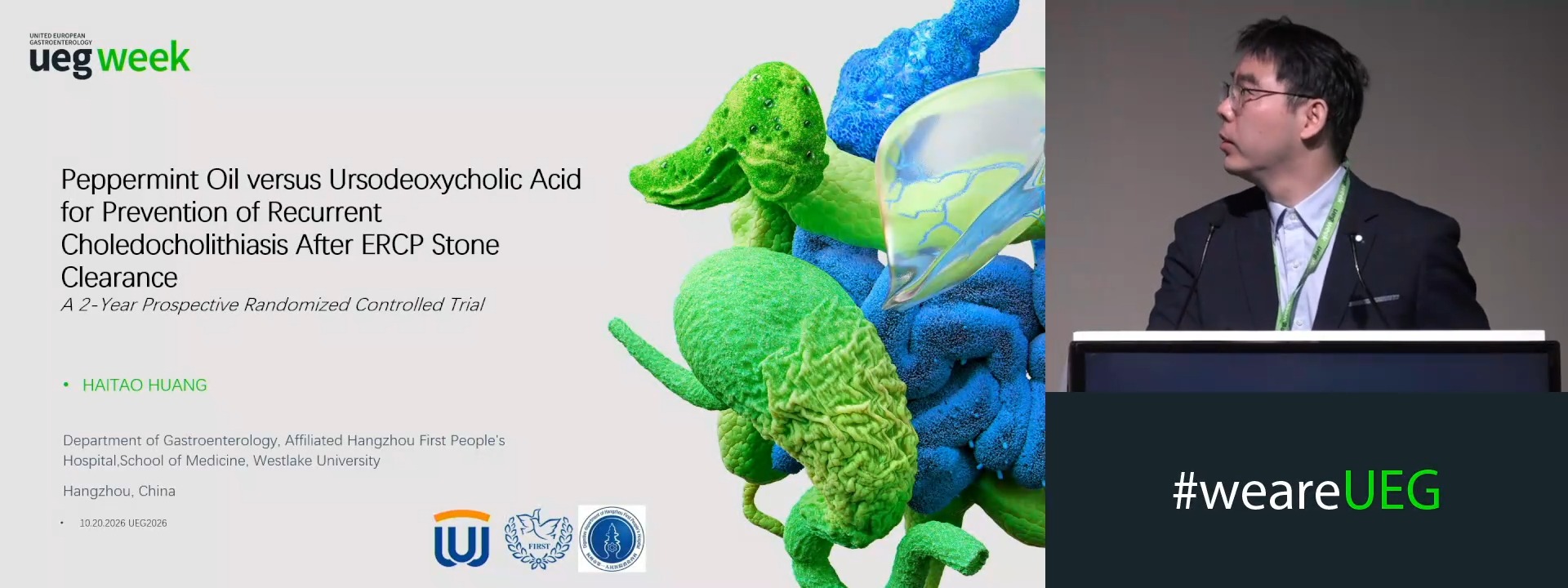
PEPPERMINT OIL VERSUS URSODEOXYCHOLIC ACID FOR PREVENTING RECURRENT CHOLEDOCHOLITHIASIS AFTER ERCP STONE CLEARANCE: A 2-YEAR PROSPECTIVE RANDOMIZED CONTROLLED TRIAL
Haitao Huang 1,2, Yiwen Feng 3, Huanlu Xu 3, Jianlong Chen 3, Liyun Zheng 1, Dongchao Xu 1, Xiaofeng Zhang 1,2, Hangbin Jin 1,2, jing Yang 1,2, Hongzhang Shen 1,2
Affiliations
1 Hangzhou First People's Hospital, Hangzhou, China
2 School of Medicine, Westlake University, Hangzhou, China
3 The Fourth Clinical Medical College, Zhejiang Chinese Medical University, Hangzhou, China