UEG's content platform for gastroenterology education bringing recordings, courses, guidelines, and more together in one place.
Trending on Gutflix
Rate for better recommendations!
Your feedback helps us show you more of what you like and less of what you dislike!
Log in to continue.
This content is part of Gutflix. Log in with your myUEG account, or create one free, to watch it.
Not sure what you can access? Learn more about account types.
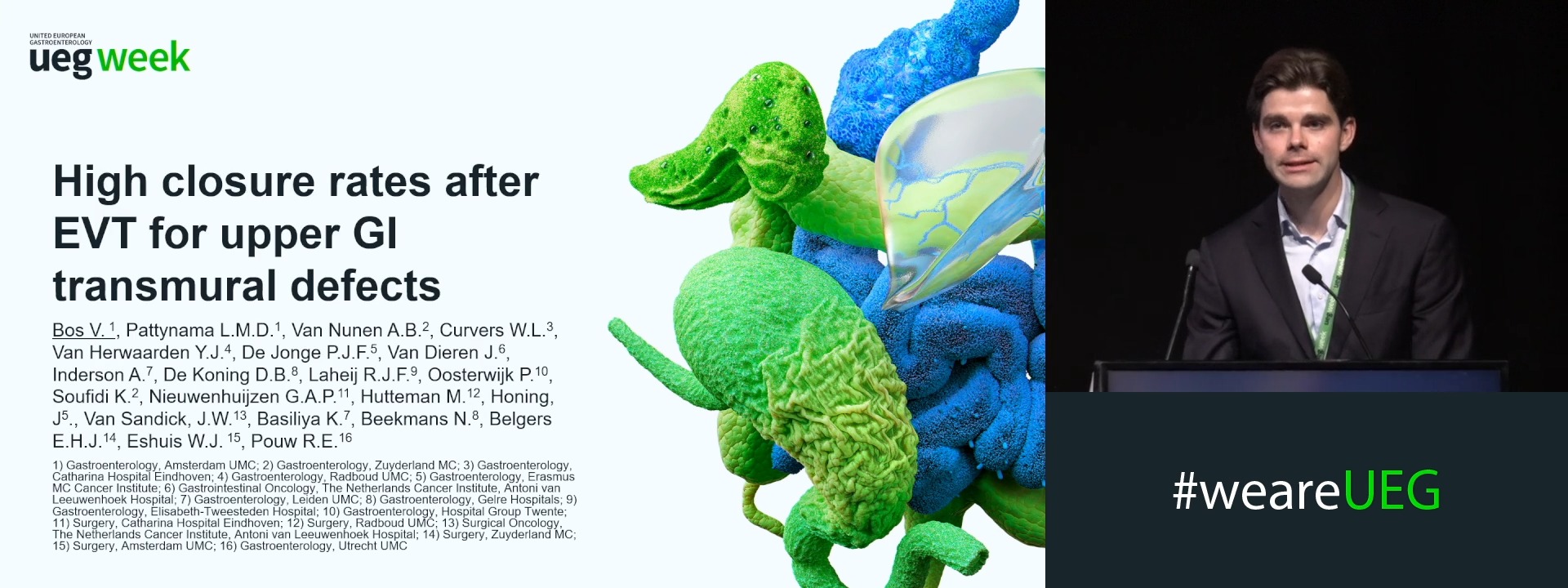
HIGH SUCCESS RATES AFTER ENDOSCOPIC VACUUM THERAPY FOR UPPER GI TRANSMURAL DEFECTS: FIRST RESULTS FROM THE DUTCH PROSPECTIVE EVT REGISTRY
Vincent Bos 1, Lisanne Pattynama 1, Annick van Nunen 2, Wouter L. Curvers 3, Yasmijn van Herwaarden 4, Pieter Jan de Jonge 5, Jolanda van Dieren 6, Akin Inderson 7, Daan De Koning 8, Robert Laheij 9, peter oosterwijk 10, K. Soufidi 2, Grard A. P. Nieuwenhuijzen 3, Merlijn Hutteman 4, Johanna van Sandick 6, Kirill Basiliya 7, Nina Beekmans 8, Eric Belgers 2, Wietse J. Eshuis 1, Roos E. Pouw 11
Affiliations
1 Amsterdam UMC, Amsterdam, Netherlands
2 Zuyderland Medical Center, Sittard-Geleen, Netherlands
3 Catharina Hospital, Eindhoven, Netherlands
4 Radboud University Medical Center, Nijmegen, Netherlands
5 Erasmus MC, Rotterdam, Netherlands
6 the Netherlands Cancer Institute, Antoni van Leeuwenhoek Hospital, Amsterdam, Netherlands
7 Leiden University Medical Center, Leiden, Netherlands
8 Gelre Hospitals, Apeldoorn, Netherlands
9 Elisabeth-Tweesteden Hospital, Tilburg, Netherlands
10 Hospital Group Twente, Almelo, Netherlands
11 UMC Utrecht, Utrecht, Netherlands
Log in to continue.
This content is part of Gutflix. Log in with your myUEG account, or create one free, to watch it.
Not sure what you can access? Learn more about account types.
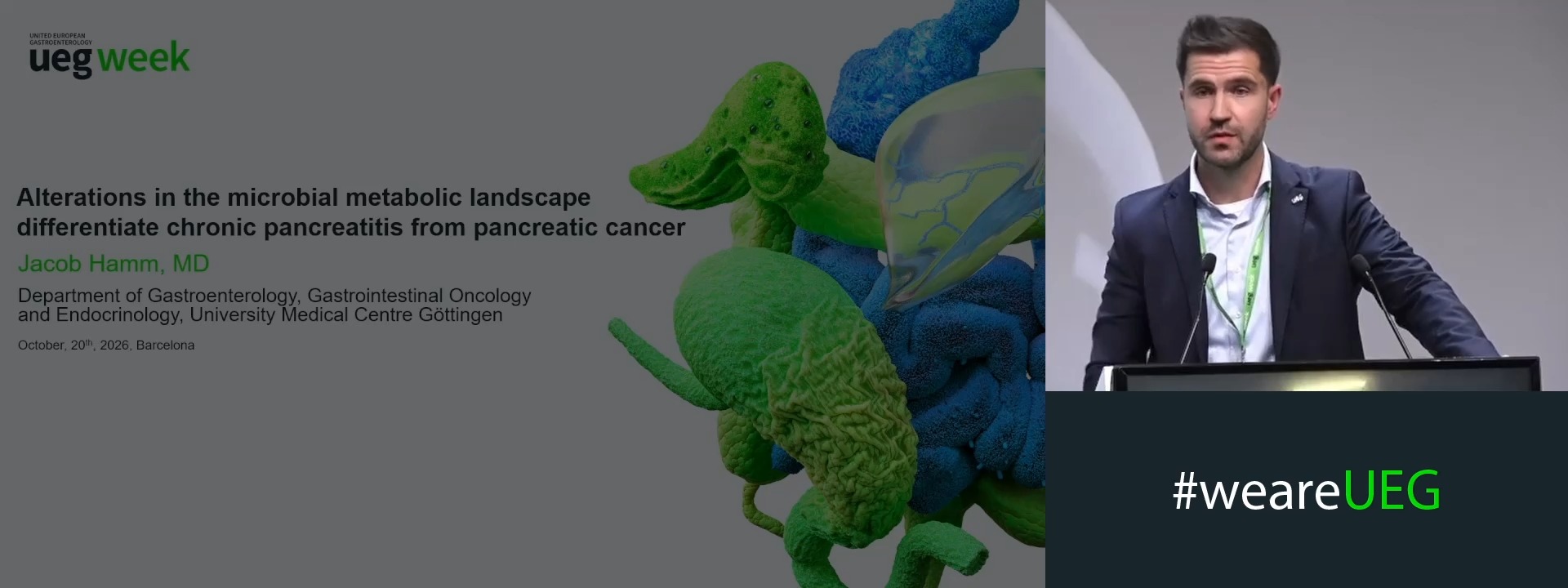
ALTERATIONS IN THE MICROBIAL METABOLIC LANDSCAPE DIFFERENTIATE CHRONIC PANCREATITIS FROM PANCREATIC CANCER
Jacob Hamm 1, Areej Shahbaz 1, Johannes Zimmermann 2, Linh Dang 1, Cathleen Heuer 1, Catharina Lingens 1, Charlotte Ratei 1, Isabel Toussaint 1, Helena Lescow 1, Louisa Eskelson 1, Tim Beißbarth 1, Angelika Hafke 1, Ralph Kraetzner 1, Christoph Gerdes 3, Georg Beyer 4, Simon Sirtl 5, Marko Damm 6, Veit Phillip 7, Sebastian Rasch 8, Robert Henker 9, Albrecht Hoffmeister 9, Maria Lourdes Ruiz Rebollo 10, Diana Riekstina 11, Aldis Pukitis 11, Juergen Brockmoeller 1, Volker Ellenrieder 1, Christoph Ammer-Herrmenau 1, Albrecht Neesse 1
Affiliations
1 University Medical Center Goettingen, Goettingen, Germany
2 Friedrich Schiller University Jena, Jena, Germany
3 Medical School Hanover, Hannover, Germany
4 University Hospital LMU Munich, München, Germany
5 LMU University Hospital Munich, Munich, Germany
6 University Hospital Halle, Halle, Germany
7 Technische Universität München, München, Germany
8 Klinikum rechts der Isar der TU München, München, Germany
9 University Hospital Leipzig, Leipzig, Germany
10 Hosptal Clinico Universitario Servicio De Aparato Digestivo, Valladolid, Spain
11 Pauls Stradins Clinical University Hospital Riga, Tukums, Latvia
Log in to continue.
This content is part of Gutflix. Log in with your myUEG account, or create one free, to watch it.
Not sure what you can access? Learn more about account types.
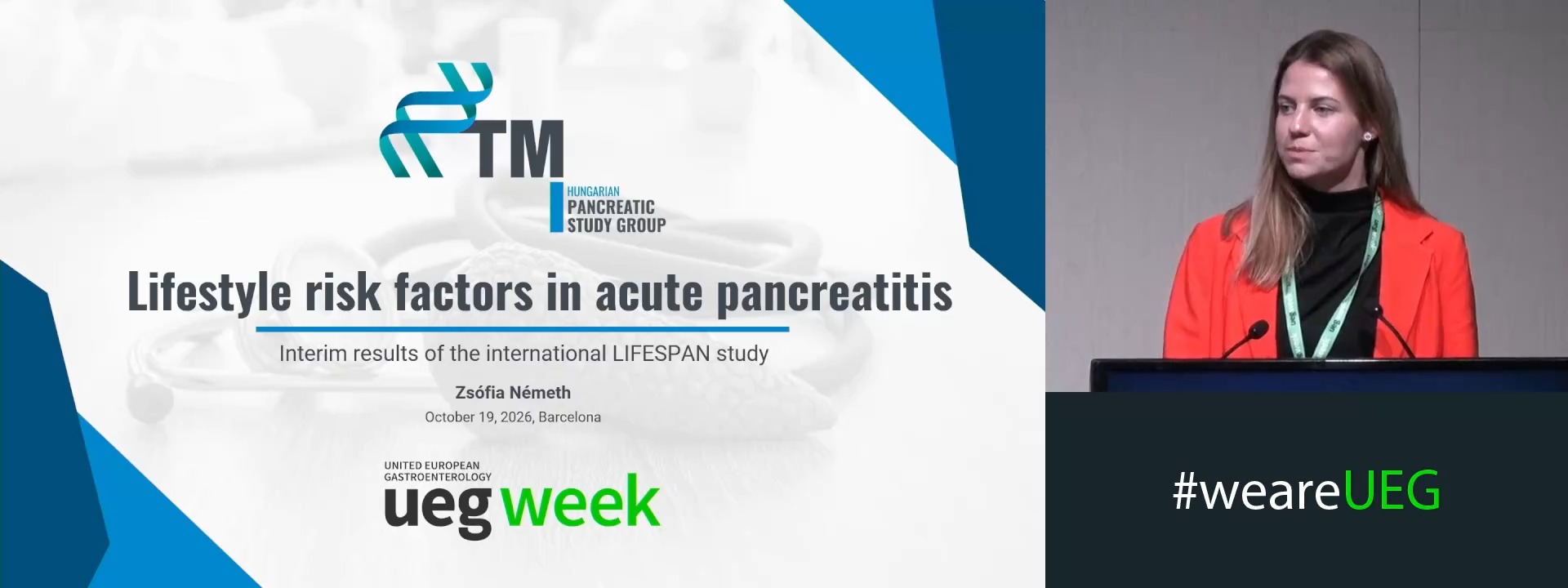
INTERIM RESULTS OF THE INTERNATIONAL LIFESPAN CASE–CONTROL STUDY: LIFESTYLE RISK FACTORS IN ACUTE PANCREATITIS
Dalma Dobszai 1,2, Zsofia Nemeth 2, Zsanett Macht-Szalai 3, Áron Vincze 3, László Czakó 4, Balint Eross 2, Peter Jeno Hegyi 2, Zoltán Hajnády 2, Ferenc Izbéki 5, László Gajdán 6, Imola Török 7, Andrey Litvin 8, elmas biberci keskin 9, Yaroslav Susak 10, Viktoriia Teterina 10, Peter Hegyi 2,3, Andrea Szentesi 2,3
Affiliations
1 University of Pécs Medical School, Pécs, Hungary
2 Semmelweis University, Budapest, Hungary
3 University of Pécs, Pécs, Hungary
4 University of Szeged, Szeged, Hungary
5 Szent György University Teaching Hospital, Szekesfehervar, Hungary
6 Szent György University Teaching Hospital, Székesfehérvár, Hungary
7 George Emil Palade University of Medicine, Targu Mures, Romania
8 Gomel State Medical University, Gomel, Belarus
9 9. Şişli Hamidiye Etfal Training and Research Hospital, Istanbul, Türkiye
10 Bogomolets National Medical University, Kyiv, Ukraine
Log in to continue.
This content is part of Gutflix. Log in with your myUEG account, or create one free, to watch it.
Not sure what you can access? Learn more about account types.
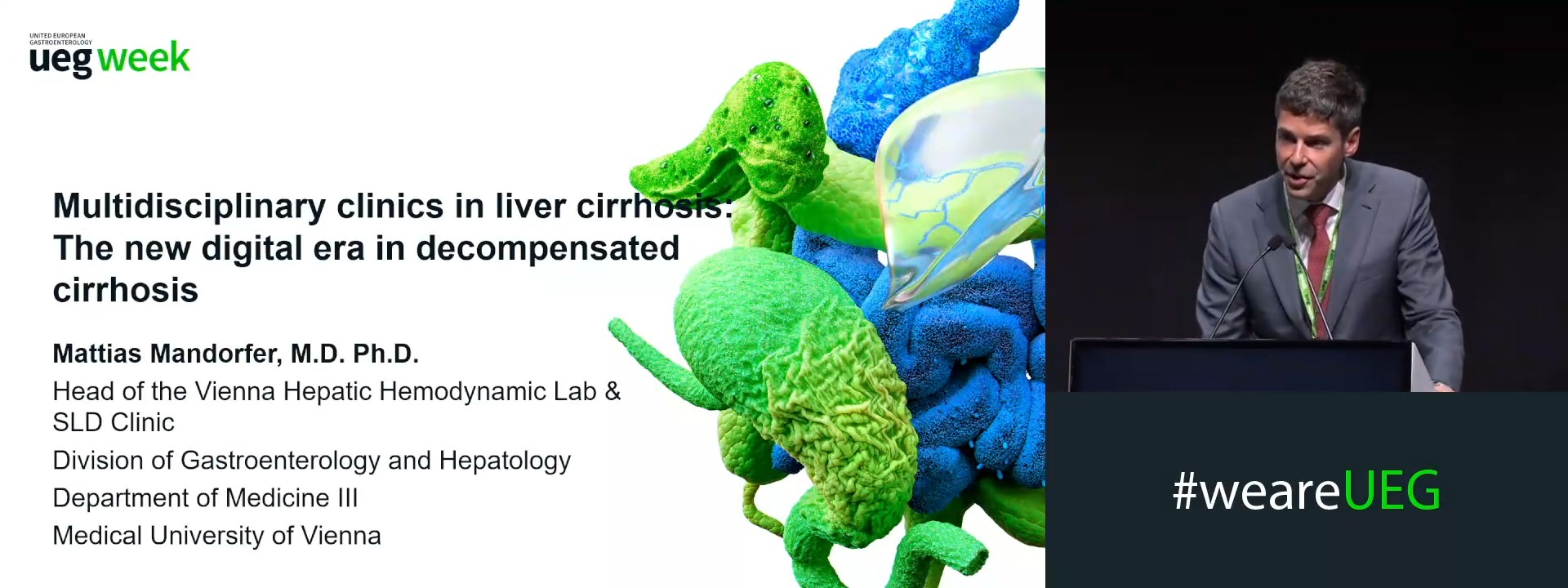
Multidisciplinary clinics in liver cirrhosis: The new digital era in decompensated cirrhosis
Affiliations
1 Medical University of Vienna, Vienna, Austria