UEG's content platform for gastroenterology education bringing recordings, courses, guidelines, and more together in one place.
Trending on Gutflix
Rate for better recommendations!
Your feedback helps us show you more of what you like and less of what you dislike!
Log in to continue.
This content is part of Gutflix. Log in with your myUEG account, or create one free, to watch it.
Not sure what you can access? Learn more about account types.
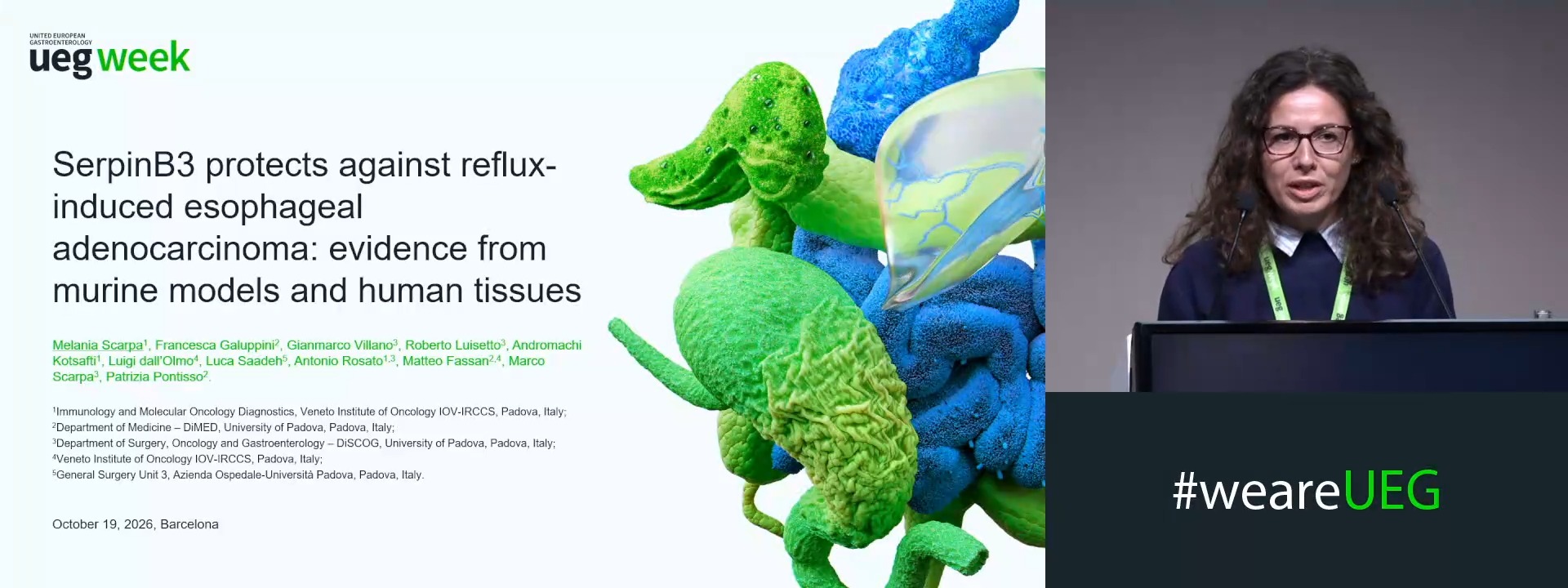
SERPINB3 PROTECTS AGAINST REFLUX-INDUCED ESOPHAGEAL ADENOCARCINOMA: EVIDENCE FROM MURINE MODELS AND HUMAN TISSUES
Melania Scarpa 1, Francesca Galuppini 2, Gianmarco Villano 3, Andromachi Kotsafti 1, Luigi Dall'Olmo 1, Luca Maria Saadeh 4, Santina Quarta 2, Mariagrazia Ruvoletto 2, Alessandra Biasiolo 2, Antonio Rosato 1, Matteo Fassan 5, Roberto Luisetto 3, Marco Scarpa 3, Patrizia Pontisso 2
Affiliations
1 Veneto Institute of Oncology IOV-IRCCS, Padova, Italy
2 University of Padova, Padova, Italy
3 DISCOG, University of Padova, Padova, Italy
4 Azienda Ospedale Università di Padova, Padova, Italy
5 University of Padova, Treviso, Italy
Log in to continue.
This content is part of Gutflix. Log in with your myUEG account, or create one free, to watch it.
Not sure what you can access? Learn more about account types.
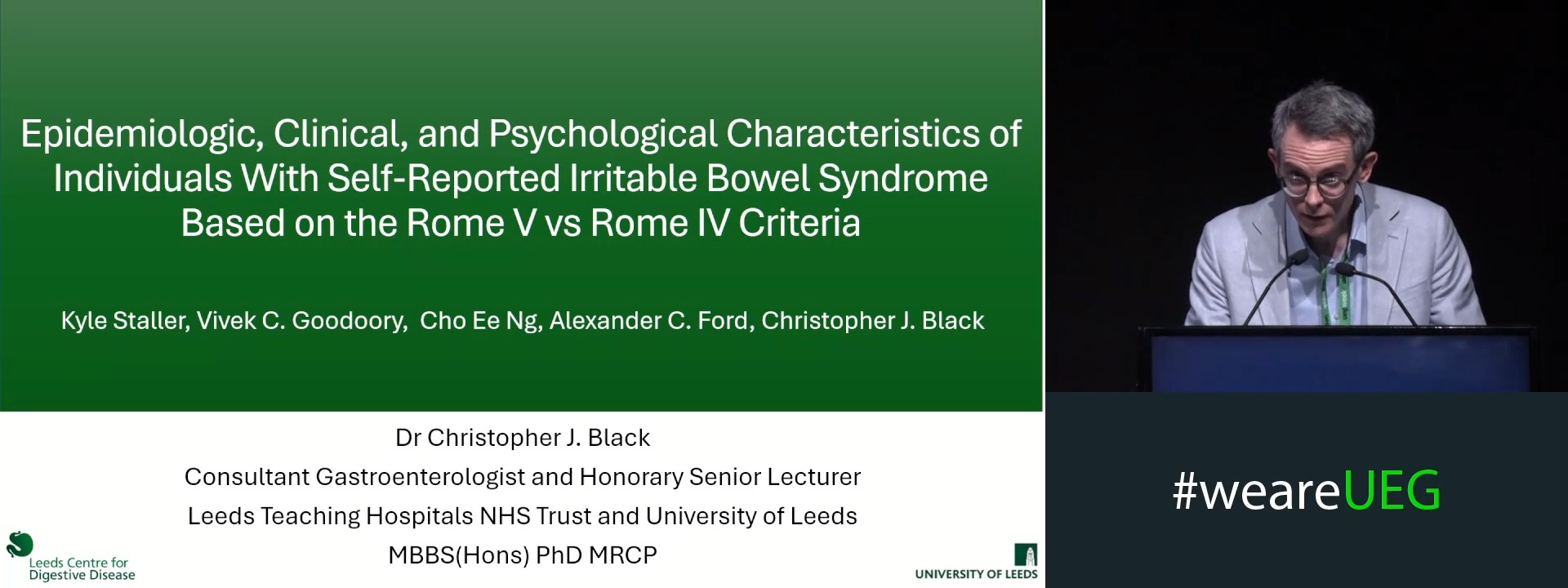
EPIDEMIOLOGICAL, CLINICAL, AND PSYCHOLOGICAL CHARACTERISTICS OF INDIVIDUALS WITH SELF-REPORTED IRRITABLE BOWEL SYNDROME BASED ON THE ROME V VERSUS ROME IV CRITERIA
Affiliations
1 Leeds Teaching Hospitals NHS Trust, Leeds, United Kingdom
2 Massachusetts General Hospital, Boston, United States
Log in to continue.
This content is part of Gutflix. Log in with your myUEG account, or create one free, to watch it.
Not sure what you can access? Learn more about account types.
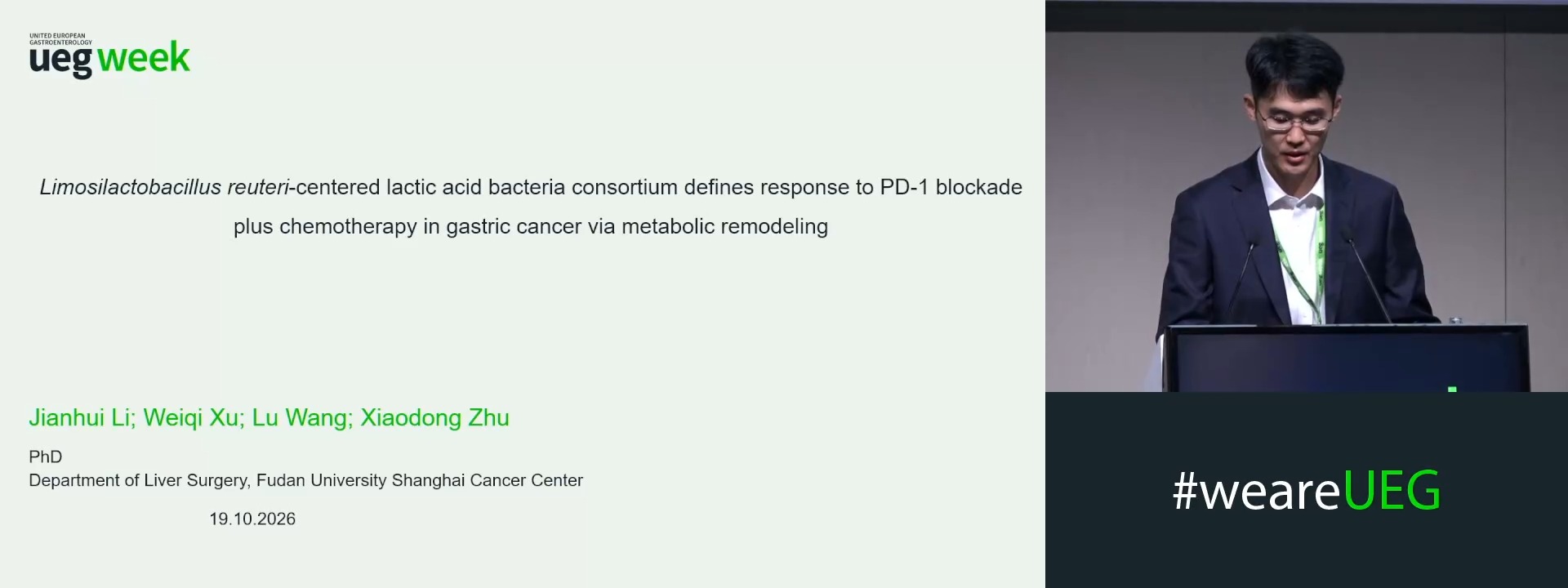
A LIMOSILACTOBACILLUS REUTERI-CENTERED LACTIC ACID BACTERIA CONSORTIUM DEFINES RESPONSE TO PD-1 BLOCKADE PLUS CHEMOTHERAPY IN GASTRIC CANCER VIA METABOLIC REMODELING
Affiliations
1 Fudan University Shanghai Cancer Center, Shanghai, China
2 Shanghai Medical College, Fudan University, Shanghai, China
Log in to continue.
This content is part of Gutflix. Log in with your myUEG account, or create one free, to watch it.
Not sure what you can access? Learn more about account types.
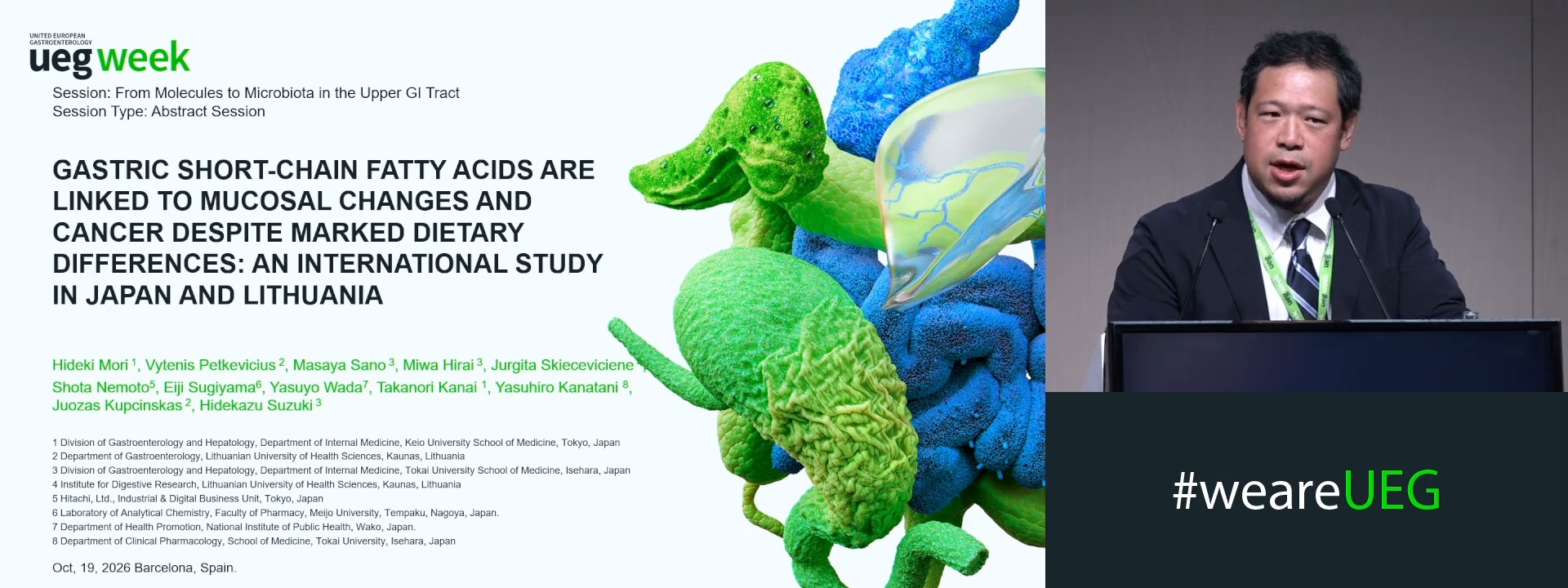
GASTRIC SHORT-CHAIN FATTY ACIDS ARE LINKED TO MUCOSAL CHANGES AND CANCER DESPITE MARKED DIETARY DIFFERENCES: AN INTERNATIONAL STUDY IN JAPAN AND LITHUANIA
Hideki Mori 1, Vytenis Petkevicius 2, Masaya Sano 3, Miwa Hirai 3, Jurgita Skieceviciene 2, Shota Nemoto 4, Eiji Sugiyama 5, Yasuyo Wada 6, Takanori Kanai 1, Yasuhiro Kanatani 3, Juozas Kupcinskas 2, Hidekazu Suzuki 3
Affiliations
1 Keio University School of Medicine, Tokyo, Japan
2 Lithuanian University of Health Sciences, Kaunas, Lithuania
3 Tokai University School of Medicine, Isehara, Japan
4 Hitachi, Ltd., Tokyo, Japan
5 Meijo University, Nagoya, Japan
6 National Institute of Public Health, Wako, Japan
Log in to continue.
This content is part of Gutflix. Log in with your myUEG account, or create one free, to watch it.
Not sure what you can access? Learn more about account types.
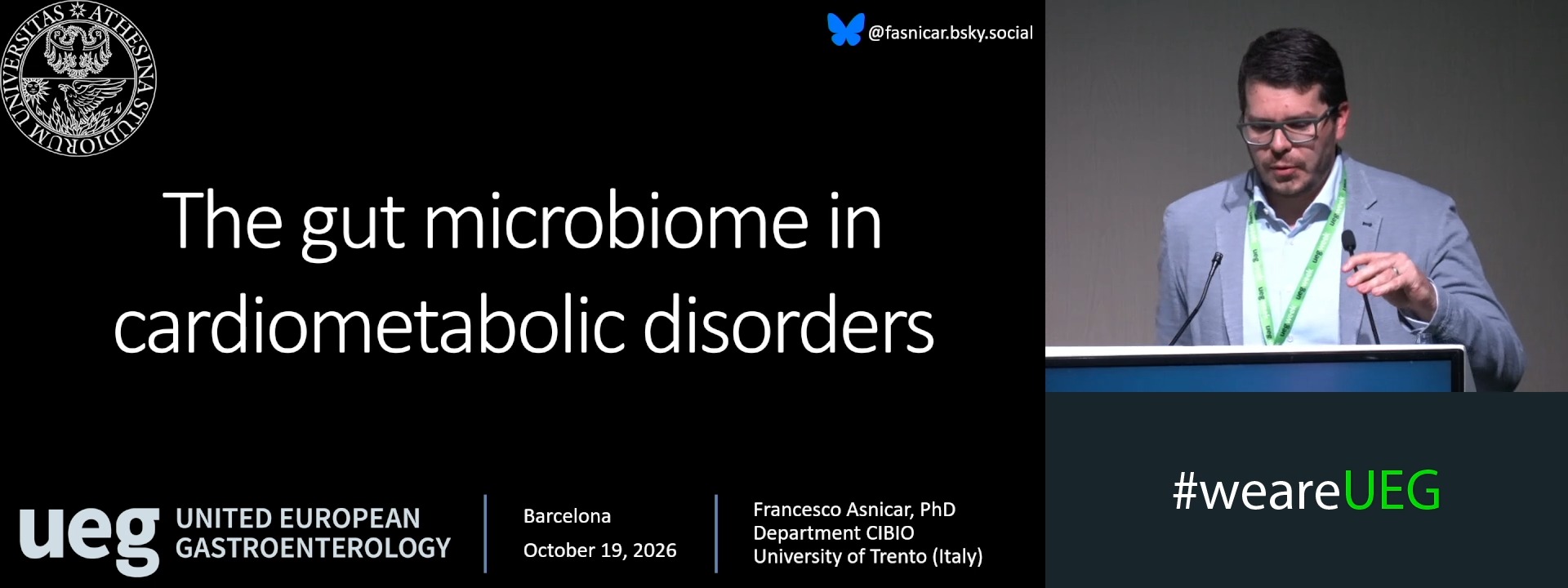
The gut microbiome in cardiometabolic disorders
Affiliations
1 University of Trento, Trento, Italy