UEG's educational platform for gastroenterology education bringing recordings, courses, guidelines, and more together in one place.
Most popular content
Rate for better recommendations!
Your feedback helps us show you more of what you like and less of what you dislike!
Log in to access this content.
Free for all myUEG account holders. Your access level is set automatically based on your occupation. Medical professionals get full access to all content. If you are a non-medical user, you can only access UEG Week content from congresses you attended.
Not sure what you can access? Learn more about account types.
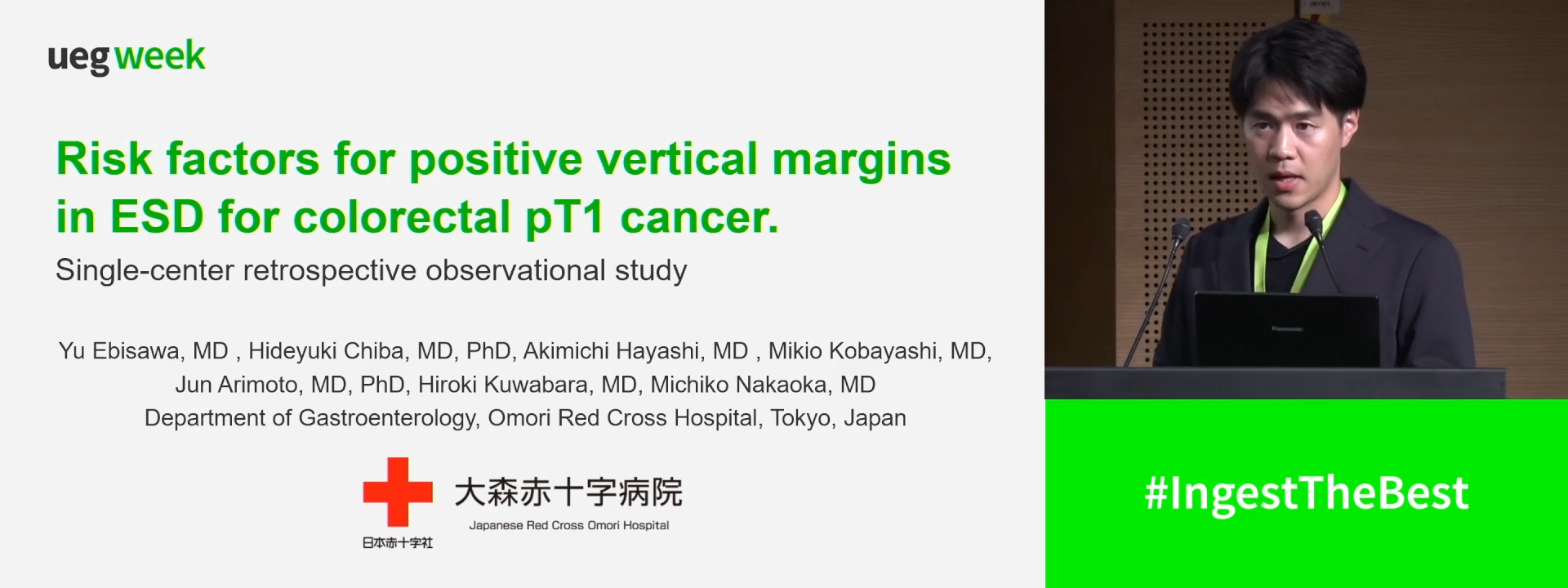
Risk factors for positive vertical margins in ESD for colorectal pT1 cancer
1 Omori Red Cross Hospital, Ota-ku, Japan
Event
Session
Citation
Published
Log in to access this content.
Free for all myUEG account holders. Your access level is set automatically based on your occupation. Medical professionals get full access to all content. If you are a non-medical user, you can only access UEG Week content from congresses you attended.
Not sure what you can access? Learn more about account types.
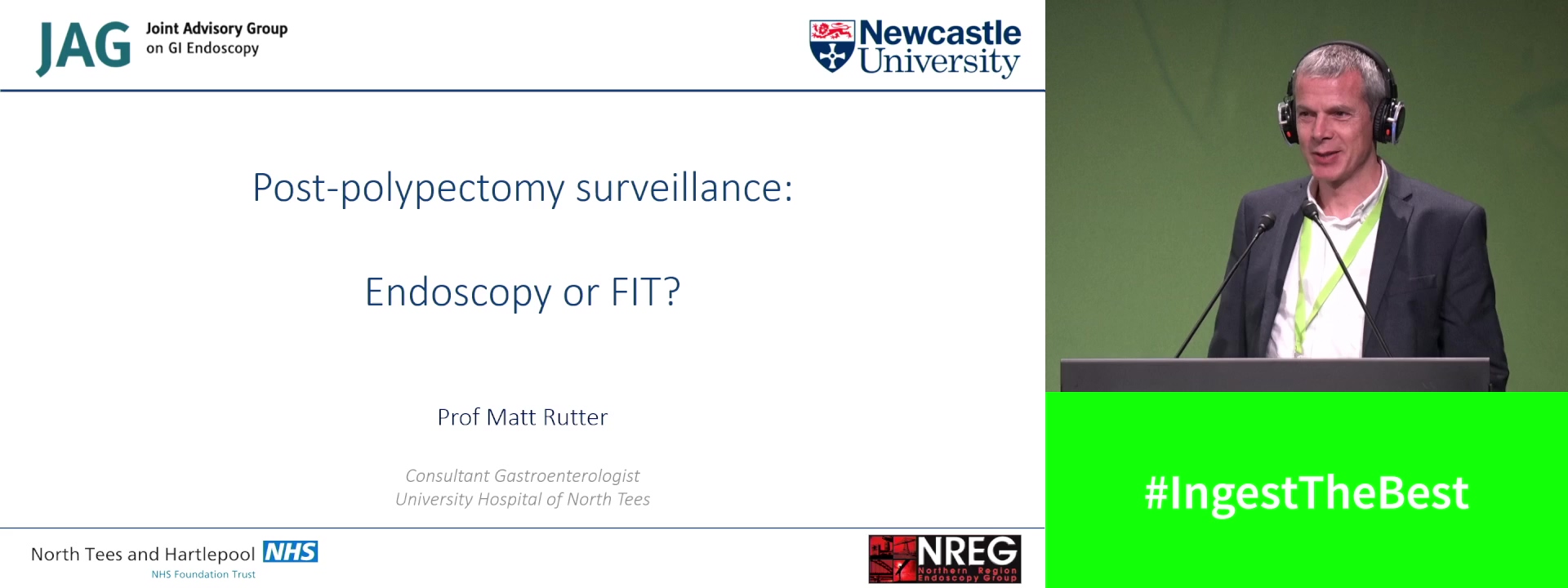
Postpolypectomy surveillance, endoscopy or FIT
1 University Hospital North Tees NHS Dept. of Gastroenterology - Gastroenterology, University Hospital, Stockton-on-Tees, United Kingdom
Event
Citation
Published
Log in to access this content.
Free for all myUEG account holders. Your access level is set automatically based on your occupation. Medical professionals get full access to all content. If you are a non-medical user, you can only access UEG Week content from congresses you attended.
Not sure what you can access? Learn more about account types.

ILEOCECAL BURKITT'S LYMPHOMA: A RARE COLORECTAL NEOPLASM IN ENDOSCOPY
Clara López Martínez 1, Enrique de la Fuente Fernández 1, Victoria Gonzalo Pascual 1, Mario Prieto Pozuelo 1, Susana Prados Leira 1
1 Hospital HM Sanchinarro, Madrid, Spain
Conference
Topics
Submission format
Session
Published
Log in to access this content.
Free for all myUEG account holders. Your access level is set automatically based on your occupation. Medical professionals get full access to all content. If you are a non-medical user, you can only access UEG Week content from congresses you attended.
Not sure what you can access? Learn more about account types.
ANORECTAL DYSFUNCTION IN PATIENTS WITH MULTIPLE SCLEROSIS
Guillermo Carranza Granero 1, Laura García Pravia 2, Ana Zatarain Valles 3, Marta Aparicio Cabezudo 3, Maria Elena Aznar Ruiz 3, Manuel Holgado Ayuso 3, Constanza Ciriza de Los Rios 3, JUAN LUIS MENDOZA 3
1 Clínico San Carlos Hospital, Madrid, Spain
2 Hospital Clínico San Carlos, Madrid, Spain
3 Hospital Clinico San Carlos, Madrid, Spain
Conference
Topics
Submission format
Session
Citation
Published
Log in to access this content.
Free for all myUEG account holders. Your access level is set automatically based on your occupation. Medical professionals get full access to all content. If you are a non-medical user, you can only access UEG Week content from congresses you attended.
Not sure what you can access? Learn more about account types.
SAFETY AND OUTCOMES OF ENDOSCOPIC SUBMUCOSAL DISSECTION AFTER TRANSANAL ENDOSCOPIC SURGERY IN LESIONS INVOLVING THE ANAL CANAL: A RETROSPECTIVE ANALYSIS
Livio Enrico Del Vecchio 1, GIULIA Piccirilli 1, Luigi Giovanni Papparella 1, Rossella Maresca 1, Tommaso Schepis 1, Federico Barbaro 1, Lucio Petruzziello 1, Cristiano Spada 1, Silvia Pecere 1
1 Policlinico Universitario Agostino Gemelli, Rome, Italy
Conference
Topics
Submission format
Citation
Published
Log in to access this content.
Free for all myUEG account holders. Your access level is set automatically based on your occupation. Medical professionals get full access to all content. If you are a non-medical user, you can only access UEG Week content from congresses you attended.
Not sure what you can access? Learn more about account types.
STING ABLATION IN T CELLS IS REQUIRED FOR THE EFFICACY OF STING AGONISTS IN CAR-T CELL IMMUNOTHERAPY OF PANCREATIC CANCER
Ignazio Piseddu 1, Rebekka Endres 2, Fabian Lanzl 2, Marleen Bérouti 2, Matthias Thaler 1, Lisa Fahr 1, Hannah Fischer 2, Varvara Varlamova 2, Linda Hammann 1, Jan Gärtig 1, Daniel Nixdorf 3, Patrick Layritz 1, David Illig 1, Anne Marie Senz 1, Ivonne Regel 1, Adrian Gottschlich 1, Marion Subklewe 2, Julia Mayerle 1, David Anz 1, Sebastian Kobold 1, Andreas Linder 1, Veit Hornung 2
1 LMU University Hospital, Munich, Germany
2 LMU Munich, Munich, Germany
3 LMU Munich, Munich, Germany|||LMU Munich, Munich, Germany
Conference
Topics
Submission format
Session
Citation
Published
Log in to access this content.
Free for all myUEG account holders. Your access level is set automatically based on your occupation. Medical professionals get full access to all content. If you are a non-medical user, you can only access UEG Week content from congresses you attended.
Not sure what you can access? Learn more about account types.
PREDICTORS OF LIVER STIFFNESS CHANGES IN CONSECUTIVE COHORTS OF PATIENTS WITH NON-ALCOHOLIC FATTY LIVER DISEASE AND LONGITUDINAL FOLLOW UP
Mirko Zoncapè 1, Antonio Liguori 2, Serena Pelusi 3, Cristiana Bianco 3, Roshni Patel 4, Davide Roccarina 4, Laura Iogna Prat 4, Anna Mantovani 1, Jennifer Clancy 4, Atul Goyale 4, Luca Valenti 3, Emmanuel Tsochatzis 4
1 University College London (UCL), London, United Kingdom|||University and Azienda Ospedaliera Universitaria Integrata of Verona, Verona, Italy
2 University College London (UCL), London, United Kingdom|||Università Cattolica del Sacro Cuore, Rome, Italy
3 Fondazione IRCCS Ca' Granda Ospedale Maggiore Policlinico, Milano, Italy
4 University College London (UCL), London, United Kingdom
Conference
Topics
Submission format
Session