UEG's educational platform for gastroenterology education bringing recordings, courses, guidelines, and more together in one place.
Most popular content
Rate for better recommendations!
Your feedback helps us show you more of what you like and less of what you dislike!
Log in to access this content.
Free for all myUEG account holders. Your access level is set automatically based on your occupation. Medical professionals get full access to all content. If you are a non-medical user, you can only access UEG Week content from congresses you attended.
Not sure what you can access? Learn more about account types.
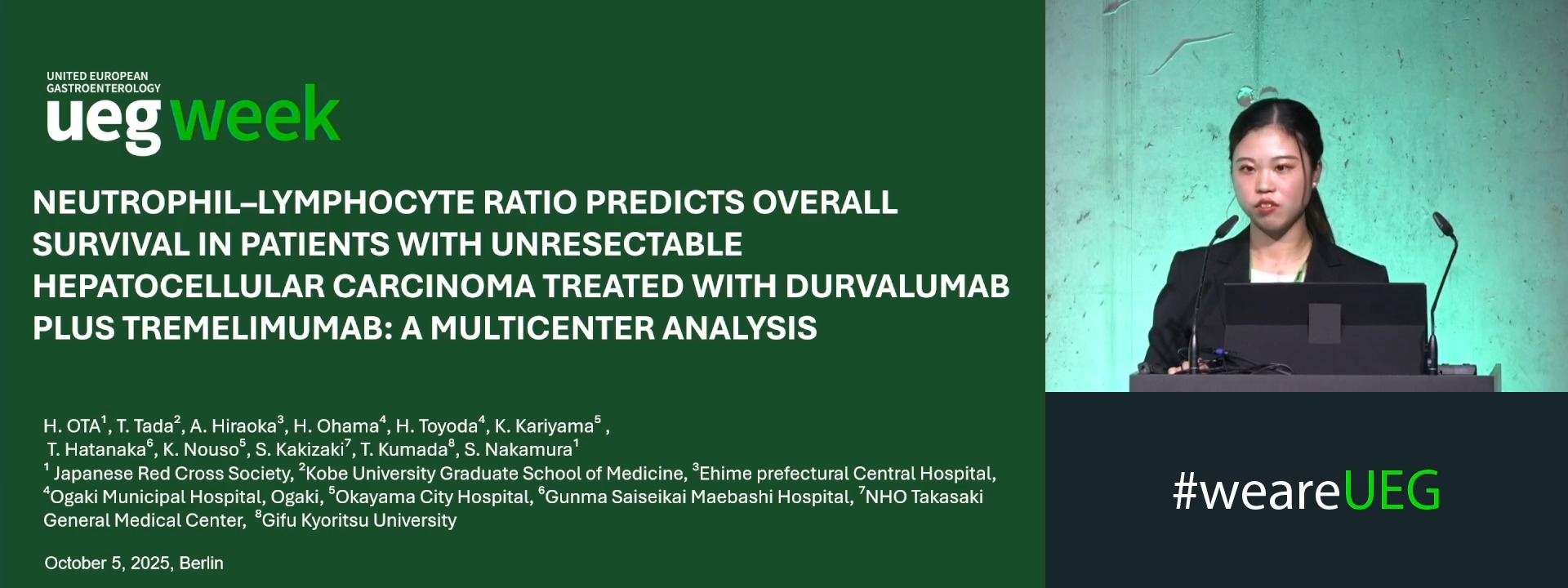
NEUTROPHIL–LYMPHOCYTE RATIO PREDICTS OVERALL SURVIVAL IN PATIENTS WITH UNRESECTABLE HEPATOCELLULAR CARCINOMA TREATED WITH DURVALUMAB PLUS TREMELIMUMAB: A MULTICENTER ANALYSIS
HANA OTA 1, Toshifumi Tada 2, Kana Ohmoto 1, Atsushi Hiraoka 3, Hideko Ohama 3, Hidenori Toyoda 4, Kazuya Kariyama 5, Takeshi Hatanaka 6, Kazuhiro Nouso 5, Satoru Kakizaki 7, Takashi Kumada 8, Shinichiro Nakamura 1
1 Japanese Red Cross Society, Himeji, Japan
2 Kobe University Graduate School of Medicine, Kobe, Japan
3 Ehime prefectural Central Hospital, Matsuyama, Japan
4 Ogaki Municipal Hospital, Ogaki, Japan
5 Okayama City Hospital, Okayama, Japan
6 Gunma Saiseikai Maebashi Hospital, Maebashi, Japan
7 NHO Takasaki General Medical Center, Takasaki, Japan
8 Gifu Kyoritsu University, Ogaki, Japan
Event
Submission format
Citation
Published
Log in to access this content.
Free for all myUEG account holders. Your access level is set automatically based on your occupation. Medical professionals get full access to all content. If you are a non-medical user, you can only access UEG Week content from congresses you attended.
Not sure what you can access? Learn more about account types.
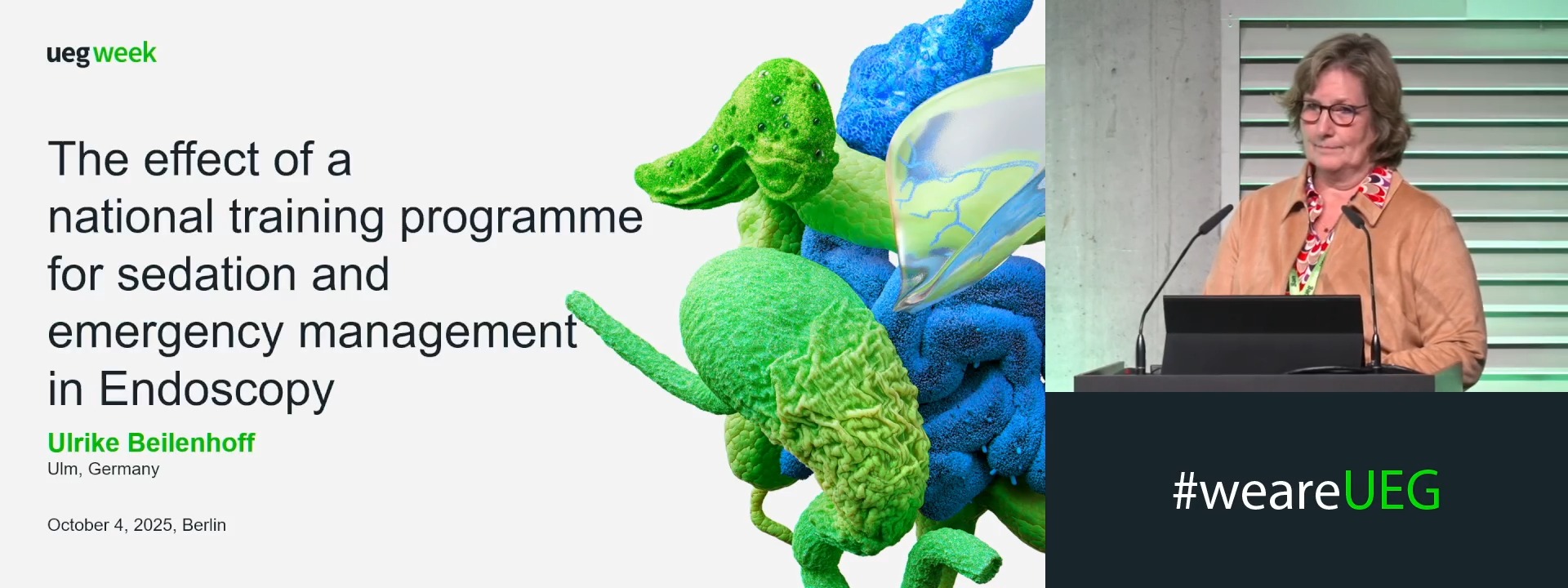
THE EFFECT OF A NATIONAL TRAINING PROGRAMME FOR SEDATION AND EMERGENCY MANAGEMENT IN ENDOSCOPY
1 ESGENA Scientific Secretary, Ulm, Germany
Event
Topics
Submission format
Citation
Published
Log in to access this content.
Free for all myUEG account holders. Your access level is set automatically based on your occupation. Medical professionals get full access to all content. If you are a non-medical user, you can only access UEG Week content from congresses you attended.
Not sure what you can access? Learn more about account types.
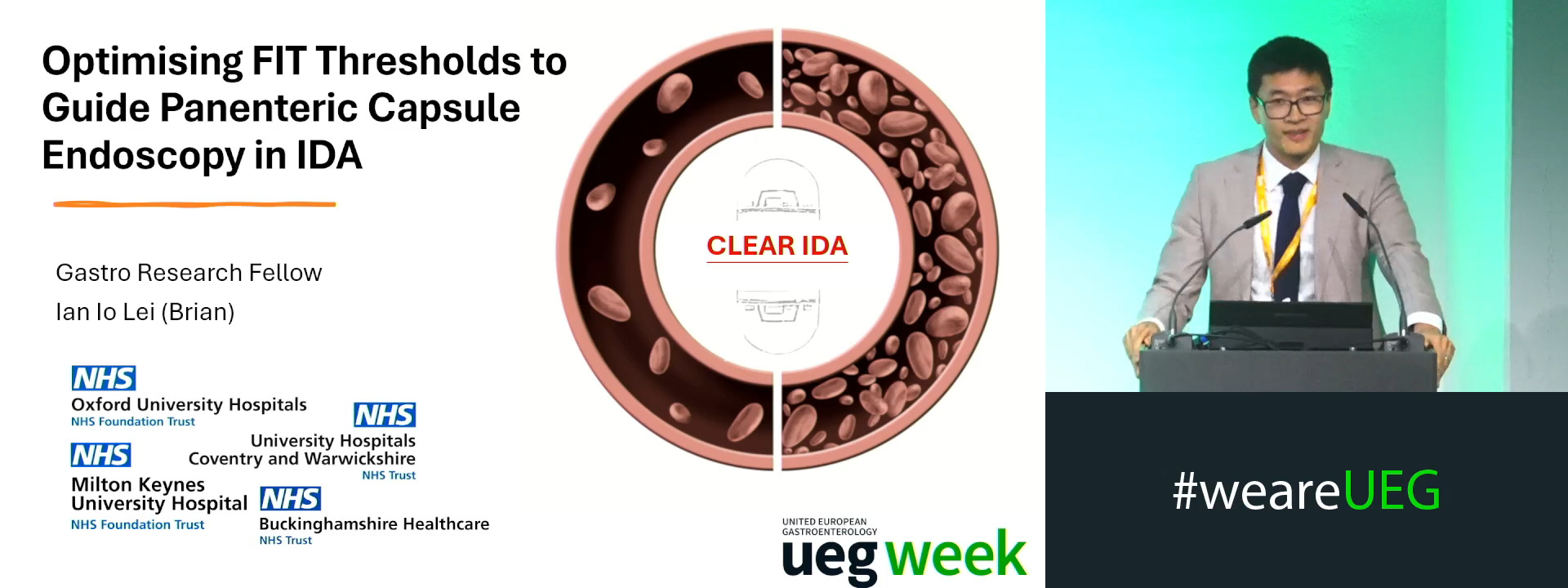
FROM STOOL TO SCOPE: OPTIMISING FIT THRESHOLDS TO GUIDE FUTURE PANENTERIC CAPSULE ENDOSCOPY AND REDUCE COLONOSCOPY BURDEN IN IRON DEFICIENCY ANAEMIA
Ian Io Lei 1, Nicola O'Connell 2, Michael Adu-Darko 3, Jessiya Parambil 4, Vishnupriya Suresh 2, Kiara McDonnell 5, Jessie Newville 5, Kirsten Chaplin 5, Deekshi Siyambalapityage 5, Asad Khan 3, Usman Muhammad 3, John Emil 3, Merali Abbas 3, Zia Kanji 3, Hamza Alam 3, Amelia Bennett 4, Hannah Soanes 4, Adrija Bhattacharyya 4, Karl Frey 4, Rosie Meakins 4, Archit Singhal 4, George Pack 4, Melike Gerrits 4, Harry Paterson 4, Vincent Cheung 6, Sue Cullen 5, Muhammad Imran Aslam 7, Ramesh P. Arasaradnam 2
1 University Hospital of Coventry and Warwickshire, Coventry, United Kingdom
2 University Hospital Coventry and Warwickshire, Coventry, United Kingdom
3 Milton Keynes University Hospital,, Milton Keynes, United Kingdom
4 Oxford University Hospital, Oxford, United Kingdom
5 Stoke Mandeville Hospital, Buckinghamshire Healthcare NHS Trust, Aylesbury, United Kingdom
6 John Radcliffe Hospital, Oxford, United Kingdom
7 University Hospitals of Coventry and Warwickshire, Coventry, United Kingdom
Event
Topics
Submission format
Citation
Published
Log in to access this content.
Free for all myUEG account holders. Your access level is set automatically based on your occupation. Medical professionals get full access to all content. If you are a non-medical user, you can only access UEG Week content from congresses you attended.
Not sure what you can access? Learn more about account types.
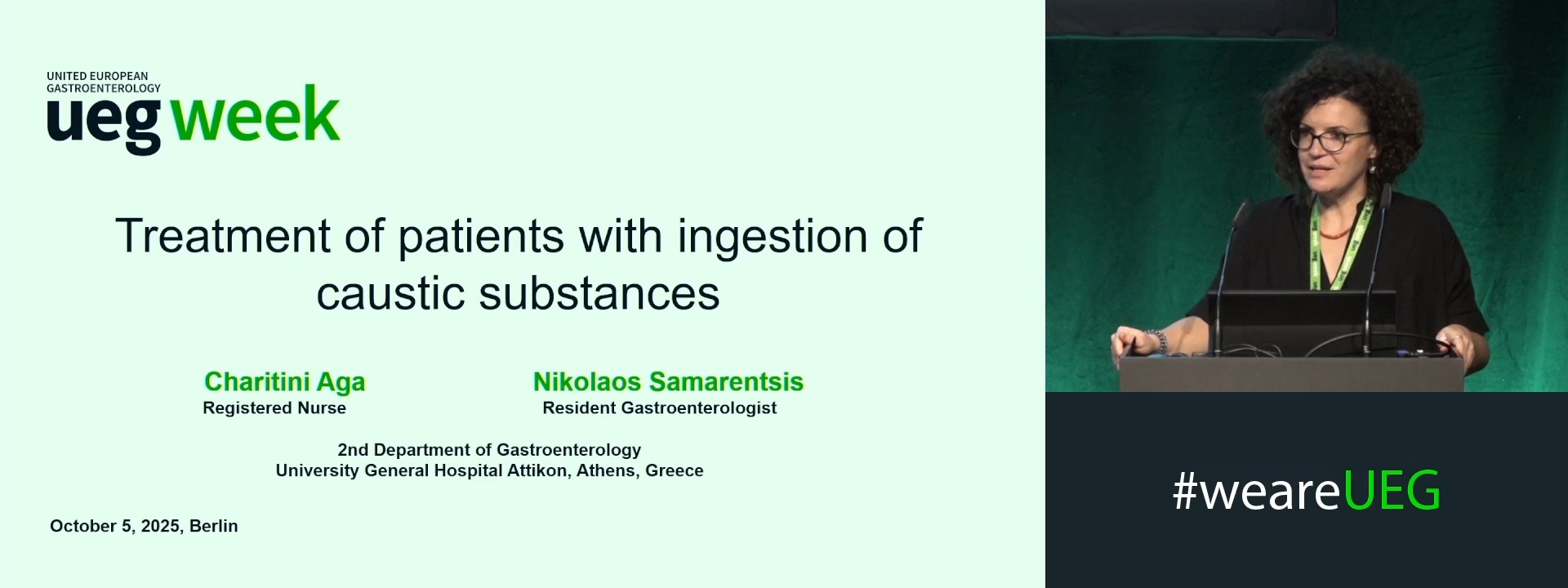
Treatment of patients with ingestion of caustic substances
1 None, None, Greece
Event
Topics
Citation
Published
Log in to access this content.
Free for all myUEG account holders. Your access level is set automatically based on your occupation. Medical professionals get full access to all content. If you are a non-medical user, you can only access UEG Week content from congresses you attended.
Not sure what you can access? Learn more about account types.
Panel discussion: The ultimate guide to colorectal cancer staging surgery adjuvant treatment
Event
Topics
Citation
Published
Log in to access this content.
Free for all myUEG account holders. Your access level is set automatically based on your occupation. Medical professionals get full access to all content. If you are a non-medical user, you can only access UEG Week content from congresses you attended.
Not sure what you can access? Learn more about account types.
Where is my chest pain coming from?!
1 University of Pisa, Pisa, Italy
Event
Topics
Citation
Published
Log in to access this content.
Free for all myUEG account holders. Your access level is set automatically based on your occupation. Medical professionals get full access to all content. If you are a non-medical user, you can only access UEG Week content from congresses you attended.
Not sure what you can access? Learn more about account types.
EUS-guided therapy of gastric varices: The role of endoscopic nurse-team work
1 Wojskowy Instytut Medyczny, Warsaw, Poland
2 Hospital of the Ministry of Interior and Administration, Szczecin, Poland
Event
Topics