UEG's educational platform for gastroenterology education bringing recordings, courses, guidelines, and more together in one place.
Most popular content
Rate for better recommendations!
Your feedback helps us show you more of what you like and less of what you dislike!
Log in to access this content.
Free for all myUEG account holders. Your access level is set automatically based on your occupation. Medical professionals get full access to all content. If you are a non-medical user, you can only access UEG Week content from congresses you attended.
Not sure what you can access? Learn more about account types.

CMV INFECTION IN ULCERATIVE COLITIS: FOCUS ON TISSUE PCR AND IMMUNOHISTOCHEMISTRY
Raffaella Rima 1, Chiara Maria Penati 2, Francesco Maria Stalla 3, Mariabeatrice Rita Daniela Principi 4, Stefano Okolicsanyi 2
1 Umberto Parini Hospital, Aosta, Italy|||Azienda Ospedaliero Universitaria Consorziale Policlinico, Bari, Italy
2 Umberto Parini Hospital, Aosta, Italy
3 Mauriziano Hospital, Turin, Italy
4 Azienda Ospedaliero Universitaria Consorziale Policlinico, Bari, Italy
Conference
Topics
Submission format
Citation
Published
Log in to access this content.
Free for all myUEG account holders. Your access level is set automatically based on your occupation. Medical professionals get full access to all content. If you are a non-medical user, you can only access UEG Week content from congresses you attended.
Not sure what you can access? Learn more about account types.
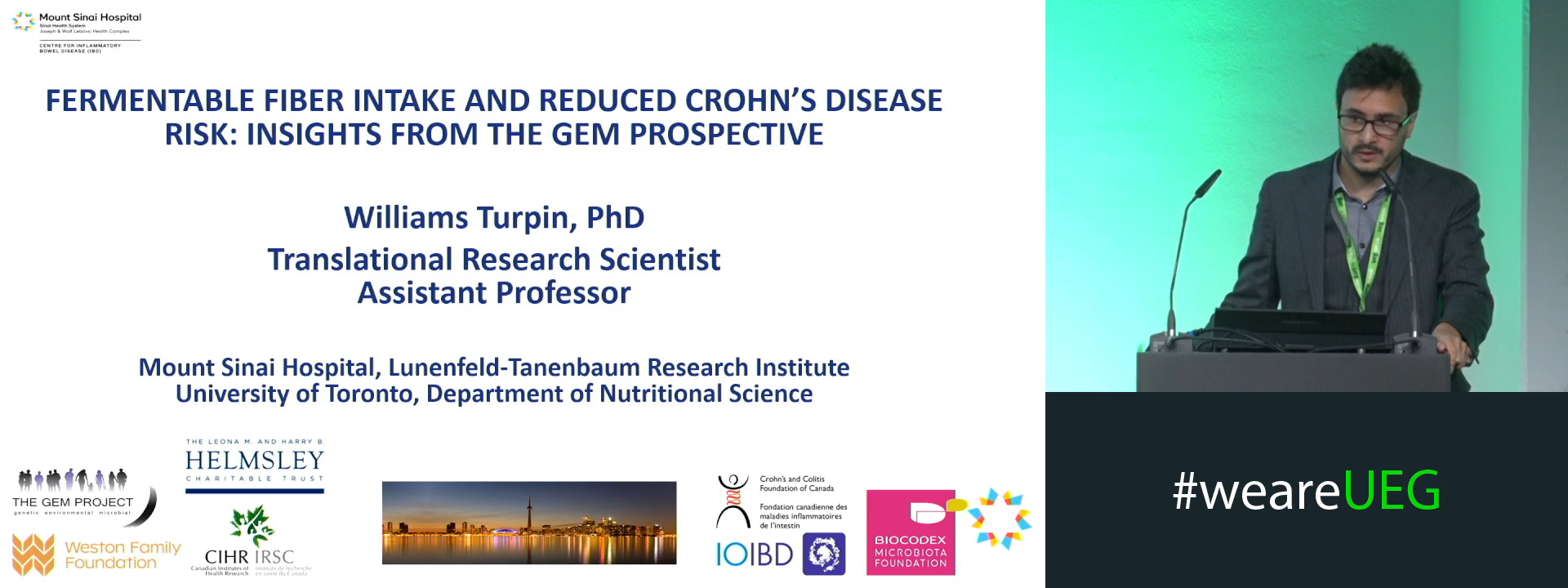
FERMENTABLE FIBER INTAKE AND REDUCED CROHN’S DISEASE RISK: INSIGHTS FROM THE GEM PROSPECTIVE COHORT
Mingyue Xue 1, Catherine Mcshane 2, Kim Jeongseok 2, Haim Leibovitzh 3, Jingcheng Shao 2, Qilong Li 2, Karen Madsen 4, Reihane Khorasaniha 2, Anne Griffiths 5, Thomas D Walters 5, Allan Hillary Steinhart 1, Mark S. Silverberg 2, Levinus Dieleman 6, Hien Huynh 6, Remo Panaccione 7, Paul Beck 7, Guy Aumais 8, Iwona Wrobel 7, Alain Bitton 9, John K. Marshall 10, Charles N. Bernstein 11, Jeffrey Hyams 12, Paul Moayyedi 13, Sun-Ho Lee 2, Heather Armstrong 6, Ken Croitoru 14, Williams Turpin 2
1 Mount Sinai Hospital Dept. of Medicine, Toronto, Canada
2 Mount Sinai Hospital, Toronto, Canada
3 Mount-Sinai Hospital, Toronto, Toronto, Canada
4 University of Alberta, Alberta, Canada
5 Hospital for Sick Children, Toronto, Canada
6 University of Alberta Division of Gastroenterology Dept. of Medicine, Edmonton, Canada
7 University of Calgary, Calgary, Canada
8 University of Montreal / Maisonneuve Hospital, Montreal, QC, Canada
9 Royal Victoria Hospital Dept. of Gastroenterology, Montreal, Canada
10 McMaster University, Burlington, Canada
11 University of Manitoba, Winnipeg, Canada
12 CT Children's, Hartford, United States
13 McMaster University Dept. of Medicine Dept. of Gastroenterology - McMaster University Dept. of Medic, Hamilton, Canada
14 Mt Sinai Hospital, Toronto, Canada
Event
Submission format
Session
Citation
Published
Log in to access this content.
Free for all myUEG account holders. Your access level is set automatically based on your occupation. Medical professionals get full access to all content. If you are a non-medical user, you can only access UEG Week content from congresses you attended.
Not sure what you can access? Learn more about account types.
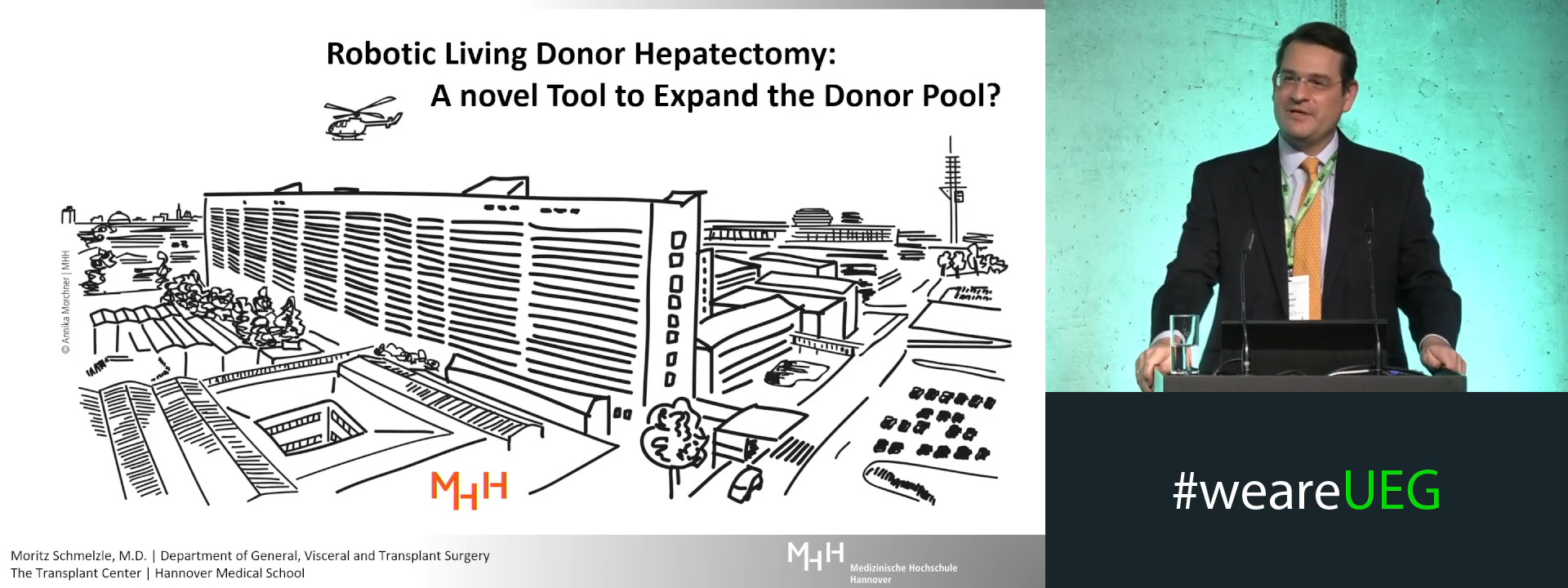
Robotic living donor hepatectomy: A novel tool to expand the donor pool
1 Hannover Medical School, Hannover, Germany
Event
Topics
Citation
Published
Log in to access this content.
Free for all myUEG account holders. Your access level is set automatically based on your occupation. Medical professionals get full access to all content. If you are a non-medical user, you can only access UEG Week content from congresses you attended.
Not sure what you can access? Learn more about account types.
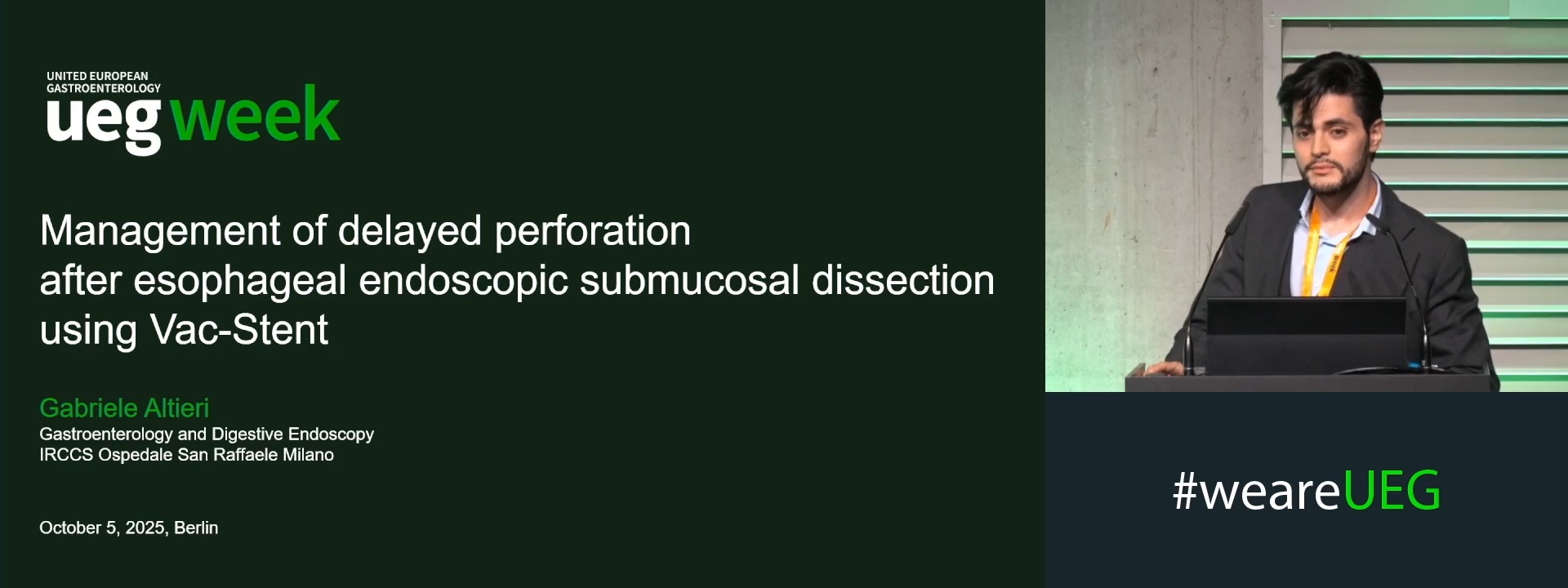
MANAGEMENT OF DELAYED PERFORATION AFTER ESOPHAGEAL ENDOSCOPIC SUBMUCOSAL DISSECTION USING VAC-STENT
Francesco Vito Mandarino 1, Gabriele Altieri 1, Giuseppe Dell'Anna 2, Alberto Barchi 1, Ernesto Fasulo 1, Francesco Azzolini 1, Silvio Danese 1, Edi Viale 1
1 IRCCS San Raffaele Institute, Milan, Italy|||Vita-Salute San Raffaele University, Milan, Italy
2 IRCCS San Raffaele Institute, Milan, Italy|||IRCCS Policlinico san Donato, Milan, Italy
Event
Submission format
Citation
Published
Log in to access this content.
Free for all myUEG account holders. Your access level is set automatically based on your occupation. Medical professionals get full access to all content. If you are a non-medical user, you can only access UEG Week content from congresses you attended.
Not sure what you can access? Learn more about account types.
CYTOMEGALOVIRUS COLITIS IN SEVERE INFLAMMATORY BOWEL DISEASE FLARES: PREVALENCE AND ASSOCIATED FACTORS
Feriel Sahbani 1, Emna Belhadj Mabrouk 2, Mensi Asma 3, Shema Ayadi 4, Leila Mouelhi 5, Radhouane Debbeche 6
1 University Hospital Rabta, Tunis, Tunisia
2 Charles Nicole Hospital, Ezzahra, Tunisia
3 Hospital La Rabta, Ben Arous, Tunisia
4 Charles Nicolle Hospital, Tunis, Tunisia
5 Hopital Charles Nicolle, Bab Saadoun Tunis, Tunisia
6 Charles Nicole Hospital, Tunis, Tunisia
Conference
Topics
Submission format
Session
Citation
Published
Log in to access this content.
Free for all myUEG account holders. Your access level is set automatically based on your occupation. Medical professionals get full access to all content. If you are a non-medical user, you can only access UEG Week content from congresses you attended.
Not sure what you can access? Learn more about account types.
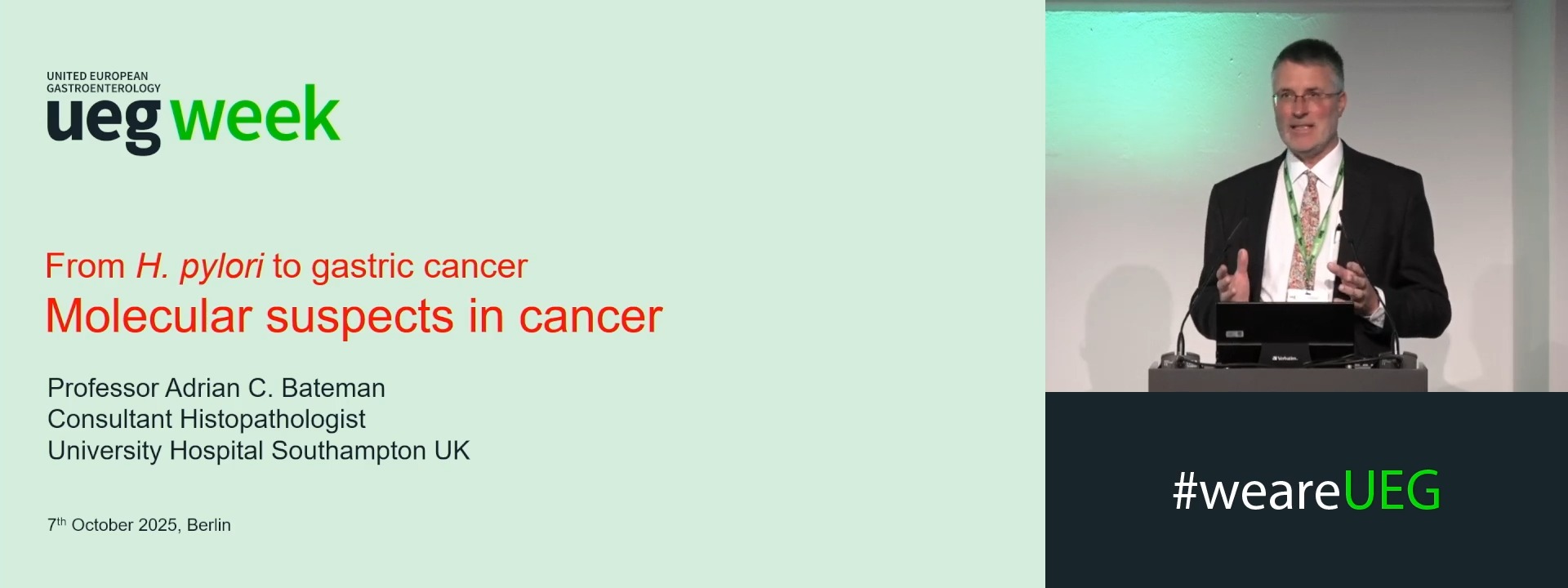
From H. pylori to cancer: Molecular suspects and mechanisms of progression
1 Southampton University Hospital NHS Trust, Southampton, United Kingdom
2 Charité Universitätsmedizin Berlin, Berlin, Germany
Event
Citation
Published
Log in to access this content.
Free for all myUEG account holders. Your access level is set automatically based on your occupation. Medical professionals get full access to all content. If you are a non-medical user, you can only access UEG Week content from congresses you attended.
Not sure what you can access? Learn more about account types.
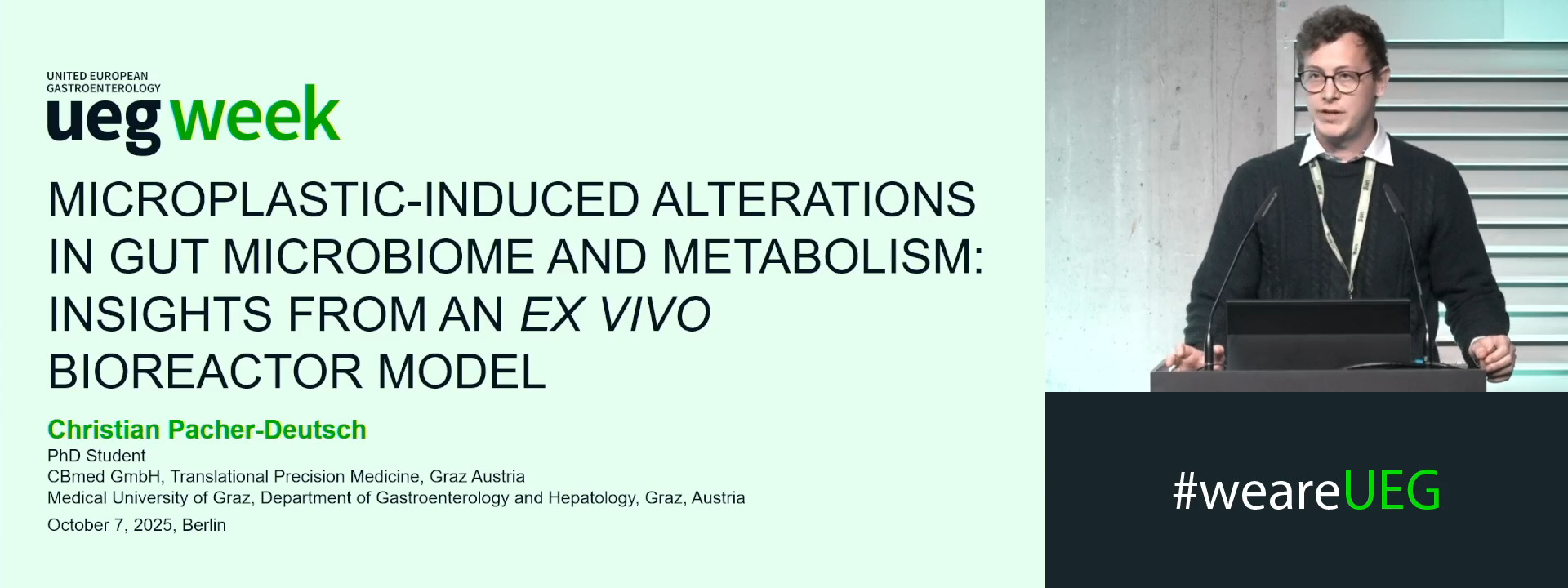
MICROPLASTIC-INDUCED ALTERATIONS IN GUT MICROBIOME AND METABOLISM: INSIGHTS FROM AN EX VIVO BIOREACTOR MODEL
Christian Pacher-Deutsch 1, Kristina Žukauskaitė 1, Cigdem Akar 2, Maximilian Nepel 2, Lukas Kogler 3, Hansjörg Habisch 2, Serena Ducoli 4, Stefania Federici 4, Tobias Madl 5, Verena Pichler 6, Angela Horvath 1, Vanessa Stadlbauer 7
1 Center for Biomarker Research in Medicine (CBmed), Graz, Austria|||Medical University of Graz, Graz, Austria
2 Medical University of Graz, Graz, Austria
3 Center for Biomarker Research in Medicine (CBmed), Graz, Austria|||University of Vienna, Vienna, Austria|||Medical University of Vienna, Vienna, Austria
4 University of Brescia, Brescia, Italy
5 Medical University of Graz, Graz, Austria|||BioTechMed-Graz, Graz, Austria
6 Center for Biomarker Research in Medicine (CBmed), Graz, Austria|||University of Vienna, Vienna, Austria
7 Center for Biomarker Research in Medicine (CBmed), Graz, Austria|||Medical University of Graz, Graz, Austria|||BioTechMed-Graz, Graz, Austria
Event
Topics