UEG's educational platform for gastroenterology education bringing recordings, courses, guidelines, and more together in one place.
Most popular content
Rate for better recommendations!
Your feedback helps us show you more of what you like and less of what you dislike!
Log in to access this content.
Free for all myUEG account holders. Your access level is set automatically based on your occupation. Medical professionals get full access to all content. If you are a non-medical user, you can only access UEG Week content from congresses you attended.
Not sure what you can access? Learn more about account types.

ADENOMA DETECTION RATE AND SUBSEQUENT RISK OF COLORECTAL CANCER: AN END TO THE RACE? A SYSTEMATIC REVIEW AND META-ANALYSIS
Leonardo Frazzoni 1, Giulio Antonelli 2, Nastazja Pilonis 3, Pieter Henk Abraham Wisse 4, Antonio Facciorusso 5, Manon C.W. Spaander 6, Mario Dinis-Ribeiro 7, Giovanni Barbara 8, Federico Orlandini 8, Marco Di Marco 1, Angelo De Padova 1, Cristiano Spada 9, Evelien Dekker 10, Michael Bretthauer 11, Michal Filip Kaminski 12, Cesare Hassan 13, Lorenzo Fuccio 8
1 AUSL Romagna, Rimini, Italy
2 Ospedale dei Castelli, Rome, Italy
3 The Maria Sklodowska-Curie Institute - Oncology Institute Warsaw, Poland, Warsaw, Poland
4 Erasmus MC Rotterdam, Rotterdam, Netherlands
5 University of Salento, Lecce, Italy
6 Erasmus Medical Center Rotterdam, Rotterdam, Netherlands
7 IPO Porto, Porto, Portugal
8 University of Bologna, Bologna, Italy
9 Catholic University Rome - Digestive Endoscopy unit, Catholic University Rome; Rome/IT, Rome, Italy
10 AMC, Amsterdam, Netherlands
11 University of Oslo, Oslo, Norway
12 Maria Sklodowska-Curie Memorial Center and Institute of Oncology, Warsaw, Poland
13 Humanitas University, Pieve Emanuele MI, Italy
Conference
Topics
Submission format
Citation
Published
Log in to access this content.
Free for all myUEG account holders. Your access level is set automatically based on your occupation. Medical professionals get full access to all content. If you are a non-medical user, you can only access UEG Week content from congresses you attended.
Not sure what you can access? Learn more about account types.
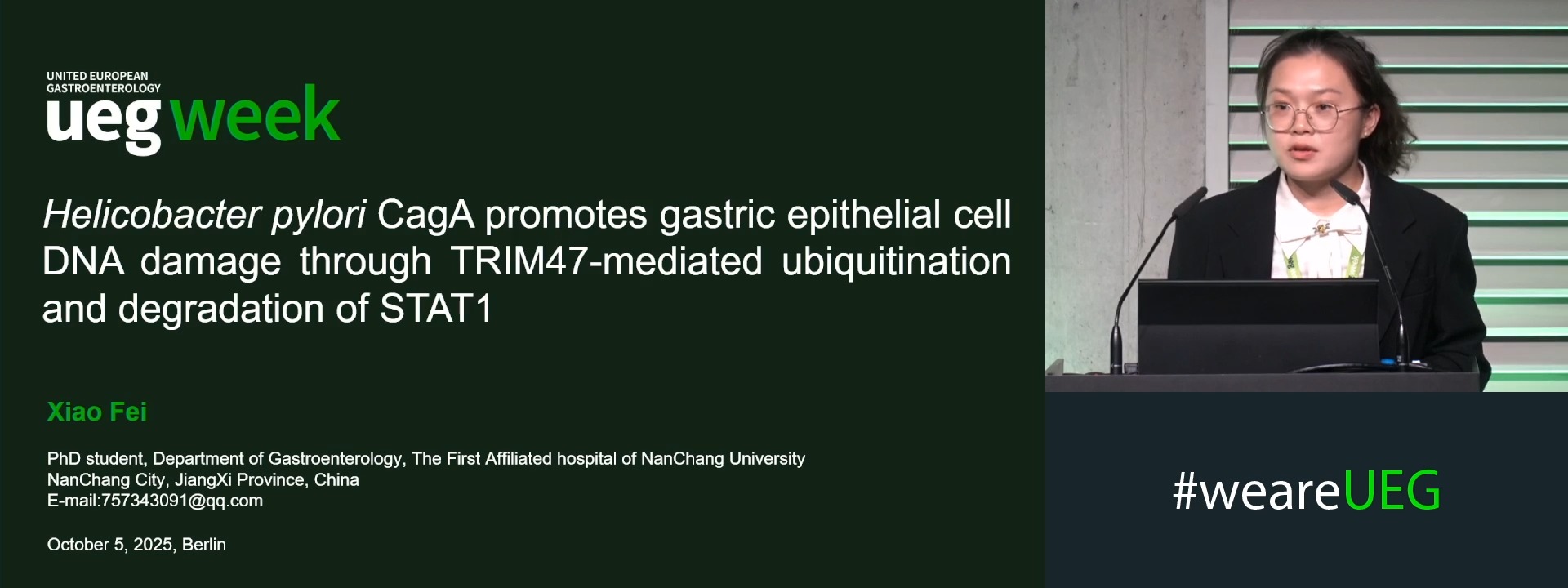
HELICOBACTER PYLORI CAGA PROMOTES GASTRIC EPITHELIAL CELL DNA DAMAGE THROUGH TRIM47-MEDIATED UBIQUITINATION AND DEGRADATION OF STAT1
1 The First Affiliated Hospital, Jiangxi Medical College, Nanchang University, Nanchang, China
Event
Submission format
Citation
Published
Log in to access this content.
Free for all myUEG account holders. Your access level is set automatically based on your occupation. Medical professionals get full access to all content. If you are a non-medical user, you can only access UEG Week content from congresses you attended.
Not sure what you can access? Learn more about account types.
A RARE CASE OF PSEUDOHEMATURIA INDUCED BY MESALAZINE
Isabel Caetano 1, Plácido Gomes 1, Diogo Simas 1, Catarina Atalaia-Martins 1, Maria Silva 1, Sandra Barbeiro 1, Helena Vasconcelos 1
1 Unidade Local de Saúde da Região de Leiria, Leiria, Portugal
Conference
Topics
Submission format
Session
Published
Log in to access this content.
Free for all myUEG account holders. Your access level is set automatically based on your occupation. Medical professionals get full access to all content. If you are a non-medical user, you can only access UEG Week content from congresses you attended.
Not sure what you can access? Learn more about account types.
REQUIRED WITHDRAWAL TIMES TO MEET ADENOMA DETECTION TARGETS DURING COLONOSCOPY
Mahsa Taghiakbari 1, Sara-Ivana Calce 1, Douglas Kevin Rex 2, Roupen Djinbachian 1, Alan N. Barkun 3, Victoire Michal 4, Claire Gefflot 4, Mickael Bouin 1, Simon Bouchard 1, Benoit Panzini 1, Erik Deslandres 1, Dane Christina Daoud 1, Robert Battat 1, Katarzyna Orlicka 1, Edmond-Jean Bernard 1, Jeremy Liu Chen Kiow 1, Daniel von Renteln 1
1 University of Montreal Hospital Center (CHUM), Montreal, Canada
2 Indiana University School of Medicine, Indianapolis, United States
3 McGill University Health Centre and McGill University, Montreal, Canada
4 University of Montreal Hospital Research Center (CRCHUM), Montreal, Canada
Conference
Topics
Submission format
Citation
Published
Log in to access this content.
Free for all myUEG account holders. Your access level is set automatically based on your occupation. Medical professionals get full access to all content. If you are a non-medical user, you can only access UEG Week content from congresses you attended.
Not sure what you can access? Learn more about account types.
PROOF OF CONCEPT IN VITRO STUDY OF THE ADSORPTION CAPACITY OF THE ENTEROSORBENT ENTEROSGEL FOR CYTOKINES AND ENZYMES RELEVANT TO ULCERATIVE COLITIS
1 Imperial College London, London, United Kingdom
2 Imperial College London, London, United Kingdom|||Imperial College Healthcare NHS Trust, London, United Kingdom
Conference
Topics
Submission format
Session
Citation
Published
Log in to access this content.
Free for all myUEG account holders. Your access level is set automatically based on your occupation. Medical professionals get full access to all content. If you are a non-medical user, you can only access UEG Week content from congresses you attended.
Not sure what you can access? Learn more about account types.
DUODENAL CONFOCAL LASER ENDOMICROSCOPY REVEALS INTESTINAL BARRIER DYSFUNCTION IN ADVANCED CHRONIC LIVER DISEASE AND PREDICTS CLINICAL OUTCOME
Benedikt Simbrunner 1, Daniel Steinacher 1, Adrian Frick 1, Katharina Pomej 1, Benedikt Hofer 1, Lorenz Balcar 1, Georg Semmler 1, Mathias Jachs 1, Lukas Hartl 1, Michael Trauner 1, Mattias Mandorfer 1, Thomas Reiberger 1, Johann Hammer 1
1 Medical University of Vienna, Wien, Austria
Conference
Topics
Submission format
Citation
Published
Log in to access this content.
Free for all myUEG account holders. Your access level is set automatically based on your occupation. Medical professionals get full access to all content. If you are a non-medical user, you can only access UEG Week content from congresses you attended.
Not sure what you can access? Learn more about account types.
INTERIM ANALYSIS OF REAL-WORLD-DATA ON PROMIS<SUP>®</SUP> GLOBAL 10 COLLECTED THROUGH THE HEALTH OUTCOME OBSERVATORY (H2O) CONSORTIUM IN PATIENTS WITH IBD
Gottfried Novacek 1, Liselotte Fierens 2, Philipp Schreiner 1, Marc Ferrante 3, Martin Bäuerle 1, Christian Primas 1, Stefanie Dabsch 1, Viktoria Schilling 1, Adrian Frick 1, Walter Reinisch 1, Karin Christine Schweiger 1, Valentin Ritschl 1, Erika Mosor 1, Preston Long 1, Elisabeth Winkler 1, Tobias Mooslechner 1, Karin Wisniowski 1, Lili Kazemi-Shirazi 1, Clemens Dejaco 1, Michael Trauner 1, Tanja Stamm 1
1 Medical University of Vienna, Vienna, Austria
2 KU Leuven, Leuven, Belgium
3 University Hospitals Leuven, Leuven, Belgium
Conference
Topics
Submission format
Session