UEG's content platform for gastroenterology education bringing recordings, courses, guidelines, and more together in one place.
Trending on Gutflix
Rate for better recommendations!
Your feedback helps us show you more of what you like and less of what you dislike!
Log in to continue.
This content is part of Gutflix. Log in with your myUEG account, or create one free, to watch it.
Not sure what you can access? Learn more about account types.
Measuring what matters: Pros and cons of therapeutic drug monitoring in IBD
Affiliations
1 Department of Gastroenterology and Hepatology, Amsterdam, Netherlands
2 Imelda General Hospital, Bonheiden, Belgium

Log in to continue.
This content is part of Gutflix. Log in with your myUEG account, or create one free, to watch it.
Not sure what you can access? Learn more about account types.
A MULTICENTER PROSPECTIVE OBSERVATIONAL STUDY OF THE PREDICTION OF ADVANCED HISTOLOGY IN SMALL COLORECTAL POLYPS USING IMAGE-ENHANCED ENDOSCOPY: THE ADVENTURE TRIAL
Hiroki Yamashita 1, Kinichi Hotta 2, Yoji Takeuchi 3, Tomohiro Iwai 4, Kazuya Ohno 5, Kazuya Hosotani 6, Toshihiro Kusaka 7, Takuji Kawamura 8, Shinya Sugimoto 9, Yasuhiro Tani 3, Yoshihiro Kishida 2, Shigehiko Fujii 7, Takahiro Inoue 3, Hiromu Fukuda 3, Tatsuro Murano 1, Sayo Ito 2, Kenichiro Imai 2, Hiroaki Ikematsu 1
Affiliations
1 National Cancer Center Hospital East, Kashiwa, Japan
2 Shizuoka Cancer Center, Sunto, Japan
3 Osaka International Cancer Institute, Osaka, Japan
4 Toyokawa City Hospital, Toyokawa, Japan
5 Shizuoka General Hospital, Shizuoka, Japan
6 Kobe City Medical Center General Hospital, Kobe, Japan
7 Kyoto Katsura Hospital, Kyoto, Japan
8 Kyoto Second Red Cross Hospital, Kyoto, Japan
9 Ise Red Cross Hospital, Ise, Japan

Log in to continue.
This content is part of Gutflix. Log in with your myUEG account, or create one free, to watch it.
Not sure what you can access? Learn more about account types.
EID for early rectal cancer: The new paradigm?
Affiliations
1 University Medical Center Utrecht, Utrecht, Netherlands

Log in to continue.
This content is part of Gutflix. Log in with your myUEG account, or create one free, to watch it.
Not sure what you can access? Learn more about account types.
Innovation technology in surveillance of genetic syndromes?
Affiliations
1 Hospital Clinic, Barcelona, Spain
Log in to continue.
This content is part of Gutflix. Log in with your myUEG account, or create one free, to watch it.
Not sure what you can access? Learn more about account types.
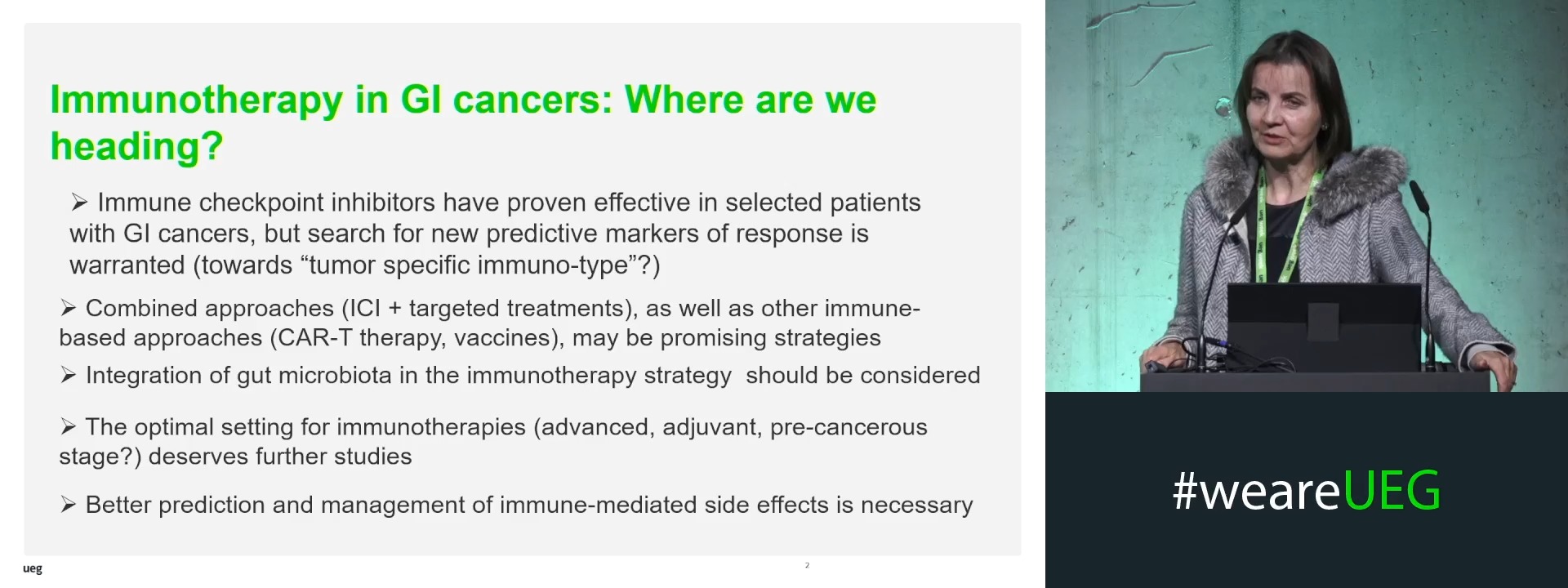
Summary: Immunotherapy in digestive cancers - Where are we heading?
Affiliations
1 CHU de Nantes IMAD, Nantes, France

Log in to continue.
This content is part of Gutflix. Log in with your myUEG account, or create one free, to watch it.
Not sure what you can access? Learn more about account types.
The role of endoscopy vs resection for T1a and T1b disease
Affiliations
1 CHU Limoges - Hepato-Gastro-Enterology, CHU Limoges; Limoges/FR, Limoges, France