Introduction
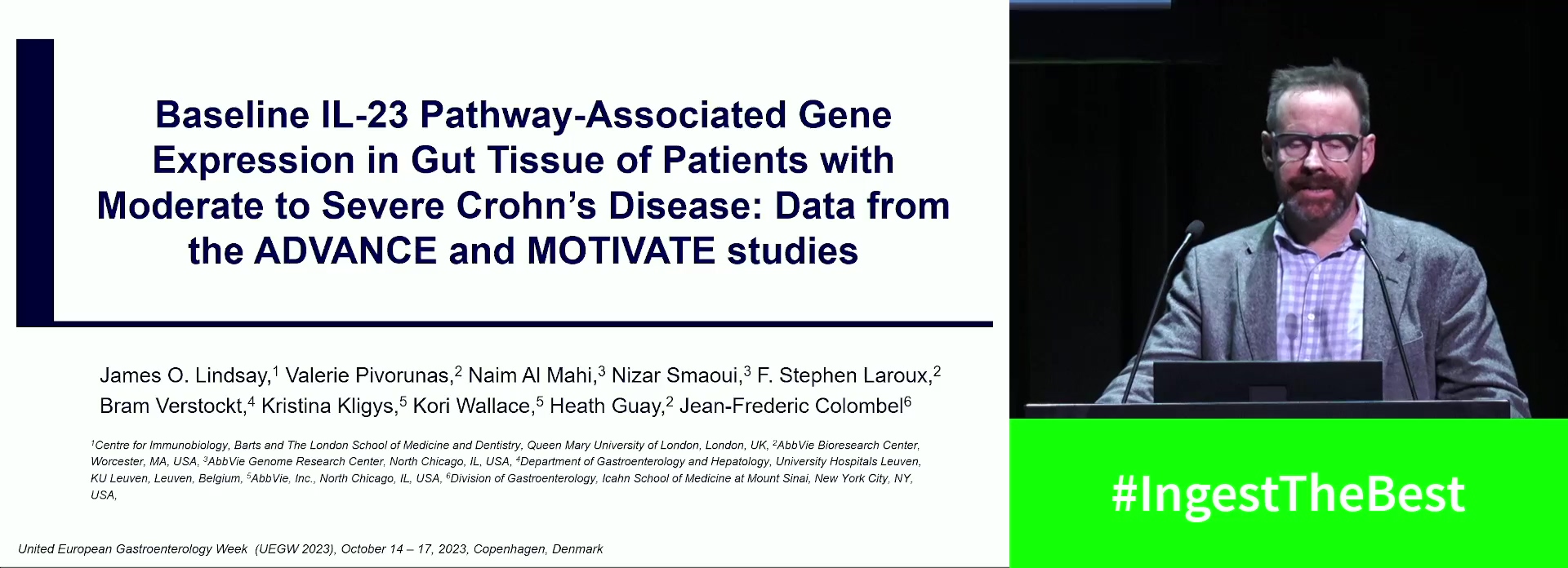
Interleukin (IL)-23 is a key driver in the pathogenesis of Crohn’s disease (CD). IL-23 is a heterodimer, consisting of p19 and p40 subunits encoded by IL-23A and -23R, respectively. Signaling through the IL-23 receptor complex leads to the transcription of effector cytokine genes, including IL-17A, -17F and -22. Risankizumab (RZB), a monoclonal antibody with specificity for IL-23p19 has demonstrated safety and efficacy for the treatment of CD.1,2 Here we investigate if baseline (BL) IL-23 pathway gene expression (IL-17A, -17F, -22, -23R, and -23A) in CD patients (pts) is associated with clinical remission and endoscopic response at week (wk) 12 of induction in patients treated with RZB (see Table footnote for endpoint definitions).
Aims & Methods
RNA-sequencing was performed to examine IL-23 pathway gene expression at BL in intestinal biopsy samples (n=280) obtained from pts (n=160) in the 600 mg intravenous (IV) RZB arms of the ADVANCE and MOTIVATE induction studies.1 Biopsies were taken from the site of active disease (colon [n=146] and/or ileum [n=134]). A linear model based differential expression was conducted between response and non-response using the co-primary endpoints of SF/APS clinical remission and endoscopic response at induction wk 12. Data were normalized using trimmed mean of M-values and log2 counts per million. P-values were adjusted using Benjamini-Hochberg method of multiple testing correction. Comparisons were performed between endoscopic responders or clinical remitters (R) and endoscopic non-responders or clinical non-remitters (NR) in all pts. Analyses were stratified by disease location and/or prior biologic response status.
Results
In the total cohort, IL-23A gene expression was higher at BL in clinical R versus (vs) NR (p=0.03) (see Table for results). However, this difference was only significant in patients with prior bio-failure (p=0.03). Additionally, no difference was observed in IL-23 pathway gene expression between endoscopic R vs NR. When stratifying by disease location, higher BL expression of IL-17A, -17F, -22 and -23A were observed in patients with colonic disease in clinical R vs NR with (p<0.05). This difference was observed in both bio-failure and non-bio-failure patients (p<0.05). No difference was observed between endoscopic R vs NR. In pts with ileal disease, no differences in IL-23 pathway gene expression were observed between clinical R versus NR. Higher BL expression of IL-17A and -17F, and lower BL expression of IL-23R, were demonstrated in endoscopic R vs NR at wk 12 (p<0.05). However this difference was only significant in bio-failure patients.
Conclusion
Endpoint
| Patient Subgroups | Baseline Gene Expression NR vs R Adjusted P-value (p<0.05 denoted in bold)
|
IL-17A
| IL-17F
| IL-22
| IL-23R
| IL-23A
|
Clinical Remission at Week 12a
| All Patients N=160 (62 R, 98 NR) Colonic Disease N=146 (56 R, 90 NR) Ileal Disease N=134 (47 R, 87 NR) Prior Bio-Failure N=113 (37 R, 76 NR) Without Prior Bio-Failure N=47 (25 R, 22 NR) Colonic Disease + Prior Bio-Failure N=101 (33 R, 68 NR) Colonic Disease + Without Prior Bio-Failure N=45 (23 R, 22 NR) Ileal Disease + Prior Bio-Failure N=94 (26 R, 68 NR) Ileal Disease + Without Prior Bio-Failure N=40 (21 R, 19 NR)
| 0.40
0.04
0.21
0.11
0.79
0.048
0.51
0.99
0.26
| 0.5
0.04
0.94
0.10
0.82
0.06
0.50
0.70
0.73
| 0.17
0.03
0.78
0.26
0.30
0.04
0.41
0.68
0.52 | 0.95
0.84
0.65
0.23
0.30
0.25
0.45
0.77
0.44
| 0.03
0.002
0.92
0.03
0.73
0.005
0.44
0.71
0.65 |
Endoscopic Response At Week 12b
| All Patients N=160 (69 R, 91 NR) Colonic Disease N=146 (37 R, 109 NR) Ileal Disease N=134 (35 R, 99 NR) Prior Bio-Failure N=113 (23 R, 90 NR) Without Prior Bio-Failure N=47 (19 R, 28 NR) Colonic Disease + Prior Bio-Failure N=101 (20 R, 81 NR) Colonic Disease + Without Prior Bio-Failure N=45 (17 R, 28 NR) Ileal Disease + Prior Bio-Failure N=94 (18 R, 76 NR) Ileal Disease + Without Prior Bio-Failure, N=40 (17 R, 23 NR)
| 0.83
0.08
0.01
0.77
0.65
0.10
0.57
0.049
0.19 | 0.45
0.44
0.049
0.35
0.98
0.49
0.85
0.02
0.9
| 0.44
0.06
0.42
0.48
0.53
0.09
0.43
0.49
0.90
| 0.44
0.06
0.42
0.48
0.53
0.09
0.43
0.49
0.90
| 0.79
0.07
0.10
0.84
1.00
0.09
0.71
0.14
0.63
|
aAverage daily SF ≤ 2.8 and not worse than BL AND average daily AP score ≤ 1 and not worse than BL; bDecrease in SES-CD > 50% from BL (or for subjects with isolated ileal disease and a BL SES-CD of 4, at least a 2 point reduction from BL), as scored by central reviewer
|
Minimal differences in BL expression of IL-23 pathway genes were detected in the total cohort between clinical R vs NR and endoscopic R vs NR. Significant differences in BL expression of several IL-23 pathway genes were identified between clinical R and NR in pts with colonic disease. Shared and unique IL-23 pathway genes were significantly altered in pts with ileal disease between endoscopic R vs NR. However, these differences are unlikely to be clinically meaningful or predictive of response to RZB.
References
1. D’Haens G, Panaccione R, Baert F, Bossuyt P, Colombel JF, Danese S, et al. Risankizumab as induction therapy for Crohn’s disease: results from the phase 3 ADVANCE and MOTIVATE induction trials. The Lancet. 2022 May;399(10340):2015–30.
2. Ferrante M, Panaccione R, Baert F, Bossuyt P, Colombel JF, Danese S, et al. Risankizumab as maintenance therapy for moderately to severely active Crohn’s disease: results from the multicentre, randomised, double-blind, placebo-controlled, withdrawal phase 3 FORTIFY maintenance trial. The Lancet. 2022 May;399(10340):2031–46.
Disclosure
James Lindsay: Consultant and an advisory board participant for AbbVie, Atlantic Healthcare, Bristol-Myers Squibb, Celgene, Celltrion, Eli Lilly, Ferring Pharmaceuticals, Galapagos, Gilead, GSK, Janssen, MSD, Napp, Pfizer, Shire, Takeda, and Vifor Pharma; has received speaker fees and sponsorship for academic meetings from AbbVie, Ferring Pharmaceuticals, Janssen, MSD, Napp, Norgine, Pfizer, Shire, Tillotts Pharma, and Takeda; and has received investigator-led research grants from AbbVie, Gilead, Pfizer, Shire and Takeda.
Bram Verstockt: Research support from AbbVie, Biora Therapeutics, Landos, Pfizer, Sossei Heptares and Takeda. -Speaker’s fees from Abbvie, Biogen, Bristol Myers Squibb, Celltrion, Chiesi, Falk, Ferring, Galapagos, Janssen, MSD, Pfizer, R-Biopharm, Takeda, Truvion and Viatris. Consultancy fees from Abbvie, Alimentiv, Applied Strategic, Atheneum, Biora Therapeutics, Bristol Myers Squibb, Galapagos, Guidepont, Mylan, Inotrem, Ipsos, Janssen, Pfizer, Progenity, Sandoz, Sosei Heptares, Takeda, Tillots Pharma and Viatris.
Jean Frederic Colombel: Research grants from AbbVie, Janssen Pharmaceuticals and Takeda; receiving payment for lectures from AbbVie, Amgen, Allergan, Inc. Ferring Pharmaceuticals, Shire, and Takeda; consulting fees from AbbVie, Amgen, Arena Pharmaceuticals, Boehringer Ingelheim, BMS, Celgene Corporation, Eli Lilly, Ferring Pharmaceuticals, Galmed Research, Genentech, Glaxo Smith Kline, Janssen Pharmaceuticals, Kaleido Biosciences, Imedex, Immunic, Iterative Scopes, Merck, Microbia, Novartis, PBM Capital, Pfizer, Protagonist Therapeutics, Sanofi,Takeda, TiGenix, Vifor; and hold stock options in Intestinal Biotech Development
Valerie Pivorunas, Naim Al Mahi, Nizar Smaoui, F. Stephen Laroux, Kristina Kligys Kori Wallace, and Heath Guay are AbbVie employees and may own AbbVie stock and/or options.