Introduction
Irritable bowel syndrome (IBS) is associated with high healthcare utilization and productivity losses, resulting in substantial costs for the healthcare systems and society. Hypnotherapy is one of several treatment options used in the management of patients with IBS. Although the clinical effectiveness of smartphone-based self-guided hypnotherapy is not non-inferior to in-person therapist-delivered hypnotherapy (based on the FDA abdominal pain responder definition in the FORTITUDE study, NCT03899779, abstract published in Gastroenterology Volume 169 (supplement), May 2025), its potential for cost savings and wider availability highlights the importance of conducting a cost-effectiveness analysis.
Aims & Methods
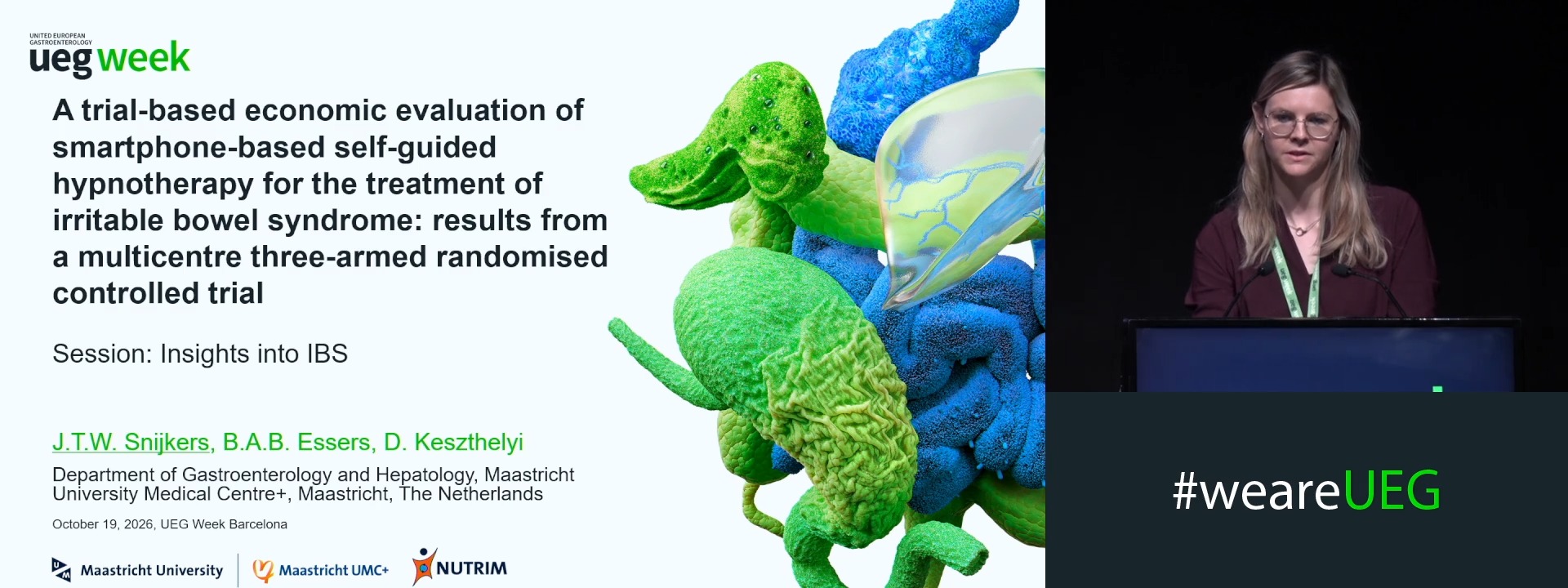
This economic evaluation assessed whether treatment for IBS via smartphone-based self-guided hypnotherapy is cost-effective compared to in-person therapist-delivered hypnotherapy and online self-guided psychoeducation (as a control condition). The 12-week treatment was studied as part of a multi-centre, three-armed randomised controlled trial in IBS patients (Rome IV) aged 16-75 years. Healthcare resource use, indirect health-related costs, and health-related quality of life were measured using the iMTA Medical Consumption Questionnaire (MCQ), iMTA Productivity Cost Questionnaire (PCQ), and Euro-Quality of Life 5 domains (EQ-5D-5L). Data were collected up to six months post-treatment and extrapolated to a 12-month time horizon. Cost-utility was expressed as Incremental Cost-Effectiveness Ratio (ICER) based on Quality Adjusted Life Years (QALYs), with uncertainty estimated using non-parametric bootstrapping. Analyses were performed from both societal and healthcare perspectives.
Results
The analysis included 230 patients (mean age 38.2±13.8 years, 70.4% female): N=78 online self-guided psychoeducation, N=75 smartphone-based self-guided hypnotherapy, and N=77 in-person therapist-delivered hypnotherapy. Both hypnotherapy groups dominated over online psychoeducation, yielding higher QALYs at lower overall costs. Smartphone-based hypnotherapy incurred lower direct healthcare costs compared to in-person therapist-delivered hypnotherapy (mean difference -€261, 95% CI -€891 to €369), while indirect costs were lower in the in-person therapist-delivered group (€2597, 95% CI -€3643 to €8837). From a societal perspective, smartphone-based hypnotherapy was unlikely to be cost-effective with 81% of the cost-effectiveness ratios more costly compared to in-person therapist-delivered hypnotherapy with minimal differences in QALYs, largely due to outliers in productivity-related losses. From a healthcare perspective, smartphone-based hypnotherapy was less costly in 81% of simulations, and in 42% of those cost-saving cases it was also more effective. When accepting a cost saving of €20.000 per QALY lost, the probability that smartphone-based hypnotherapy is cost-effective from a healthcare perspective is 65%.
Conclusion
From a healthcare perspective, smartphone-based self-guided hypnotherapy presents itself as a potentially cost-effective treatment option for IBS, especially in healthcare settings where in-person therapist-delivered hypnotherapy is not feasible. Its scalability and flexibility may support broader implementation in routine care, although its value from a societal perspective remains uncertain. Compared to online psychoeducation, smartphone-based self-guided hypnotherapy appears to be a cost-effective treatment for IBS, offering improved outcomes and cost savings.
Disclosure
DK: DK has received research funding from ZonMw, Rome Foundation, Horizon Europe, Horizon 2020, Dutch Foundation for Gastroenterology-Hepatology (MDL Fonds) and speaker’s fee from Rome Foundation (paid to host institute).
JTWS and BE: none