UEG's content platform for gastroenterology education bringing recordings, courses, guidelines, and more together in one place.
Trending on Gutflix
Rate for better recommendations!
Your feedback helps us show you more of what you like and less of what you dislike!
Log in to continue.
This content is part of Gutflix. Log in with your myUEG account, or create one free, to watch it.
Not sure what you can access? Learn more about account types.
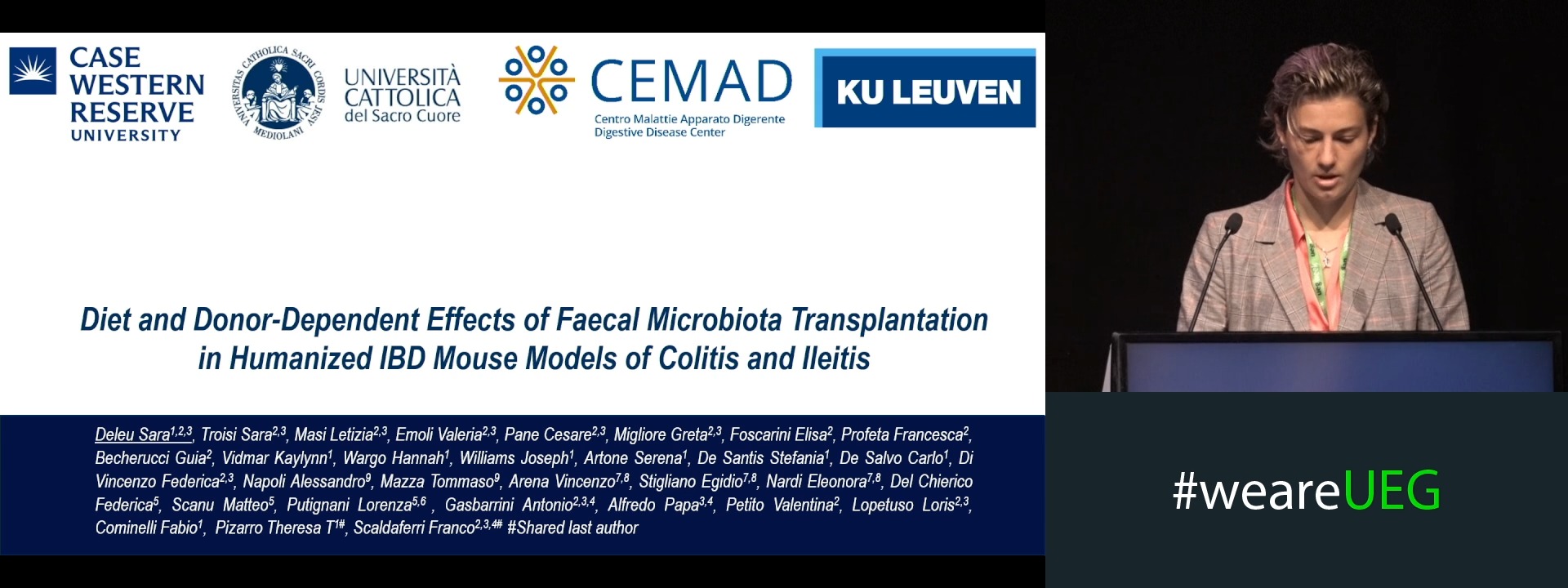
DIET AND DONOR-DEPENDENT EFFECTS OF FAECAL MICROBIOTA TRANSPLANTATION IN HUMANIZED IBD MOUSE MODELS OF COLITIS AND ILEITIS
Sara Deleu 1,2,3, Sara Troisi 2,4, Letizia Masi 2,4, Valeria Emoli 2,4, Cesare Pane 2,4, Greta Migliore 4,2, Elisa Foscarini 4, Francesca Profeta 4, Guia Becherucci 4, Kaylynn Vidmar 3, Hannah Wargo 3, Joseph Williams 3, Serena Artone 3, Stefania De Santis 3, Carlo De Salvo 3, Federica Di Vincenzo 2,4, Alessandro Napoli 5, Federica Del Chierico 6, Matteo Scanu 6, Lorenza Putignani 6,7, Tommaso Mazza 5, Vincenzo Arena 4,2, Egidio Stigliano 4,2, Eleonora Nardi 2,4, Alfredo Papa 2,5, Valentina Petito 4, Loris Riccardo Lopetuso 4,2, Fabio Cominelli 3, Theresa Pizarro 3, Franco Scaldaferri 4,2
Affiliations
1 KU Leuven, Leuven, Belgium
2 Università Cattolica Del Sacro Cuore, Roma, Italy
3 Case Western Reserve University, Cleveland, United States
4 Fondazione Policlinico Universitario “A. Gemelli” IRCCS, Rome, Italy
5 Fondazione Policlinico Gemelli,IRCCS, Rome, Italy
6 Bambino Gesù Children’s Hospital IRCCS, Rome, Italy
7 Link Campus University, Rome, Italy