UEG's educational platform for gastroenterology education bringing recordings, courses, guidelines, and more together in one place.
Most popular content
Rate for better recommendations!
Your feedback helps us show you more of what you like and less of what you dislike!
Log in to access this content.
Free for all myUEG account holders. Your access level is set automatically based on your occupation. Medical professionals get full access to all content. If you are a non-medical user, you can only access UEG Week content from congresses you attended.
Not sure what you can access? Learn more about account types.

THE IMPACT OF NUCLEOS(T)IDE ANALOGUES ON THE WAITING LIST FOR LIVER TRANSPLANTATION IN A SINGLE TERTIARY CENTER
Sara Battistella 1, Alberto Zanetto 1, Martina Gambato 1, Giacomo Germani 1, Marco Senzolo 1, Umberto Cillo 2, Alessandro Vitale 2, Enrico Gringeri 2, Patrizia Burra 1, Francesco Paolo Russo 1
1 Gastroenterology and Multivisceral Transplant Unit - University of Padova, Padova, Italy
2 Hepatobiliary Surgery and Liver Transplantation Unit - University of Padova, Padova, Italy
Conference
Topics
Submission format
Citation
Published
Log in to access this content.
Free for all myUEG account holders. Your access level is set automatically based on your occupation. Medical professionals get full access to all content. If you are a non-medical user, you can only access UEG Week content from congresses you attended.
Not sure what you can access? Learn more about account types.
Mistakes in liver transplantation and how to avoid them
Topics
Citation
Published
Log in to access this content.
Free for all myUEG account holders. Your access level is set automatically based on your occupation. Medical professionals get full access to all content. If you are a non-medical user, you can only access UEG Week content from congresses you attended.
Not sure what you can access? Learn more about account types.
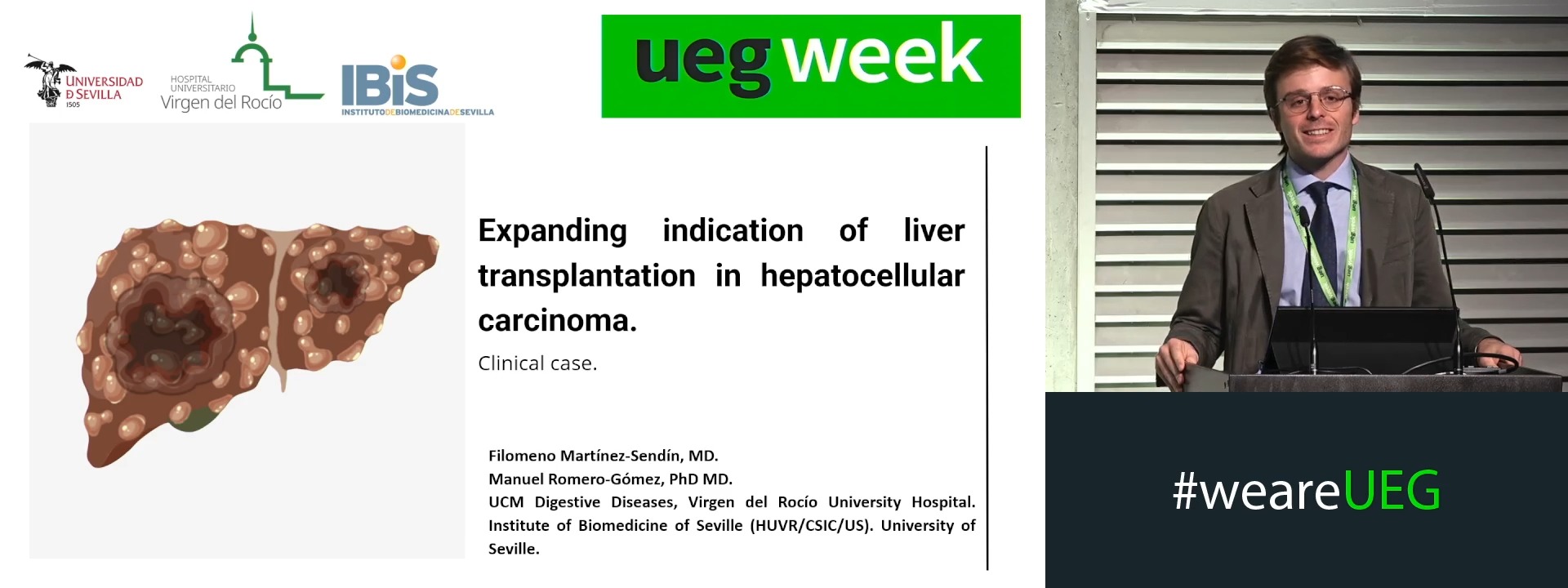
Expanding indication of liver transplantation in HCC
1 Virgen del Rocío University Hospital, Seville, Spain
Event
Topics
Citation
Published
Log in to access this content.
Free for all myUEG account holders. Your access level is set automatically based on your occupation. Medical professionals get full access to all content. If you are a non-medical user, you can only access UEG Week content from congresses you attended.
Not sure what you can access? Learn more about account types.
HCC RECURRENCE AFTER LIVER TRANSPLANTATION: THE VALIDATION OF RETREAT SCORE IN A SINGLE CENTER COHORT
Sara Battistella 1, Alberto Zanetto 1, Filippo Pelizzaro 1, Marco Senzolo 1, Giacomo Germani 1, Alessandro Vitale 2, Enrico Gringeri 2, Umberto Cillo 2, Francesco Paolo Russo 1, Patrizia Burra 1, Martina Gambato 1
1 Gastroenterology and Multivisceral Transplant Unit - University of Padova, Padova, Italy
2 Hepatobiliary Surgery and Liver Transplantation Unit - University of Padova, Padova, Italy
Conference
Topics
Submission format
Citation
Published
Log in to access this content.
Free for all myUEG account holders. Your access level is set automatically based on your occupation. Medical professionals get full access to all content. If you are a non-medical user, you can only access UEG Week content from congresses you attended.
Not sure what you can access? Learn more about account types.
Q&A Fulminant hepatitis, liver failure and liver transplantation
1 University of Padua-Multivisceral Transplant Unit- Gastroenterology, Padova, Italy
2 Hôpital Paul Brousse, Villejuif, France
3 Consorcio Hospital General Valencia (Spain), Valencia, Spain
4 Klinikum rechts der Isar, München, Germany
5 LMU Klinikum, Munich, Germany
Event
Topics
Published
Log in to access this content.
Free for all myUEG account holders. Your access level is set automatically based on your occupation. Medical professionals get full access to all content. If you are a non-medical user, you can only access UEG Week content from congresses you attended.
Not sure what you can access? Learn more about account types.
ACUTE-ON-CHRONIC LIVER FAILURE AND LIVER TRANSPLANTATION: A TERTIARY REFERRAL CENTER EXPERIENCE
Luís Santos 1, Carlos Borges Chaves 1, Ana Torres Oliveira 2, David Perdigoto 3, Suzana Calretas 4, Dario Gomes 3, Pedro Narra Figueiredo 3, Dulce Diogo 2
1 Gastroenterology Department, Centro Hospitalar e Universitário de Coimbra, Coimbra, Portugal
2 Liver Transplantation Unit, Centro Hospitalar e Universitário de Coimbra, Coimbra, Portugal
3 Gastroenterology Department, Centro Hospitalar e Universitário de Coimbra, Coimbra, Portugal|||Faculty of Medicine, University of Coimbra, Coimbra, Portugal
4 Liver Transplantation Unit, Centro Hospitalar e Universitário de Coimbra, Coimbra, Portugal|||Faculty of Medicine, University of Coimbra, Coimbra, Portugal
Conference
Topics
Submission format
Session
Citation
Published
Log in to access this content.
Free for all myUEG account holders. Your access level is set automatically based on your occupation. Medical professionals get full access to all content. If you are a non-medical user, you can only access UEG Week content from congresses you attended.
Not sure what you can access? Learn more about account types.
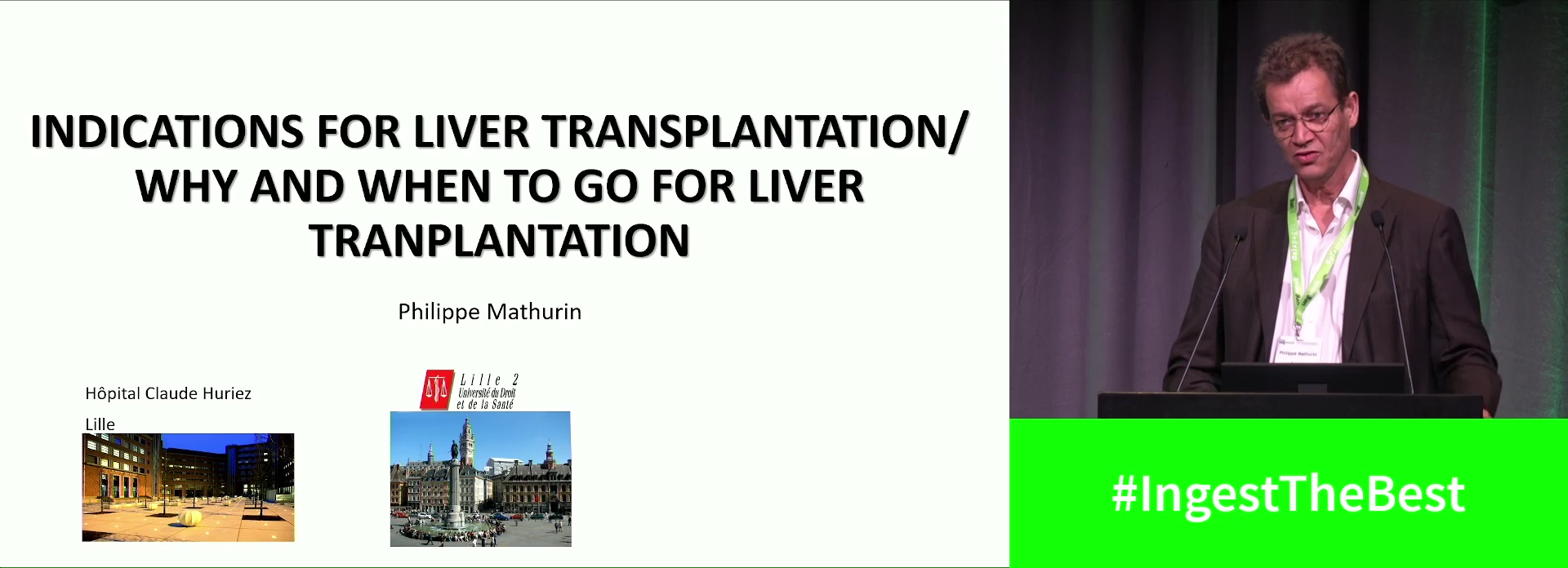
Indications for liver transplantation: Why and when to go for liver transplantation?
1 CHRU Lille Service MADN Hopital Huriez, Lille, France
Event
Topics