Introduction
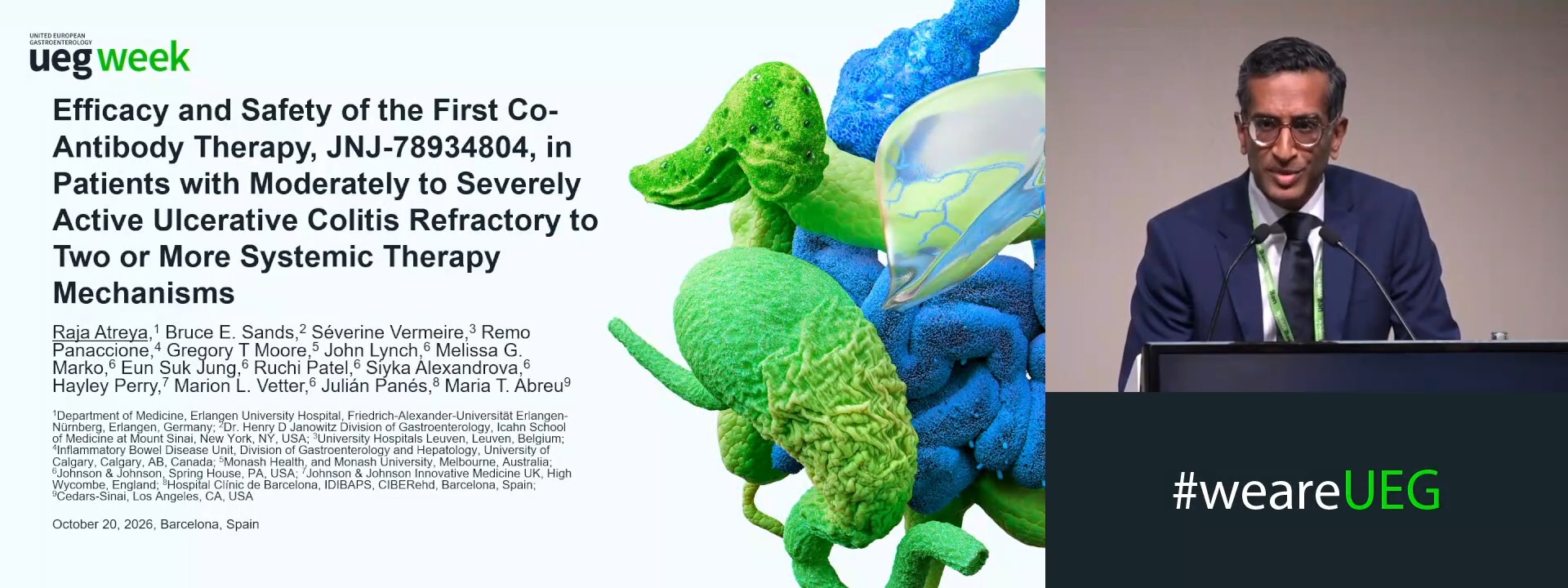
There is a high unmet need for treatment of patients with ulcerative colitis (UC) refractory to multiple prior systemic therapies (STs; biologics and small molecules). We previously reported results from the DUET-UC study of JNJ-78934804 (JNJ-4804), the first fixed-dose, co-antibody therapy with guselkumab (GUS) and golimumab (GOL) targeting the complementary IL-23 and TNF pathways. In DUET-UC, JNJ-4804 showed substantial clinical benefit vs GUS and GOL monotherapies in the subpopulation of participants (pts) with UC refractory to ≥2 ST mechanisms (anti-TNFs, anti-IL-12/23s, anti-IL-23p19s, anti-integrins, JAK inhibitors, S1PR modulators). Here, we present additional efficacy and safety data from this ≥2 ST subpopulation.
Aims & Methods
In this Phase 2b, randomized, double-blind, dose-ranging, active- and placebo (PBO)-controlled, parallel-group, multicenter study, pts were randomized 1:2:2:2:2:2 to PBO, GUS, GOL, or JNJ-4804 (low, mid, or high dose). The primary endpoint was week (W) 48 clinical remission (CR). Secondary endpoints (W48) included corticosteroid-free clinical remission (CF-CR), endoscopic improvement, and histologic remission AND endoscopic improvement (HREI). Change from baseline in fecal calprotectin concentrations was also assessed.
Results
In pts with UC refractory to ≥2 ST mechanisms, those receiving high-dose JNJ-4804 showed clinically meaningful improvements in W48 CR, CF-CR, endoscopic improvement, and HREI vs GOL (Δ22.9, Δ20.5, Δ31.9, and Δ27.3, respectively), vs GUS (Δ12.5, Δ12.3, Δ17.3, Δ16.9), and vs PBO (Δ19.7, Δ17.2, Δ28.3, Δ23.6; Table). Mean change from baseline at W48 in fecal calprotectin was also greater with high-dose JNJ-4804 vs the other groups, showing greater reduction in inflammatory burden (Table). Safety events per 100 patient-years with JNJ-4804 in the subpopulation were overall similar to or lower than in other groups; adverse event (AE) rates [number of events] per 100 patient-years were 568.4 [53] (PBO), 618.0 [167] (GOL), 587.6 [194] (GUS), 679.5 [230] (JNJ-4804 high dose), and 552.2 [512] (JNJ-4804 combined). Respective serious AE rates were 32.2 [3], 29.6 [8], 18.2 [6], 23.6 [8], and 18.3 [17]. AEs leading to treatment discontinuation were lower or similar with JNJ-4804 (high dose: 8.9 [3]; combined: 12.9 [12]) vs other groups (PBO: 32.2 [3]; GOL: 22.2 [6]; GUS: 9.1 [3]). Across groups, there were no deaths and serious infection rates were low (PBO: 0.0 [0], GOL: 7.4 [2], GUS: 0.0 [0], JNJ-4804 high dose: 8.9 [3], JNJ-4804 combined: 6.5 [6]).
| Key endpoints at Week 48 in the subpopulation of participants with ulcerative colitis that was refractory to 2 or more systemic therapy mechanisms |
|---|
aThe modified full analysis set is the full analysis set excluding participants with a modified Mayo Score that was <5 or missing at baseline.
bClinical remission was defined as a stool frequency subscore of 0 or 1, a rectal bleeding subscore of 0, and an endoscopy subscore of 0 or 1 per central review of the video endoscopy. Corticosteroid-free (60-day) clinical remission was defined as clinical remission with no concomitant corticosteroids received for at least 60 days. Endoscopic improvement was defined as an endoscopy subscore of 0 or 1 per central review of the video endoscopy. Histologic remission was defined as the absence of neutrophils from the mucosa (both lamina propria and epithelium), no crypt destruction, and no erosions, ulcerations, or granulation tissue (Geboes score ≤2B.0). HREI was defined as achieving both histologic remission and endoscopic improvement.
cParticipants were considered not to have met the Week 48 endpoint from that timepoint onward if any of the following occurred prior to Week 48: An ostomy or colectomy (partial or total); prohibited change in UC medication; treatment escalation due to inadequate response at Week 24; discontinuation of study treatment due to lack of efficacy or an AE of worsening UC; discontinuation of study treatment due to COVID-19 infection or any other reason. Participants who discontinued study treatment for COVID-19-related reasons (excluding COVID-19 infection) had their observed data used, if available.
dMissing data imputation: After accounting for the conditions in footnote c, participants with missing Mayo subscores (any or all) at Week 48 (for clinical remission and corticosteroid-free clinical remission), missing endoscopy subscores at Week 48 (for endoscopic improvement and HREI), or missing histology data at Week 48 (for HREI) were considered not to have met the endpoint at Week 48.
eWald CIs were based on normal approximation. In cases of rare events, the exact confidence limits were provided.
fThe Mantel-Haenszel estimate of the common risk difference and the 95% CI using Mantel-Haenszel stratum weights and the Sato variance estimator were used for obtaining the adjusted differences and associated 95% CIs for pairwise comparisons of each JNJ-4804 treatment group with the comparator treatment group.
gAs-observed, log-transformed data, excluding inadequate responder data after treatment escalation at Week 24
AE=adverse event, CI=confidence interval, GOL=golimumab, GUS=guselkumab, HREI=histologic remission and endoscopic improvement, IQR=interquartile range, IR=inadequate response or intolerance, MOA=mechanism of action, PBO=placebo, UC=ulcerative colitis. |
Subpopulation: ≥2 ST mechanisms
Modified full analysis seta
| Placebo
(N=21)
| Golimumab
(N=47)
| Guselkumab
(N=50)
| JNJ-4804 high
(N=45) |
Clinical remissionb,c,d
n participants (%)
95% CIe
Comparator,
Adjusted treatment differencef (95% CIf)
PBO
GOL
GUS
|
1 (4.8%)
(0.0, 13.9)
-
-
-
|
1 (2.1%)
(0.0, 6.3)
-
-
-
|
8 (16.0%)
(5.8, 26.2)
-
-
-
|
12 (26.7%)
(13.7, 39.6)
19.7 (5.8, 33.5)
22.9 (9.1, 36.7)
12.5 (-3.6, 28.5)
|
Corticosteroid-free clinical remissionb,c,d
n participants (%)
95% CIe
Comparator,
Adjusted treatment differencef (95% CIf)
PBO
GOL
GUS
|
1 (4.8%)
(0.0, 13.9)
-
-
-
|
1 (2.1%)
(0.0, 6.3)
-
-
-
|
7 (14.0%)
(4.4, 23.6)
-
-
-
|
11 (24.4%)
(11.9, 37.0)
17.2 (4.0, 30.5)
20.5 (7.1, 33.8)
12.3 (-3.0, 27.6)
|
Endoscopic improvementb,c,d
n participants (%)
95% CIe
Comparator,
Adjusted treatment differencef (95% CIf)
PBO
GOL
GUS
|
1 (4.8%)
(0.0, 13.9)
-
-
-
|
1 (2.1%)
(0.0, 6.3)
-
-
-
|
10 (20.0%)
(8.9, 31.1)
-
-
-
|
16 (35.6%)
(21.6, 49.5)
28.3 (12.9, 43.8)
31.9 (17.2, 46.6)
17.3 (-0.2, 34.8)
|
Combination of histologic remission and endoscopic improvementb,c,d
n participants (%)
95% CIe
Comparator,
Adjusted treatment differencef (95% CIf)
PBO
GOL
GUS
|
1 (4.8%)
(0.0, 13.9)
-
-
-
|
1 (2.1%)
(0.0, 6.3)
-
-
-
|
8 (16.0%)
(5.8, 26.2)
-
-
-
|
14 (31.1%)
(17.6, 44.6)
23.6 (8.9, 38.2)
27.3 (13.1, 41.4)
16.9 (0.5, 33.3)
|
Change from baseline at Week 48 in fecal calprotectin (mg/kg) (log-transformed, as observed)a,g
n participants
Mean (SD)
IQR
|
2
0.38 (0.484)
0.04, 0.72
|
9
-1.00 (1.980)
-2.76, 0.22
|
18
-1.61 (2.344)
-3.17, -0.05
|
16
-2.98 (1.851)
-4.84, -1.34
|
Conclusion
JNJ-4804, the first co-antibody therapy in development for IBD, delivered substantial and clinically meaningful efficacy in pts with UC refractory to ≥2 ST mechanisms. These benefits exceeded those of GOL or GUS alone. The JNJ-4804 safety profile in this subpopulation was similar to the monotherapies. These results support advancement to Phase 3 in the rapidly growing population of patients with disease refractory to STs.
Disclosure
Raja Atreya served as a speaker or consultant for or received research grants from AbbVie, Amgen, Arena Pharmaceuticals, AstraZeneca, Biogen, Boehringer Ingelheim, Bristol Myers Squibb, Celgene, Celltrion Healthcare, Dr Falk Pharma, Galapagos, Gilead, InDex Pharmaceuticals, Johnson & Johnson, Lilly, Merck Sharp & Dohme, Novartis, Pandion Therapeutics, Pfizer, Roche, Samsung Bioepis, Takeda, and Viatris.
Bruce E. Sands reports consulting honoraria from Aclaris Therapeutics, Adaxion Therapeutics, Adiso Therapeutics, Agomab Therapeutics, Alfasigma, Alimentiv, Amgen, AnaptysBio, AstraZeneca, Attovia Therapeutics, Biolojic Design, BiomeBank, Biora Therapeutics, Boehringer-Ingelheim, Caldera Therapeutics, Cellarity, Cytoki Pharma, Disc Medicine, Ensho Therapeutics, Enthera, Enveda Biosciences, Equilium, Evommune, Ferring, Fzata, Galapagos, Genentech/Roche, Genesis Therapeutics, Gilead Sciences, GSK, Globalport, Ignite Biomedical, Imedex, Imhotex, Immunitas Therapeutics, Immunyx Pharma, Kallyope, Kyowa Kirin, LifeMine Therapeutics, Lilly, Merck & Co., Merck Sharp & Dohme, Microba, Microbiotica, Mirador Therapeutics, Mitsubishi Tanabe Pharma, Mobius Care, Morphic Therapeutic, MRM Health, Nexus Therapeutics, Nimbus Discovery, Novartis, Numab Therapeutics, Odyssey Therapeutics, ONO Pharmaceutical, OSE Immunotherapeutics, Palisade Bio, Pioneering Medicines Explorations, Prometheus Biosciences, Protagonist Therapeutics, Q32 Bio, Quotient Therapeutics, Rasayana Therapeutics, Recludix Pharma, Reistone Biopharma, Sanofi, Slate Bio, Sorriso Pharmaceuticals, Spyre Therapeutics, Synlogic, Target RWE, Televant, Teva, Thetis Pharmaceuticals, SRT Therapeutics, TR1X, Trex Bio, Union Therapeutics, VectivBio, Vedanta Biosciences, Vividion Therapeutics, and Xencor; consulting/speaking honoraria and other support from AbbVie, Abivax, Bristol Myers Squibb, Celltrion, Genentech/Roche, Johnson & Johnson, Lilly, Merck & Company, Pfizer, Takeda, and Teva; consulting honoraria and stock options from Caldera Therapeutics, Mirador Therapeutics and SRT Therapeutics; and stock from Doximity.
Séverine Vermeire reports grants from AbbVie, Johnson & Johnson, Pfizer, Takeda, and Galapagos; consulting and/or speaking fees from AbbVie, AbolerIS, AgomAb, Alimentiv, Arena, AstraZeneca, Avaxia, Bristol Myers Squibb, Boehringer Ingelheim, Celgene, CVasThera, Cytoki, Dr Falk, Ferring, Galapagos, Genentech/Roche, Gilead, GSK, Hospira, Imidomics, Johnson & Johnson, Lilly, Materia Prima, MiroBio, Morphic, MrMHealth, Mundipharma, MSD, Pfizer, Prodigest, Progenity, Prometheus, Robarts Clinical Trials, Second Genome, Shire, Surrozen, Takeda, Theravance, Tillots, and Zealand.
Remo Panaccione reports consulting fees from Abbivax, Abbott, AbbVie, Alimentiv, Amgen, AnaptysBio, Arena Pharmaceuticals, AstraZeneca, Biogen, Boehringer Ingelheim, Bristol Myers Squibb, Celgene, Celltrion, Cosmos Pharmaceuticals, Eisai, Elan, Ferring, Fresenius Kabi, Galapagos, Genentech, Gilead Sciences, GSK, BioJAMP, Johnson & Johnson, Lilly, Merck, Mylan, Novartis, Oppilan Pharma, Organon, Pandion Pharma, Pendopharm, Pfizer, Progenity, Prometheus Biosciences, Protagonist Therapeutics, Roche, Sandoz, Satisfai Health, Shire, Spyre Therapeutics, Sublimity Therapeutics, Takeda, Theravance Biopharma, Trellus, Union Biopharma, Viatris, Ventyx Biosciences, and UCB; speaker’s fees from AbbVie, Amgen, Arena Pharmaceuticals, Bristol Myers Squibb, Celgene, Ferring, Fresenius Kabi, Gilead Sciences, Johnson & Johnson, Lilly, Merck, Organon, Pfizer, Roche, Sandoz, Shire, and Takeda; and participation in advisory boards for AbbVie, Alimentiv, Amgen, Arena Pharmaceuticals, AstraZeneca, Biogen, Boehringer Ingelheim, Bristol Myers Squibb, Celgene, Ferring, Fresenius Kabi, Genentech, Gilead Sciences, GSK, BioJAMP, Johnson & Johnson, Lilly, Merck, Mylan, Novartis, Oppilan Pharma, Organon, Pandion Pharma, Pfizer, Progenity, Protagonist Therapeutics, Roche, Sandoz, Shire, Sublimity Therapeutics, Takeda, and Ventyx Biosciences.
Gregory T Moore reports speaker or consultancy fees or advisory board fees for AbbVie, BMS, Celgene, Celltrion, Chiesi, Dr Falk Pharma, Ferring, Johnson & Johnson, Lilly, MSD, Pfizer, Sanofi and Takeda and research support from CCA, The Gutsy Group, and MRFF.
John Lynch, Melissa G. Marko, Eun Suk Jung, Ruchi Patel, Siyka Alexandrova, Hayley Perry, and Marion L. Vetter are employees of and may own stock in Johnson & Johnson.
Julián Panés reports consultancy fees/honorarium from AbbVie, Alimentiv, Boehringer Ingelheim, Ferring, Galapagos, Genentech/Roche, GSK, Johnson & Johnson, Mirum, Nimbus, Pfizer, Progenity, Prometheus, Protagonist, Revolo, Sanofi, Sorriso, Spyre Therapeutics, Surrozen, Takeda, and Wasserman; and serving on data safety monitoring boards for Alimentiv, Mirum, Roche, Sorriso, Sanofi, and Surrozen.
Maria T. Abreu reports being a consultant/advisory board member for AbbVie, Amgen, Bristol Myers Squibb, Genentech, Gilead Sciences, Johnson & Johnson, Lilly, Pfizer, Takeda, and UCB.