UEG's educational platform for gastroenterology education bringing recordings, courses, guidelines, and more together in one place.
Most popular content
Rate for better recommendations!
Your feedback helps us show you more of what you like and less of what you dislike!
Log in to access this content.
Free for all myUEG account holders. Your access level is set automatically based on your occupation. Medical professionals get full access to all content. If you are a non-medical user, you can only access UEG Week content from congresses you attended.
Not sure what you can access? Learn more about account types.
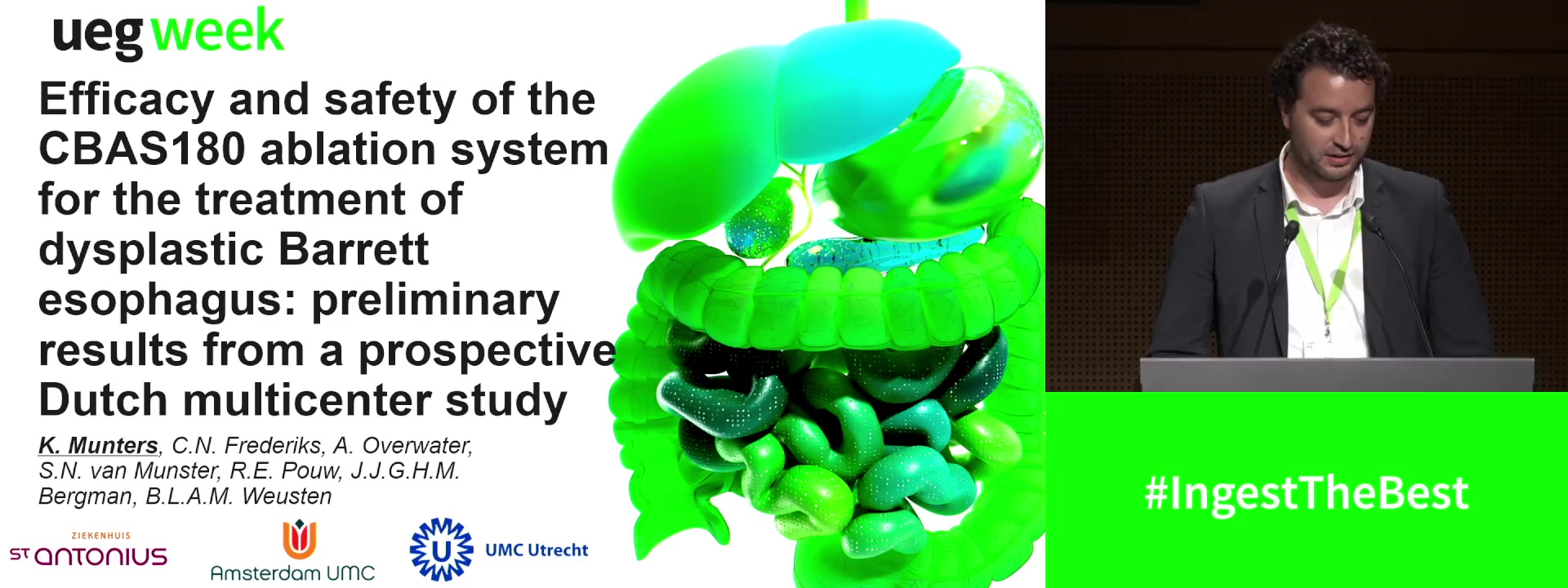
EFFICACY AND SAFETY OF CRYOBALLOON180 ABLATION FOR THE TREATMENT OF DYSPLASTIC BARRETT ESOPHAGUS: PRELIMINARY RESULTS FROM A PROSPECTIVE MULTICENTER STUDY
Koen Munters 1, Charlotte N. Frederiks 2, Anouk Overwater 2, Roos E. Pouw 3, Jacques J. Bergman 4, Sanne van Munster 5, Bas L.A.M. Weusten 2
1 St. Antonius Hospital, Nieuwegein, Netherlands|||UMC Utrecht, Utrecht, Netherlands
2 UMC Utrecht, Utrecht, Netherlands|||St. Antonius Hospital, Nieuwegein, Netherlands
3 Amsterdam UMC, Amsterdam, Netherlands
4 Academic Medical Centre, Amsterdam, Netherlands
5 St. Antonius Hospital, Nieuwegein, Netherlands|||Academic Medical Centre, Amsterdam, Netherlands
Event
Topics
Submission format
Citation
Published
Log in to access this content.
Free for all myUEG account holders. Your access level is set automatically based on your occupation. Medical professionals get full access to all content. If you are a non-medical user, you can only access UEG Week content from congresses you attended.
Not sure what you can access? Learn more about account types.
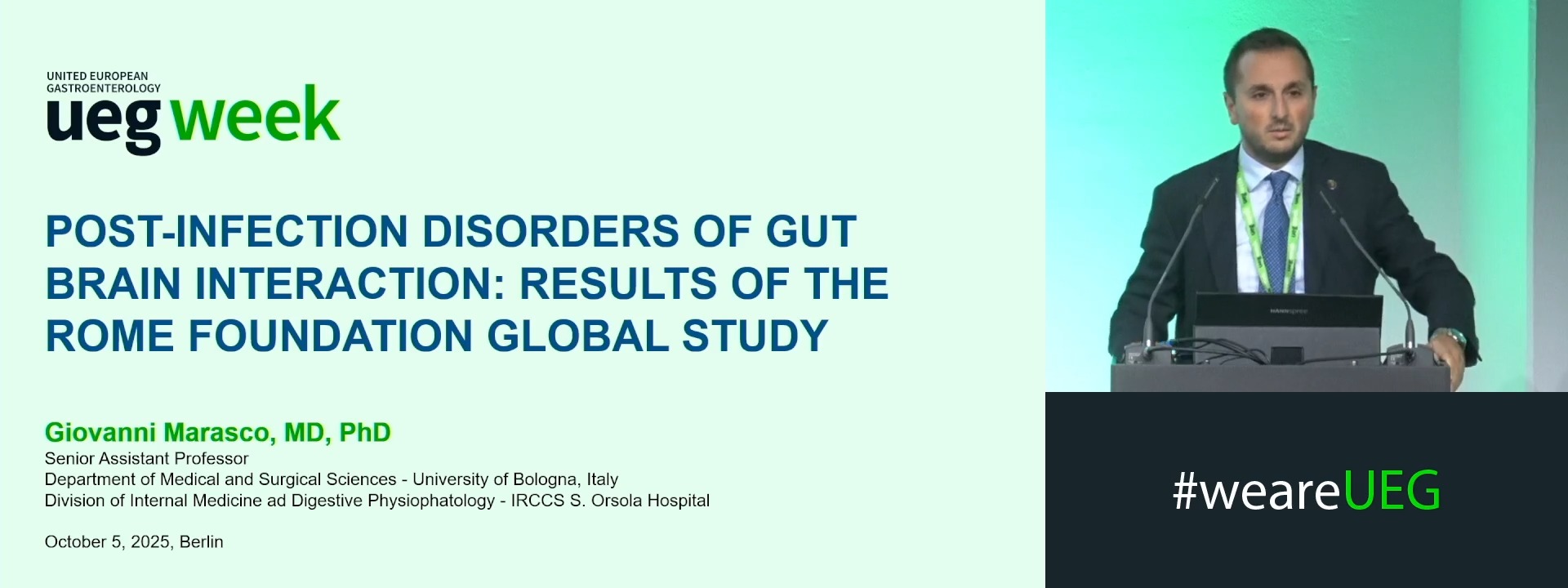
POST-INFECTION DISORDERS OF GUT BRAIN INTERACTION: RESULTS OF THE ROME FOUNDATION GLOBAL STUDY
Giovanni Marasco 1, Max Julio Schmulson Wasserman 2, Uday C. Ghoshal 3, Rutaba Khatun 4, Shrikant I. Bangdiwala 5, Olafur S. Palsson 6, Ami D. Sperber 7, Giovanni Barbara 1
1 University of Bologna, Bologna, Italy
2 Universidad Nacional Autónoma de México (UNAM), Mexico City, Mexico
3 Sanjay Gandhi Postgraduate Institute of Medical Sciences, Lucknow, India
4 McMaster University, Hamilton, Canada|||McMaster University, Hamilton, Canada
5 McMaster University, Hamilton, Canada
6 University of North Carolina, Chapel Hill, Chapel Hill, NC, United States
7 Ben-Gurion University of the Negev, Farod, Israel
Event
Submission format
Session
Citation
Published
Log in to access this content.
Free for all myUEG account holders. Your access level is set automatically based on your occupation. Medical professionals get full access to all content. If you are a non-medical user, you can only access UEG Week content from congresses you attended.
Not sure what you can access? Learn more about account types.
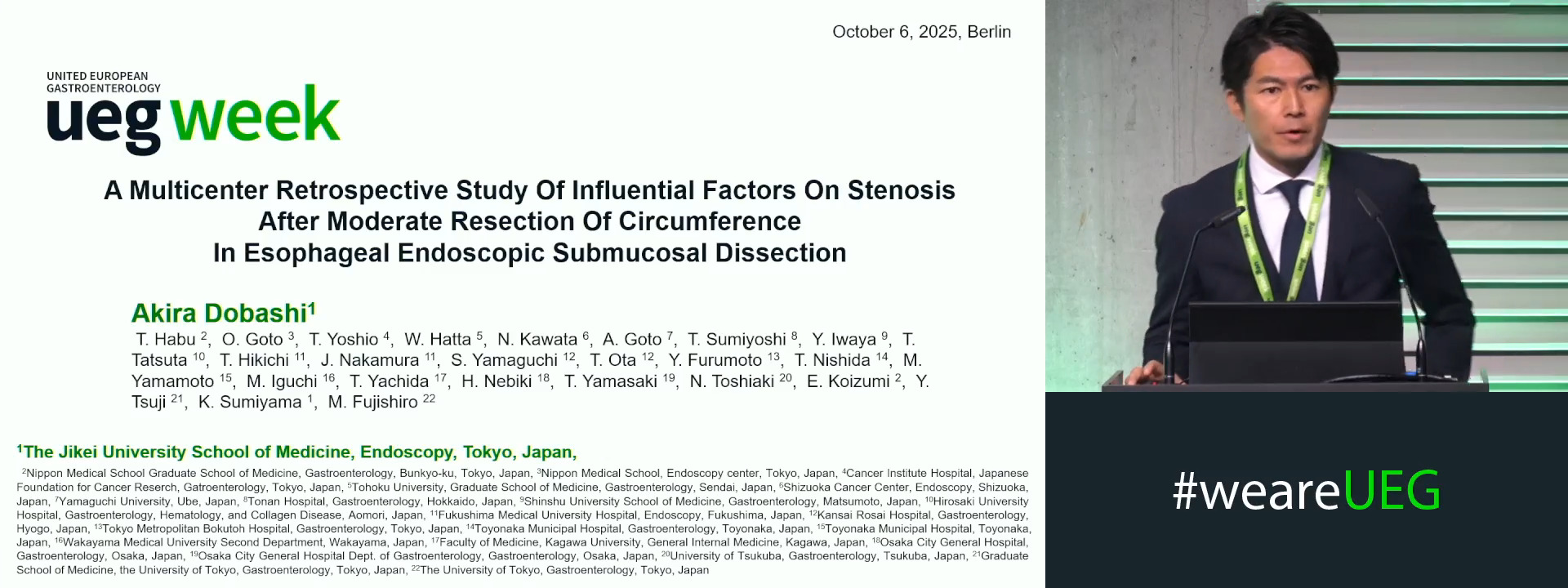
A MULTICENTER RETROSPECTIVE STUDY OF INFLUENTIAL FACTORS ON STENOSIS AFTER MODERATE RESECTION OF CIRCUMFERENCE IN ESOPHAGEAL ENDOSCOPIC SUBMUCOSAL DISSECTION
Akira Dobashi 1, Tsugumi Habu 2, Osamu Goto 3, Toshiyuki Yoshio 4, Waku Hatta 5, Noboru Kawata 6, Atsushi Goto 7, Unknown Unknown 8, Yugo Iwaya 9, Tetsuya Tatsuta 10, Takuto Hikichi 11, Jun Nakamura 11, Shinjiro Yamaguchi 12, Takashi Ohta 12, Yohei Furumoto 13, Tsutomu Nishida 14, Masashi Yamamoto 14, Mikitaka Iguchi 15, Tatsuo Yachida 16, Hiroko Nebiki 17, Tomoaki Yamasaki 17, Toshiaki Narasaka 18, Eriko Koizumi 2, Yosuke Tsuji 19, Kazuki Sumiyama 1, Mitsuhiro Fujishiro 19
1 The Jikei University School of Medicine, Tokyo, Japan
2 Nippon Medical School Graduate School of Medicine, Bunkyo-ku, Tokyo, Japan
3 Nippon Medical School, Tokyo, Japan
4 Cancer Institute Hospital, Japanese Foundation for Cancer Reserch, Tokyo, Japan
5 Tohoku University, Graduate School of Medicine, Sendai, Japan
6 Shizuoka Cancer Center, Shizuoka, Japan
7 Yamaguchi University Graduate School of Medicine, Ube, Japan
8 Tonan Hospital, Hokkaido, Japan
9 Shinshu University School of Medicine, Matsumoto, Japan
10 Hirosaki University Hospital, Aomori, Japan
11 Fukushima Medical University Hospital, Fukushima, Japan
12 Kansai Rosai Hospital, Hyogo, Japan
13 Tokyo Metropolitan Bokutoh Hospital, Tokyo, Japan
14 Toyonaka Municipal Hospital, Toyonaka, Japan
15 Wakayama Medical University, Wakayama, Japan
16 Faculty of Medicine, Kagawa University, Kagawa, Japan
17 Osaka City General Hospital, Osaka, Japan
18 University of Tsukuba, Tsukuba, Japan
19 The University of Tokyo, Tokyo, Japan
Event
Topics
Submission format
Citation
Published
Log in to access this content.
Free for all myUEG account holders. Your access level is set automatically based on your occupation. Medical professionals get full access to all content. If you are a non-medical user, you can only access UEG Week content from congresses you attended.
Not sure what you can access? Learn more about account types.

THE IMPACT OF THE TIF PROCEDURE ON ESOPHAGEAL MANOMETRY RESULTS: A PROSPECTIVE CONTROLLED STUDY
1 IBHOH, Ras Al-Khiemah, United Arab Emirates
Conference
Topics
Submission format
Citation
Published
Log in to access this content.
Free for all myUEG account holders. Your access level is set automatically based on your occupation. Medical professionals get full access to all content. If you are a non-medical user, you can only access UEG Week content from congresses you attended.
Not sure what you can access? Learn more about account types.
EFFECTIVENESS AND ADVERSE EVENTS OF HELICOBACTER PYLORI TREATMENT REGIMENS: AN ELEVEN-YEAR PROSPECTIVE COHORT STUDY
Rita Regatia 1, Maria Inês Viegas 1, Sandra Saraiva 1, Miguel Areia 1, Mara Costa 1, Luís Elvas 1, Susana Alves 1, Daniel Brito 1, Teresa Cadime 1
1 Portuguese Oncology Institute of Coimbra, Coimbra, Portugal
Conference
Topics
Submission format
Citation
Published
Log in to access this content.
Free for all myUEG account holders. Your access level is set automatically based on your occupation. Medical professionals get full access to all content. If you are a non-medical user, you can only access UEG Week content from congresses you attended.
Not sure what you can access? Learn more about account types.
PREVALENCE OF PRIMARY CLARITHROMYCIN, METRONIDAZOLE AND LEVOFLOXACIN RESISTANCE IN PATIENTS INFECTED WITH HELICOBACTER PYLORI IN EUROPE: A REVIEW OF THE LAST FOUR DECADES
1 Instituto de Investigación Sanitaria Biodonostia, Hospital Universitario Donostia-San Sebastián, and Centro de Investigación Biomédica en Red de Enfermedades Hepáticas y Digestivas (CIBERehd), San Sebastián, Spain
2 Department of Gastroenterology, Hospital Universitario de La Princesa, Instituto de Investigación Sanitaria Princesa (IIS-Princesa), Universidad Autónoma de Madrid (UAM), Madrid, Spain
Conference
Topics
Submission format
Citation
Published
Log in to access this content.
Free for all myUEG account holders. Your access level is set automatically based on your occupation. Medical professionals get full access to all content. If you are a non-medical user, you can only access UEG Week content from congresses you attended.
Not sure what you can access? Learn more about account types.
INCIDENCE OF HELICOBACTER PYLORI AND PRECANCEROUS LESIONS IN A TERTIARY CENTRE IN TRANSYLVANIA REGION
1 University of Medicine, Pharmacy, Science and Technology, GE Palade, Emmergency Hospital, Targu-Mures, Romania
Conference
Topics
Submission format
Session