UEG's content platform for gastroenterology education bringing recordings, courses, guidelines, and more together in one place.
Trending on Gutflix
Rate for better recommendations!
Your feedback helps us show you more of what you like and less of what you dislike!
Log in to continue.
This content is part of Gutflix. Log in with your myUEG account, or create one free, to watch it.
Not sure what you can access? Learn more about account types.
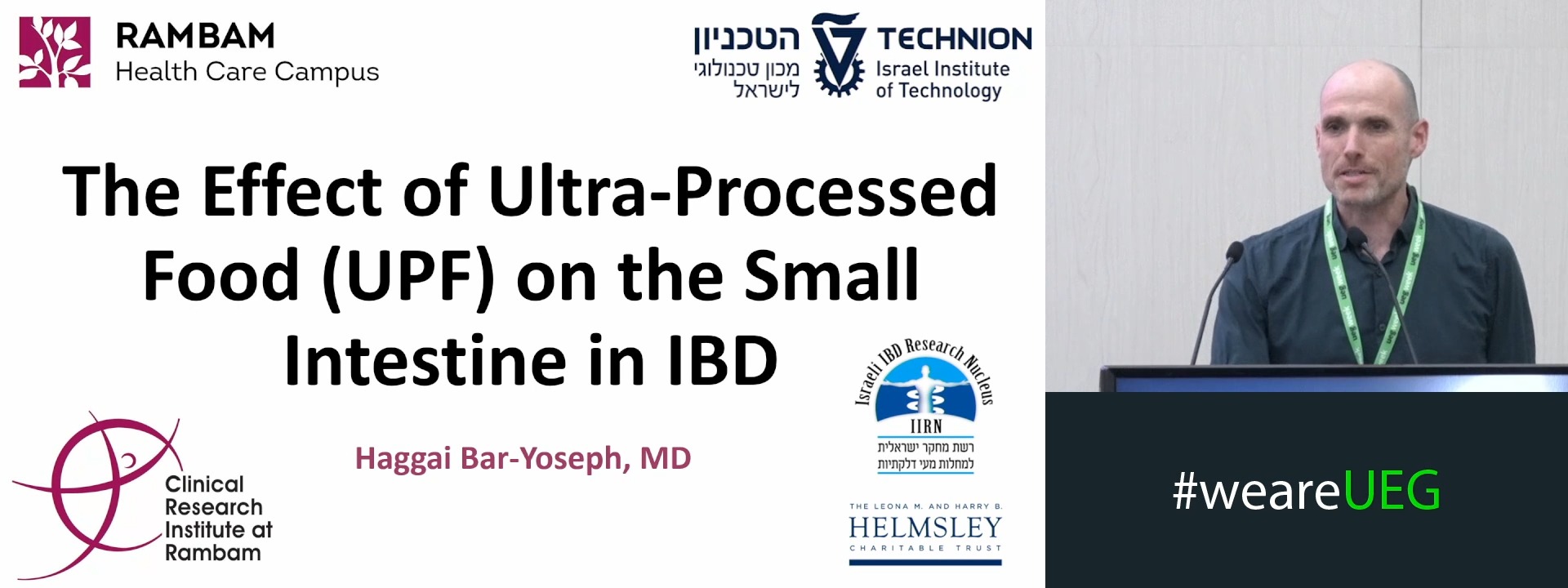
GOING DEEP: THE EFFECT OF ULTRA-PROCESSED FOODS ON THE SMALL INTESTINE, A PILOT STUDY ON ILEOSTOMY PATIENTS
Haggai Bar-Yoseph 1,2, Zohar Leshinsky 1, Yuval Molcho 1, Jonathan Sahar 2, Julia Belansky 2, Neta Milman 2, Tal Gefen 2, Alexandra Blatt 1, Sigal Pressman 1, Tarek Arraf 1, Rabiaa Fared 1, Inbar Kesten 1, Haim Gilshtein 1, Timothy Cooper 2, Maria Postnikov 1, Naama Geva-Zatorsky 2, Shai Shen-Orr 2, Yehuda Chowers 3
Affiliations
1 Rambam Health Care Campus, Haifa, Israel
2 Technion - Israel Institute of Technology, Haifa, Israel
3 CytoReason, Tel Aviv, Israel
Log in to continue.
This content is part of Gutflix. Log in with your myUEG account, or create one free, to watch it.
Not sure what you can access? Learn more about account types.
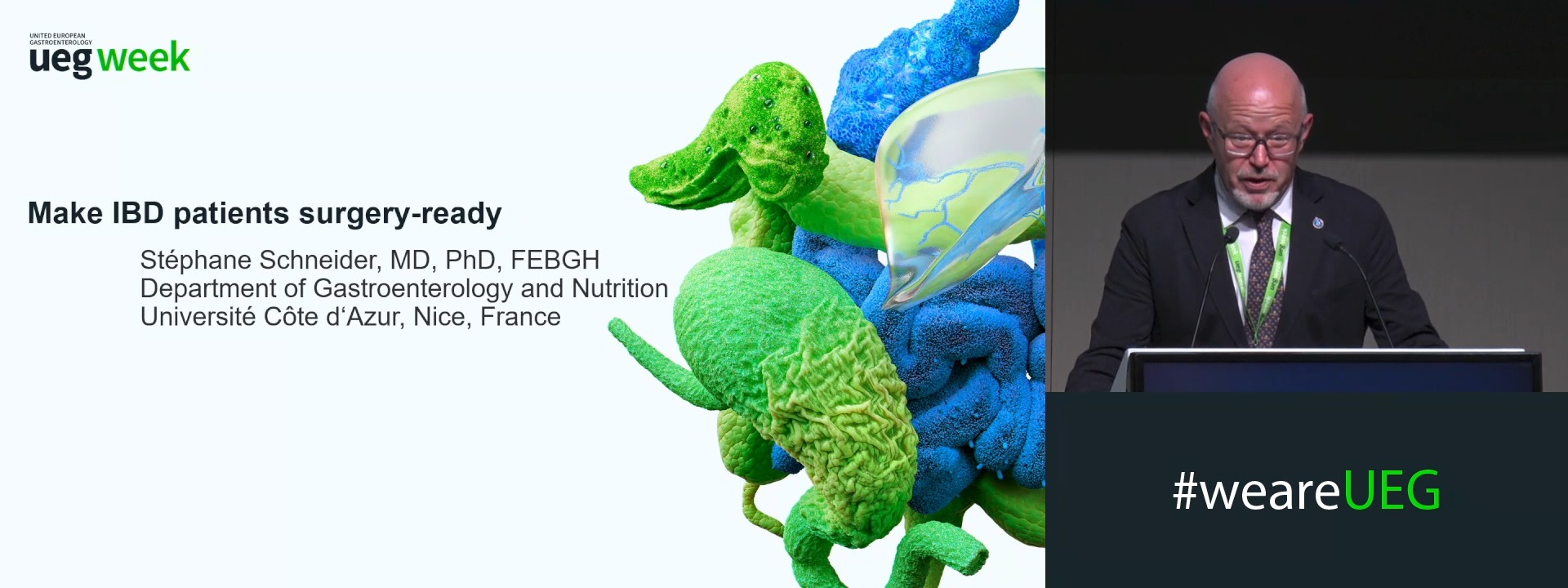
Make IBD patients surgery ready
Affiliations
1 CHU de Nice - Archet, Nice, France
Log in to continue.
This content is part of Gutflix. Log in with your myUEG account, or create one free, to watch it.
Not sure what you can access? Learn more about account types.
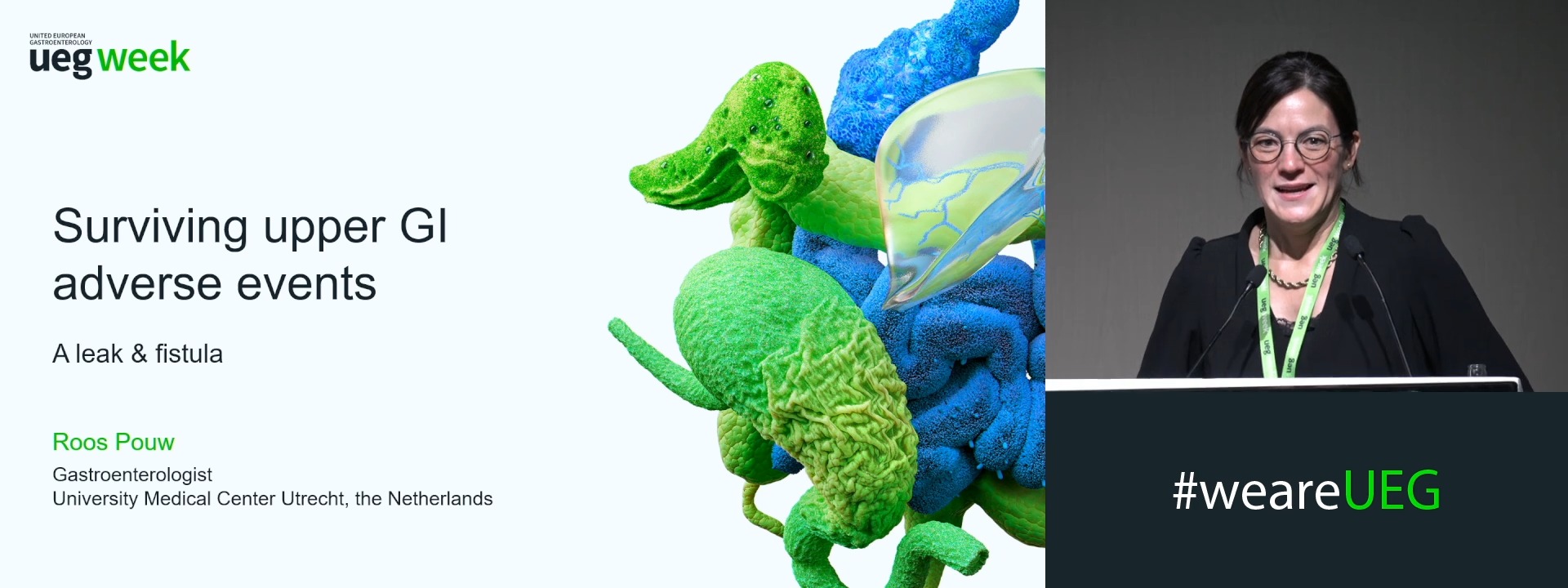
Surviving upper GI adverse events (Complete Session)
Log in to continue.
This content is part of Gutflix. Log in with your myUEG account, or create one free, to watch it.
Not sure what you can access? Learn more about account types.
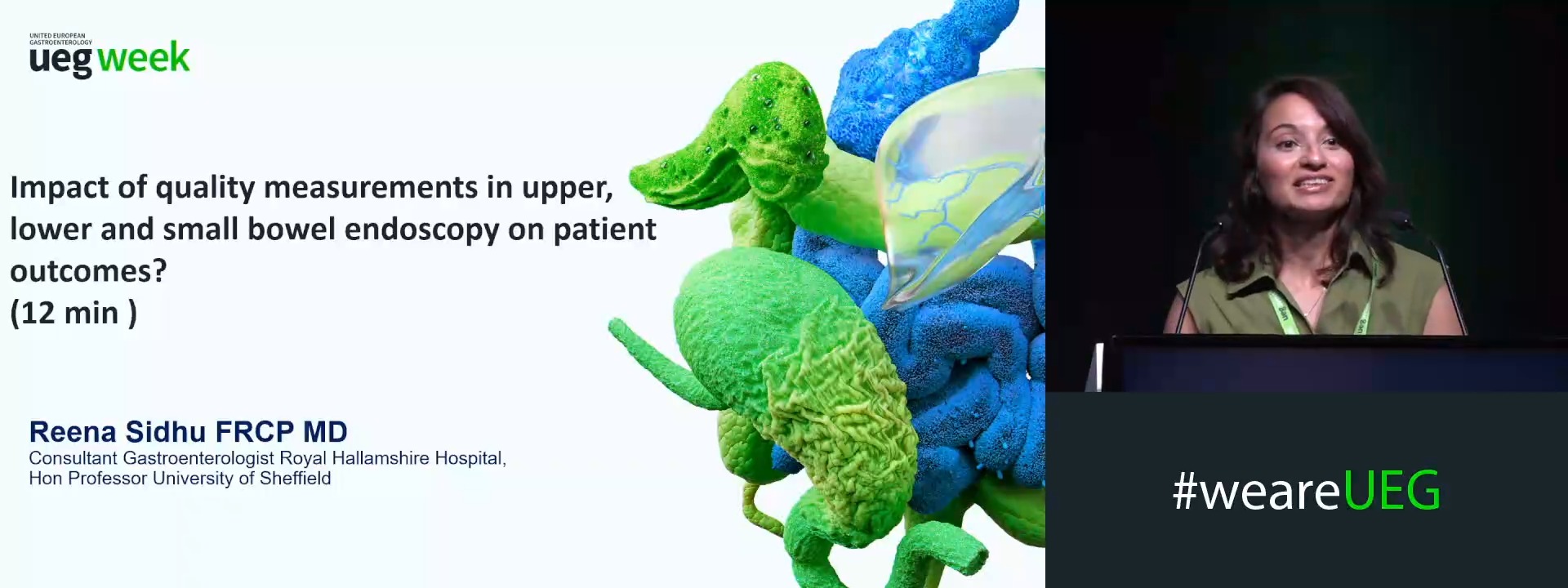
Impact of quality measurements in upper, lower and small bowel endoscopy on patient outcomes?
Affiliations
1 Royal Hallamshire Hospital , Sheffield Teaching Hospitals, Sheffield, United Kingdom
Log in to continue.
This content is part of Gutflix. Log in with your myUEG account, or create one free, to watch it.
Not sure what you can access? Learn more about account types.
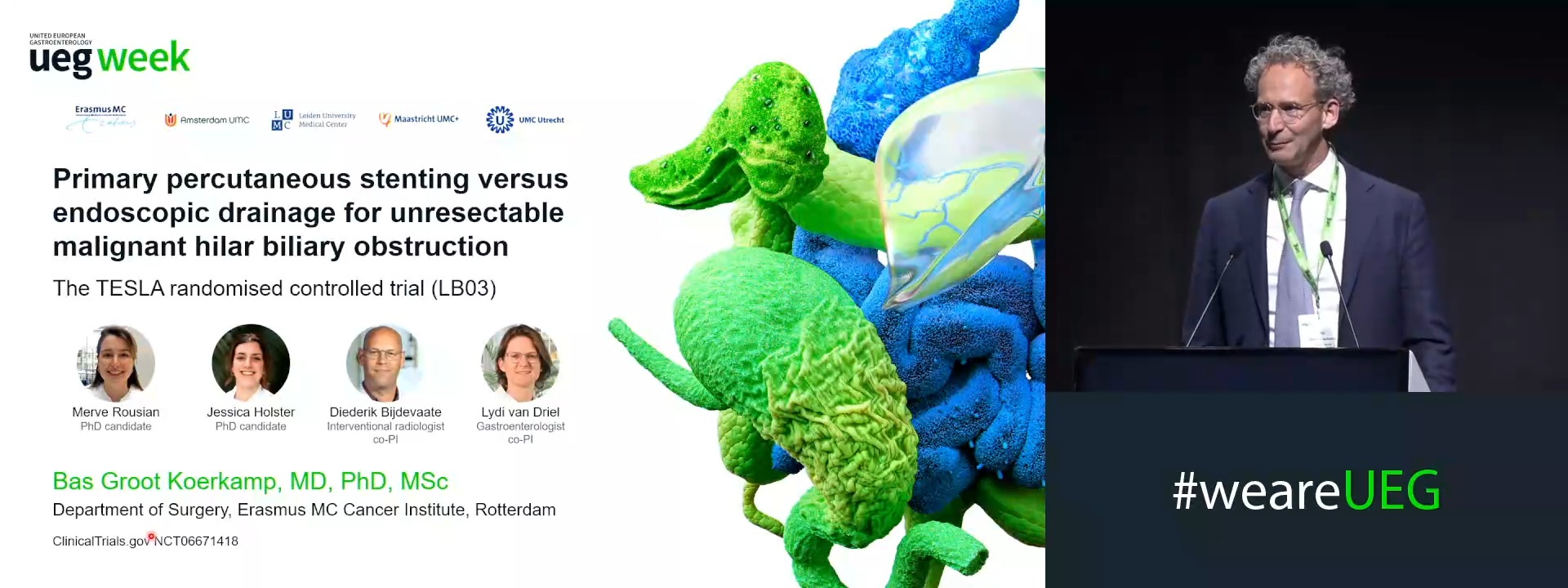
PRIMARY PERCUTANEOUS STENTING VERSUS ENDOSCOPIC DRAINAGE FOR UNRESECTABLE MALIGNANT HILAR BILIARY OBSTRUCTION: A MULTICENTER RANDOMIZED CONTROLLED TRIAL, THE TESLA RCT
Merve Rousian 1, Jessica Holster 1, Victorien M. T. van Verschuer 2, Stijn Franssen 3, Andries E. Braat 2, Joep de Bruijne 3, Marc C. Burgmans 2, Otto M. van Delden 4, Maxime Dewulf 5, Joris I. Erdmann 6, Jeroen Hagendoorn 3, Akin Inderson 2, Christiaan van der Leij 5, Jan Werner Poley 5, Maarten L. J. Smits 3, Rogier P. Voermans 6, Ijsbrand A. J. Zijlstra 4, Bronno van der Holt 1, Diederik C. Bijdevaate 1, Behnam Mohseny 1, Lydi van Driel 7, Bas Groot Koerkamp 8
Affiliations
1 Erasmus MC Cancer Institute, Rotterdam, Netherlands
2 Leiden University Medical Center, Leiden, Netherlands
3 University Medical Center Utrecht, Utrecht, Netherlands
4 Academic Medical Center (AMC), Amsterdam, Netherlands
5 Maastricht University Medical Center, Maastricht, Netherlands
6 Amsterdam University Medical Center, Amsterdam, Netherlands
7 Erasmus Medical Center, Schiedam, Netherlands
8 Erasmus MC University Medical Center, Rotterdam, Netherlands
Log in to continue.
This content is part of Gutflix. Log in with your myUEG account, or create one free, to watch it.
Not sure what you can access? Learn more about account types.
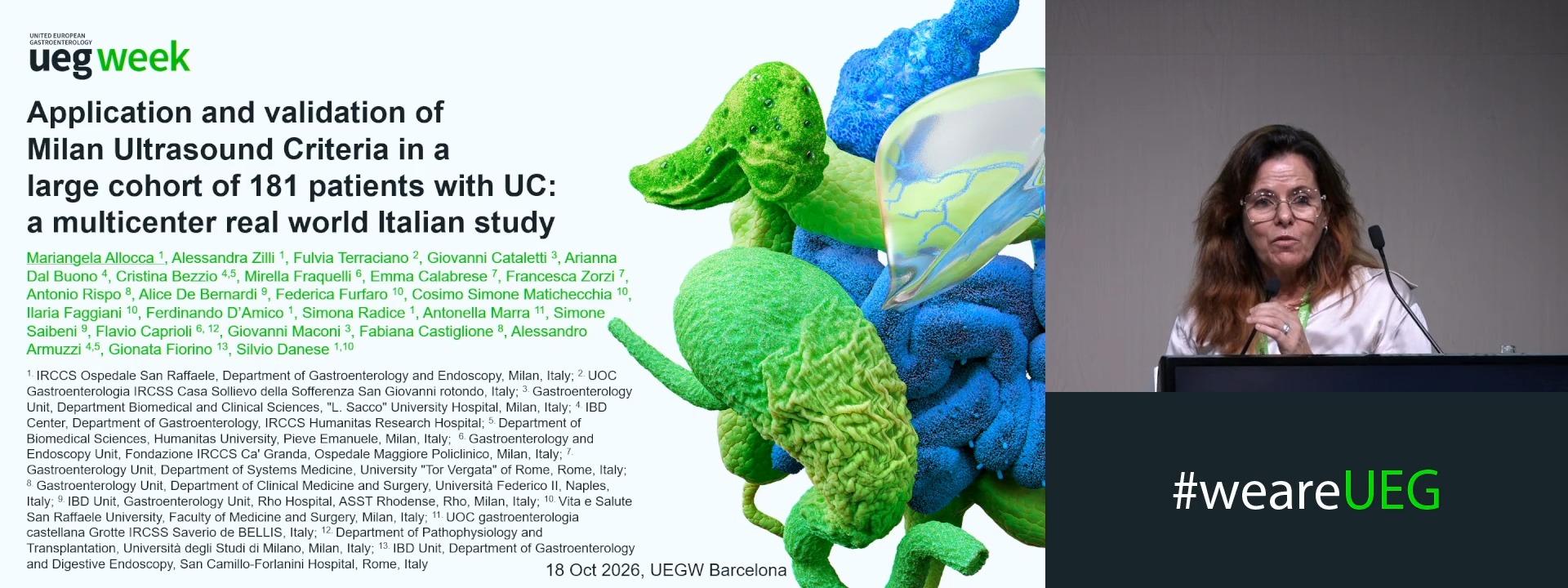
APPLICATION AND VALIDATION OF MILAN ULTRASOUND CRITERIA IN A LARGE COHORT OF 181 PATIENTS WITH ULCERATIVE COLITIS: A MULTICENTER REAL WORLD ITALIAN STUDY
Mariangela Allocca 1, Alessandra Zilli 1, Fulvia Terracciano 2, Giovanni Cataletti 3, Arianna Dal Buono 4, Cristina Bezzio 4, Mirella Fraquelli 5, Emma Calabrese 6, Francesca Zorzi 6, Antonio Rispo 7, Alice De Bernardi 8, Federica Furfaro 1, Cosimo Simone Matichecchia 9, Ilaria Faggiani 1, Ferdinando D'Amico 1, Simona Radice 4, Antonella Marra 10, Simone Saibeni 8, Flavio Caprioli 5, Giovanni Maconi 11, Fabiana Castiglione 7, Alessandro Armuzzi 4, Gionata Fiorino 12, Silvio Danese 1
Affiliations
1 IRCCS Hospital San Raffaele and University Vita-Salute San Raffaele, Milano, Italy
2 Casa Sollievo Della Sofferenza, San Giovanni Rotondo, Italy
3 Department Biomedical and Clinical Sciences, "L. Sacco" University Hospital, Milan, Italy
4 IRCCS Humanitas Research Hospital, Rozzano, Milan, Italy
5 Fondazione IRCCS Ca' Granda, Ospedale Maggiore Policlinico, Milano, Italy
6 University of Rome Tor Vergata, Rome, Italy
7 University ´´Federico II´´of Naples, Naples, Italy
8 ASST Rhodense, Rho, Italy
9 Vita e Salute San Raffaele University, Milan, Italy
10 IRCSS Saverio de BELLIS, Castellana Grotte, Italy
11 Luigi Sacco University Hospital Gastroenterology Unit Biomed and Clinical Sciences, Milan, Italy
12 San Camillo-Forlanini Hospital, Rome, Italy