UEG's educational platform for gastroenterology education bringing recordings, courses, guidelines, and more together in one place.
Most popular content
Rate for better recommendations!
Your feedback helps us show you more of what you like and less of what you dislike!
Log in to access this content.
Free for all myUEG account holders. Your access level is set automatically based on your occupation. Medical professionals get full access to all content. If you are a non-medical user, you can only access UEG Week content from congresses you attended.
Not sure what you can access? Learn more about account types.
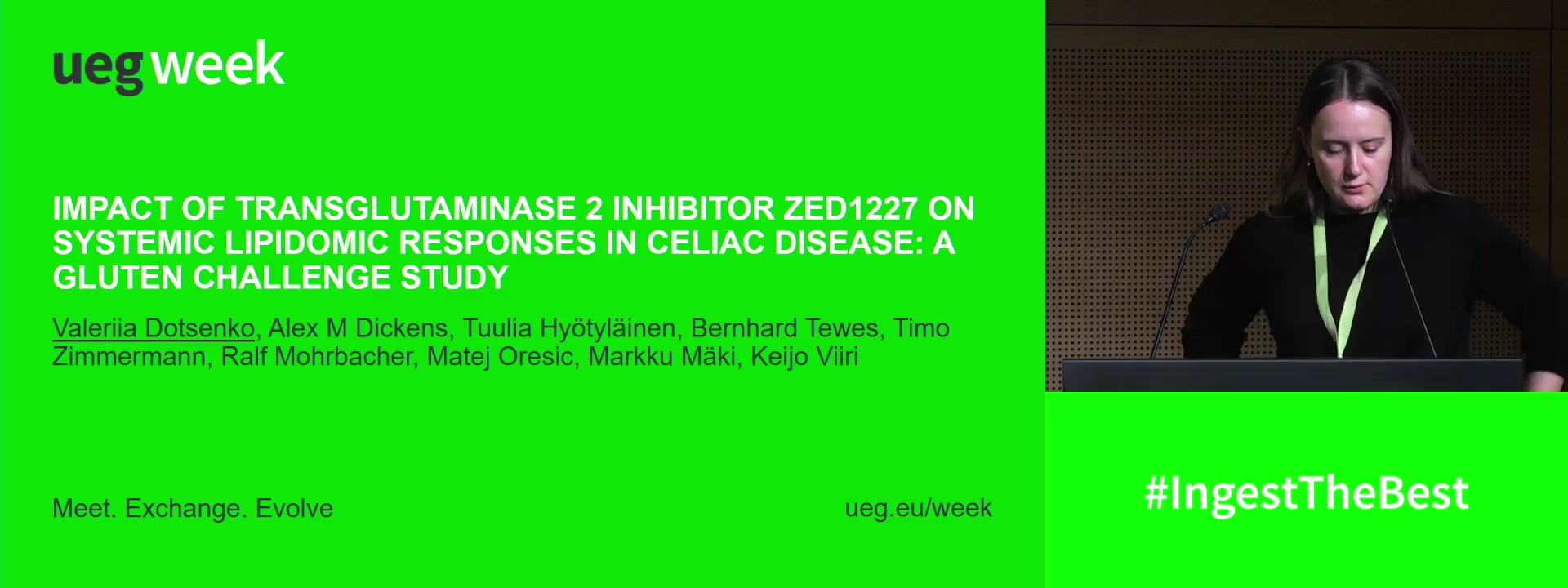
IMPACT OF TRANSGLUTAMINASE 2 INHIBITOR ZED1227 ON SYSTEMIC LIPIDOMIC RESPONSES IN CELIAC DISEASE: A GLUTEN CHALLENGE STUDY
Valeriia Dotsenko 1, Alex Dickens 2, Tuulia Hyötyläinen 3, Bernhard Tewes 4, Timo Zimmermann 4, Ralf Mohrbacher 4, Matej Oresic 5, Markku Mäki 1, Keijo Viiri 1
1 Tampere University and Tampere University hospital, Tampere, Finland
2 University of Turku and Åbo Akademi University, Turku, Finland
3 Örebro University, Örebro, Sweden
4 Dr. Falk Pharma GmbH, Freiburg, Germany
5 University of Turku and Åbo Akademi University, Turku, Finland|||Örebro University, Örebro, Sweden
Event
Submission format
Session
Citation
Published
Log in to access this content.
Free for all myUEG account holders. Your access level is set automatically based on your occupation. Medical professionals get full access to all content. If you are a non-medical user, you can only access UEG Week content from congresses you attended.
Not sure what you can access? Learn more about account types.
Log in to access this content.
Free for all myUEG account holders. Your access level is set automatically based on your occupation. Medical professionals get full access to all content. If you are a non-medical user, you can only access UEG Week content from congresses you attended.
Not sure what you can access? Learn more about account types.
Best of UEG Week - IBD
1 Bradford Teaching Hospitals NHS trust, Leeds, United Kingdom
2 Klinikum der LMU München-Grosshadern, München, Germany
3 Cambridge University Hopsital NHS Foundation Trust, Cambridge, United Kingdom
Topics
Published
Log in to access this content.
Free for all myUEG account holders. Your access level is set automatically based on your occupation. Medical professionals get full access to all content. If you are a non-medical user, you can only access UEG Week content from congresses you attended.
Not sure what you can access? Learn more about account types.
Log in to access this content.
Free for all myUEG account holders. Your access level is set automatically based on your occupation. Medical professionals get full access to all content. If you are a non-medical user, you can only access UEG Week content from congresses you attended.
Not sure what you can access? Learn more about account types.
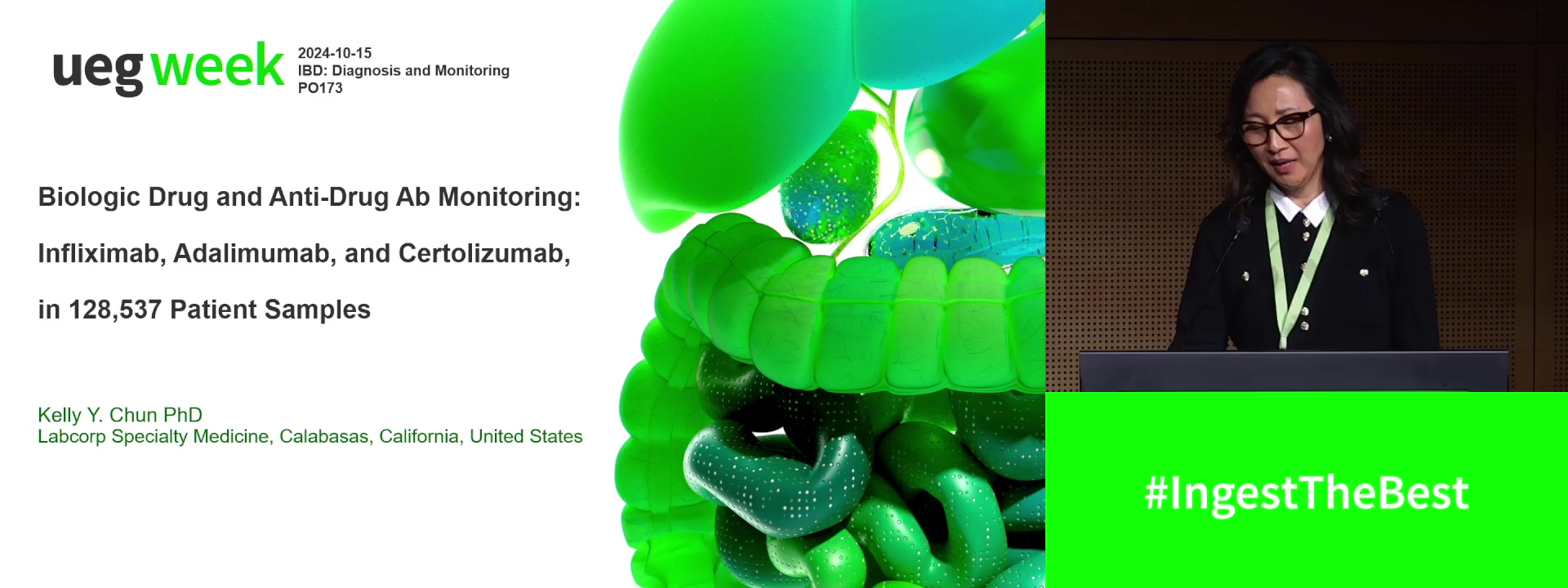
BIOLOGIC DRUG AND ANTI-DRUG ANTIBODY MONITORING: TNF INHIBITORS, INFLIXIMAB, ADALIMUMAB, AND CERTOLIZUMAB PEGOL, IN 128,537 PATIENT SAMPLES
1 Labcorp, Calabasas, United States
Event
Submission format
Session
Citation
Published
Log in to access this content.
Free for all myUEG account holders. Your access level is set automatically based on your occupation. Medical professionals get full access to all content. If you are a non-medical user, you can only access UEG Week content from congresses you attended.
Not sure what you can access? Learn more about account types.

THE FRENCH CONSENSUS ON IDIOPATHIC GASTROPARESIS IN ADULTS AND CHILDREN
Heithem Soliman 1, Fabien Wuestenberghs 2, Madeleine Aumar 3, Charlène Brochard 4, Marion Chambaz 4, Benoit Coffin 5, Charlotte Desprez 6, Pauline Jouet 2, Hélène Lengliné 7, gilles macaigne 8, Chloé Melchior 9, Francois Mion 10, Sabine Roman 11, Alberto Zalar 12, Frank Zerbib 13, Nicolas Caron 14, Guillaume Gourcerol 15
1 Hôpital Louis Mourier - AP-HP, Colombes, France
2 APHP, Avicenne Hospital, Sorbonne Paris Nord University, Bobigny, France
3 CHU Lille, Lille, France
4 CHU Rennes, Rennes, France
5 Hopital Louis Mourier, Colombes, France
6 Rouen University Hospital, Rouen, France
7 AP-HP, Robert Debré Hospital, Paris, France
8 GHI Le Raincy Montfermeil, Montfermeil, France
9 Rouen University Hospital, INSERM U1073, CIC-CRB-1404, Rouen, France
10 Hospices Civils de Lyon, Lyon, France
11 Hôpital Edouard Herriot, Lyon, France
12 Cabinet Medical, Rouen, France
13 CHU de Bordeaux - Hôpital Haut Leveque, Pessac, France
14 CHU Lyon, Hospices Civils de Lyon, Lyon, France
15 CHU Rouen Hopital C. Nicolle, Rouen Cedex, France
Conference
Topics
Submission format
Citation
Published
Log in to access this content.
Free for all myUEG account holders. Your access level is set automatically based on your occupation. Medical professionals get full access to all content. If you are a non-medical user, you can only access UEG Week content from congresses you attended.
Not sure what you can access? Learn more about account types.
The future of immunotherapy → are surgeons obsolete soon? with Jeroen Dekervel
Topics