Introduction
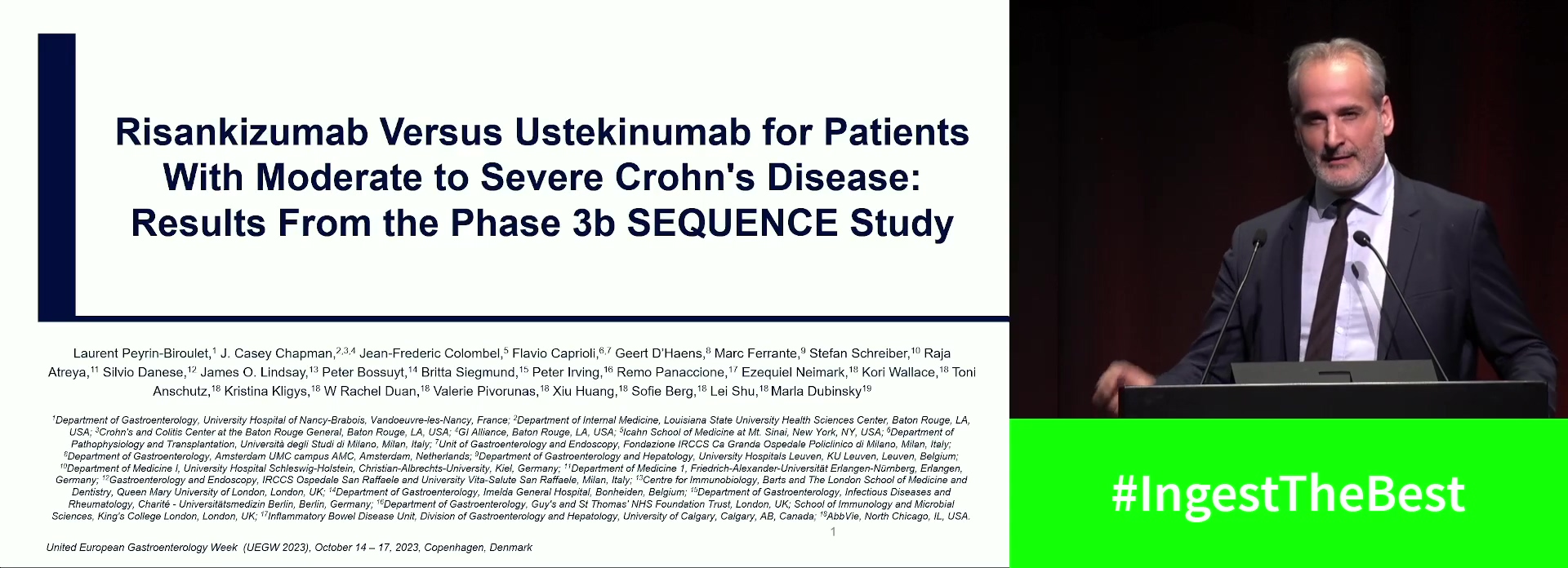
Inhibition of interleukin (IL)-23 has been demonstrated as a safe and effective mechanism of action for treating various chronic inflammatory diseases, including Crohn's disease (CD). The phase 3b SEQUENCE study directly compared the efficacy and safety of risankizumab (RZB), a selective IL-23 p19 subunit inhibitor, and ustekinumab (UST), an IL-12/IL-23 p40 subunit inhibitor, in patients (pts) with moderate to severe CD.
Aims & Methods
SEQUENCE, an open-label, multicenter, randomized, efficacy assessment-blinded study, enrolled pts who previously failed ≥1 anti-TNF therapies and had a CD Activity Index score of 220-450, Simple Endoscopic Score for CD ≥6 for ileocolonic or colonic disease (≥4 for isolated ileal disease) excluding the presence of narrowing component, plus an average (avg) daily stool frequency ≥4 and/or avg daily abdominal pain score ≥2. In Part 1 of the trial, described herein, pts were randomized 1:1 to receive RZB (600 mg IV induction dosing at baseline [BL], weeks [wks] 4 and 8, followed by 360 mg SC maintenance dosing every 8 wks [Q8w] starting at wk12) or UST (a single weight-based IV induction dose, followed by 90 mg SC maintenance dosing Q8w starting at wk8) over a period of 48 wks.1 Randomization was stratified by number of anti-TNF therapies failed (1, >1) and steroid use at BL (Y, N). A mandatory steroid taper started at wk2. Two primary endpoints were clinical remission at wk24 (non-inferiority of RZB vs UST in 50% of planned subjects) and endoscopic remission at wk48 (superiority of RZB vs UST). Ranked secondary endpoints included clinical remission at wk48, endoscopic response at wks 48 and 24, steroid-free (SF) endoscopic remission at wk48, and SF clinical remission at wk48 (all tested for superiority of RZB vs UST). Safety was assessed throughout the trial.
Results
Variable
| RZB
N=255
n/N (%)
| UST
N=265
n/N (%)
| Treatment Difference
RZB – UST
% [95% CI]
|
Primarya
1. Clinical remission
at wk 24 (ITT-1Hb)
2. Endoscopic remission
at wk 48 (ITT-1d)
Ranked Secondarya,d
1. Clinical remission
at wk 48
2. Endoscopic response
at wk 48
3. Endoscopic response
at wk 24
4. Steroid-free endoscopic remission
at wk 48
5. Steroid-free clinical remission at
wk 48
|
75/128 (58.6%)
81/255 (31.8%)
155/255 (60.8%)
115/255 (45.1%)
115/255 (45.2%)
80/255 (31.4%)
155/255 (60.8%)
|
54/137 (39.5%)
43/265 (16.2%)
108/265 (40.8%)
58/265 (21.9%)
70/265 (26.4%)
41/265 (15.5%)
107/265 (40.4%)
|
Non-inferiorityc met;
18.4 [6.6, 30.3]
15.6 [8.4, 22.9], P<0.0001
19.7 [11.3, 28.1], P<0.0001
23.3 [15.4, 31.2], P<0.0001
18.9 [10.9, 26.9], P<0.0001
15.9 [8.8, 23.1], P<0.0001
20.1 [11.7, 28.4], P<0.0001
|
Treatment Emergent Adverse Events (AEs)e
| RZB
N=262
PYs = 257.6
Events (E/100PYs)f
| UST
N=265
PYs = 269.9
Events (E/100PYs)f
| Treatment Difference
RZB – UST
% [95% CI]
|
All TEAEs
Investigator-defined drug-related AEg,h
Severe AE
Serious AE
AEs leading to study drug discontinuation
Death
Adverse Events of Special Interest
Adjudicated MACE/Extended MACEi
Serious infections
Active tuberculosis
Opportunistic infections excluding
tuberculosis and herpes zosterj
Herpes zoster
Malignant tumoursk
Non-melanoma skin cancer (NMSC)
Malignancies excluding NMSC
Hypersensitivity
Serious hypersensitivity
Adjudicated anaphylactic reaction
Hepatic events
Injection site reactions
| 879 (341.2)
167 (64.8)
60 (23.3)
36 (14.0)
10 (3.9)
0
0
10 (3.9)
0
1 (0.4)
1 (0.4)
1 (0.4)
1 (0.4)
0
37 (14.4)
0
0
26 (10.1)
5 (1.9)
| 763 (282.7)
111 (41.1)
82 (30.4)
64 (23.7)
14 (5.2)
0
1 (0.4)
14 (5.2)
0
0
1 (0.4)
1 (0.4)
0
1 (0.4)
32 (11.9)
0
0
23 (8.5)i
8 (3.0)
| 58.5 (28.3, 88.7)
23.7 (11.2, 36.2)
-7.1 (-15.9, 1.7)
-9.7 (-17.1, -2.4)
-1.3 (-4.9, 2.3)
0
-0.4 (-1.1, 0.4)
-1.3 (-4.9, 2.3)
0
0.4 (-0.4, 1.1)
0.0 (-1.0, 1.1)
0.0 (-1.0, 1.1)
0.4 (-0.4, 1.1)
-0.4 (-1.1, 0.4)
2.5 (-3.7, 8.7)
0
0
1.6 (-3.6, 6.8)
-1.0 (-3.7, 1.6)
|
AE – adverse event; BL - baseline; CD – Crohn’s disease; CDAI – CD activity index; ITT – intention to treat; RZB - risankizumab; PY, patient years; SES-CD, simple endoscopic score for CD; TEAE – treatment emergent AE; UST – ustekinumab; wk, week
Clinical remission – CDAI < 150
Endoscopic remission - SES-CD ≤ 4 and at least a 2-point reduction versus BL and no sub score greater than 1 in any individual variable, as scored by a central reviewer blinded to treatment allocation
Endoscopic response - decrease in SES-CD > 50% from BL (or for pts with isolated ileal disease and a BL SES-CD of 4, at least a 2-point reduction from BL), as scored by central reviewer
Steroid-free endoscopic remission - endoscopic remission and not receiving steroids at the corresponding visit
Steroid-free clinical remission - clinical remission and not receiving steroids at the corresponding visit
*SEQUENCE Part 1 compared the efficacy and safety of RZB versus UST over 48 wks, while Part 2 is an ongoing open-label long-term extension to evaluate the long-term safety of RZB in pts who received RZB in Part 1 and completed wk48 visit.
aCategorical variables were analyzed using Cochran-Mantel-Haenszel (CMH) test. For both the primary and secondary endpoints, the non-responder imputation while incorporating multiple imputation to handle missing data (due to COVID-19 or geopolitical conflict) was used. Primary and secondary endpoints were tested sequentially in the order specified using the CMH risk difference estimate test stratified by the number of failed anti-TNF therapies (1, > 1) and steroid use at baseline (yes, no).
bITT1H population is a subset of ITT-1 population and includes approximately 50% of ITT1 subjects who have opportunity to reach wk24 by the time of the primary analysis of CDAI clinical remission at wk24; non-inferiority of RZB vs. UST
cNon-inferiority test: If the lower limit of 95% confidence interval based on the CMH estimation for the risk difference between RZB and UST groups (RZB – UST) was greater than the negative of 10% noninferiority margin, then noninferiority was demonstrated for clinical remission at wk24. If non-inferiority was demonstrated for clinical remission (CDAI) at Week 24, the superiority for the endoscopic remission at Week 48 was subsequentially tested at two-sided significance level of 0.05 using the CMH test.
dIntent-to-treat-1 (ITT-1) population included all randomized subjects who were randomized to RZB with the selected RZB dose (RZB 600 mg IV followed by RZB 360 mg SC) or UST and who received at least 1 dose of study drug during Part 1 of the study; superiority of RZB vs. UST
eTEAEs are events that begin either on or after the first dose of UST or RZB in Part 1 and until the first dose of study drug (RZB) in Part 2 if the pt is enrolled into the Part 2 or within 140 days after the last dose administration of the study drugs (UST or RZB) in Part 1 if the pt does not participate in Part 2. Only safety data obtained before 12JUL2023 or Week 52 dosing date (the first dose date of Part 2), whichever occurred earlier, are reported here.
fSA1 population includes all pts who received at least 1 dose of study drug during Part 1 of the study.
gAs assessed by investigator
hRZB related: 3 patients with SAEs related to RZB (anal fistula, anal abscess, campylobacter, cystitis, localized infection, genital fistula); 8 patients with SAEs related to UST (abdominal pain, anal fistula, CD, ileal stenosis, vomiting)
iMACE: Major Adverse Cardiovascular Events, defined as cardiovascular death or death due to stroke, non-fatal myocardial infarction, and non-fatal stroke; extended MACE defined as MACE with hospitalization for unstable angina and coronary revascularization procedures
jOpportunistic infection: RZB, oesophageal candidiasis
kMalignant tumor: RZB, squamous cell carcinoma of skin; UST, anal squamous cell carcinoma
iOne case of potential Hy’s Law in the UST treatment group
|
In total, 520 pts were randomized and assessed for efficacy: RZB (N=255) and UST (N=265). The proportion of pts who completed the study was numerically higher with RZB (89.4%) vs UST (74.0%). The two primary endpoints of the study were met. At wk24, in half of the patients enrolled, clinical remission rates were 58.6% (75/128) for RZB and 39.5% (54/137) for UST (Δ18.4 [6.6-30.3], non-inferiority met with the pre-defined margin of 10%) (
Table). At wk48, endoscopic remission rates were 31.8% (81/255) for RZB and 16.2% (43/265) for UST (Δ15.6% [8.4-22.9], P<0.0001 for superiority). RZB was superior to UST for all secondary endpoints (all P<0.0001). Exposure adjusted adverse event (AE) rates (Events [E/100PYs]) were comparable between RZB (879 [341.2]) and UST (763 [282.7]). Rates of serious AEs and AEs leading to study drug discontinuation were numerically higher with UST than RZB (
Table). Rates of serious infections and hepatic events were similar between treatment groups, with no serious hepatic events with RZB. Two cases of malignancy were reported (one in each treatment arm). There was one event of adjudicated MACE with UST. There were no deaths.
Conclusion
In pts with moderate to severe CD who failed anti-TNF therapy, RZB demonstrated non-inferiority to UST in achieving wk24 clinical remission, superiority in achieving wk48 endoscopic remission, and superiority for achieving all secondary endpoints. The safety profiles of RZB and UST were consistent with previously published results.
References
1. Stelara Label [Internet]. Available from: https://www.accessdata.fda.gov/drugsatfda_docs/label/2022/125261s161lbl.pdf
Disclosure
Laurent Peyrin-Biroulet: Fees: Galapagos, AbbVie, Janssen, Genentech, Alimentiv, Ferring, Tillots, Celltrion, Takeda, Pfizer, Index, Sandoz, Celgene, Biogen, SamsungBioepis, Inotrem, Allergan, MSD, Roche, Arena, Gilead, Amgen, BMS, Vifor, Norgine, Mylan, Lilly, Fresenius Kabi, OSEImmunotherapeutics, Enthera, Theravance, Pandion, Gossamer, Viatris, ThermoFisher, ONOPharma, Mopac, Cytoki, Morphic, Prometheus, Applied MolecularTransport; J. Casey Chapman: Consultant: AbbVie, Medtronic; Advisory Board: AbbVie, Pfizer, Takeda; Speaker: AbbVie, BMS, Janssen, Pfizer, Takeda; Jean-Frederic Colombel: Grants: AbbVie, Janssen, Takeda, BMS; Speaking fees: AbbVie, Takeda; Consultant: AbbVie, Amgen, AnaptysBio, Allergan, Arena, BI, BMS, Celgene, Celltrion, Lilly, Ferring, Galmed, GSK, Genentech (Roche), Janssen, Kaleido, Immunic, IterativeScopes, Merck, Landos, Microba Life Science, Novartis, Otsuka, Pfizer, ProtagonistTherapeutics, Sanofi, Takeda, TiGenix, Vifor; Stock options: IntestinalBiotechDevelopment; Flavio Caprioli: Consultant: AbbVie, MSD, Takeda, Janssen, Roche, Celgene, BMS, Galapagos, Gllead, Pfizer, Mundipharma, Galapagos, Biogen; Speaker: AbbVie, Ferring, Takeda, AllergyTherapeutics, Janssen, Pfizer, Biogen; Research grants: Giuliani, Sofar, MSD, Takeda, AbbVie; Geert D’Haens: Advisor: AbbVie, Ablynx, ActiveBiotechAB, AgomabTherapeutics, Alimentiv, Allergan, Alphabiomics, Amakem, Amgen, AMPharma, AppliedMolecularTherapeutics, Arena, AstraZeneca, Biogen, BMS, BI, Celltrion, DSMPharma; Echo, Engene, Exeliom, Ferring, Dr Falk, Galapagos, Genentech/Roche, Gilead, GSK, Gossamerbio, Immunic, J&J, Kintai, Lilly, Lument, Lycera, Medtronic, MSD, MitsubishiTanabe, NovoNordisk, Otsuka, Pfizer, Photopill, ProciseDx, Prodigest, Progenity, Prometheus/Nestlé, Protagonist, RedHill, SamsungBioepis, Sandoz, Seres, Setpoint, Shire, Takeda, Teva, Tillotts, Topivert, Versant, Vifor. Marc Ferrante: Grants: AbbVie, Amgen, Biogen, EG, Janssen, Pfizer, Takeda, Viatris; Consultant: AbbVie, Agomab, BI, Celgene, Celltrion, Lilly, Janssen-Cilag, Medtronic, MSD, Pfizer, Regeneron, SamsungBioepis, Sandoz, Takeda, ThermoFisher; Speaker: AbbVie, Amgen, Biogen, BI, Falk, Ferring, Janssen-Cilag, Lamepro, MSD, Pfizer, Sandoz, Takeda, Truvion, Viatris; Stefan Schreiber: Consultant: AbbVie, Amgen, Arena, BMS, BI, Celltrion, Dr Falk, Ferring, Fresenius, Galapagos, Genentech, Gilead, GSK, IMAB-Biopharma, Janssen, Lilly, Merck, Novartis/Sandoz, Pfizer, Protagonist, Takeda, Theravance. Raja Atreya: Speaker, consultant, or grants: AbbVie, Amgen, Arena, Biogen, BI, BMS, Cellgene, Celltrion, DrFalk, Galapagos, Gilead, InDex, Janssen-Cilag, Lilly, MSD, Novartis, Pandion, Pfizer, Roche, SamsungBioepis, Takeda, Viatris; Silvio Danese: Consultant: AbbVie, Alimentiv, Allergan, Amgen, AstraZeneca, AthosTherapeutics, Biogen, BI, Celgene, Celltrion, Lilly, Enthera, Ferring, Gilead, Hospira, Inotrem, Janssen, J&J, MSD, Mundipharma, Mylan, Pfizer, Roche, Sandoz, Sublimity, Takeda, TiGenix, UCB, and Vifor; Lecture fees: Abbvie, Amgen, Dr Falk, Ferring, Gilead, Janssen, Mylan, Pfizer, Takeda. James O. Lindsay: Consultant/advisory board: AbbVie, AtlanticHealthcare, BMS, Celgene, Celltrion, Lilly, Ferring, Galapagos, Gilead, GSK, Janssen, MSD, Napp, Pfizer, Shire, Takeda, Vifor; Speaker fees/sponsorship: AbbVie, Ferring, Janssen, MSD, Napp, Norgine, Pfizer, Shire, Tillotts, Takeda; Grants: AbbVie, Gilead, Pfizer, Shire, Takeda; Peter Bossuyt: Grants: AbbVie, Amgen, Janssen, Mundipharma, Mylan, Pfizer; Speaker: AbbVie, Celltrion, Janssen, Pfizer, Takeda; Advisory Board: AbbVie, Arena, BMS, Hospira, Janssen, Lilly, Merck, Mundipharma, PentaxMedical, Pfizer, PSI CRO, Roche, Sandoz, Takeda; Britta Siegmund: Consultant: AbbVie, Arena, BI, BMS, Celgene, Falk, Galapagos, Janssen, Lilly, Pfizer, Prometheus, Takeda; Speaker’s fees: AbbVie, CEDServiceGmbH, Falk, Ferring, Janssen, Novartis, Pfizer, Takeda; Peter Irving: Grants/ Fees: Janssen, MSD,Takeda; Personal fees: AbbVie, Arena, Dr. Falk, Lilly, Ferring, Genentech, Hospira, Pfizer, Pharmacosmos, SamsungBioepis, Sandoz, Shire, Tillotts, TopiVert, VHsquared, Vifor, WarnerChilcott. Remo Panaccione: Consultant: AbbVie, Abbott, Alimentiv, Amgen, Arena, AstraZeneca, BMS, BI, Celgene, Celltrion, Cosmos, Eisai, Elan, Ferring, Galapagos, Genentech, Gilead, GSK, Janssen, Lilly, Merck, Mylan, Oppilan, Pandion, Pfizer, Progenity, Protagonist, Roche, Sandoz, Satisfai, Schering-Plough, Shire, Sublimity, Theravance, UCB, Takeda; Speaker: AbbVie, Arena, Celgene, Ferring, Gilead, Janssen, Lilly, Merck, Pfizer, Roche, Sandoz, Shire, and Takeda; Grants: AbbVie, Ferring, Janssen, Pfizer, Takeda; Advisory board: AbbVie, Amgen, Arena, BMS, Celgene, Celltrion, Ferring, Galapagos, Genentech, Gilead, GSK, Janssen, Lilly, Merck, Mylan, Oppilan, Pandion, Pfizer, Sandoz, Shire, Sublimity, Takeda, Theravance. Marla Dubinsky: Consultant: AbbVie, Arena, BMS, Celgene, Lilly, Genentech, Gilead, Janssen, Pfizer, Prometheus, Takeda; Founder/shareholder Trellus Health.
Ezequiel Neimark, Kori Wallace, Toni Anschutz, Kristina Kligys, W Rachel Duan, Valerie Pivorunas, Xiu Huang, Sofie Berg, Lei Shu: AbbVie full-time employees; may own AbbVie stock or options.