Introduction
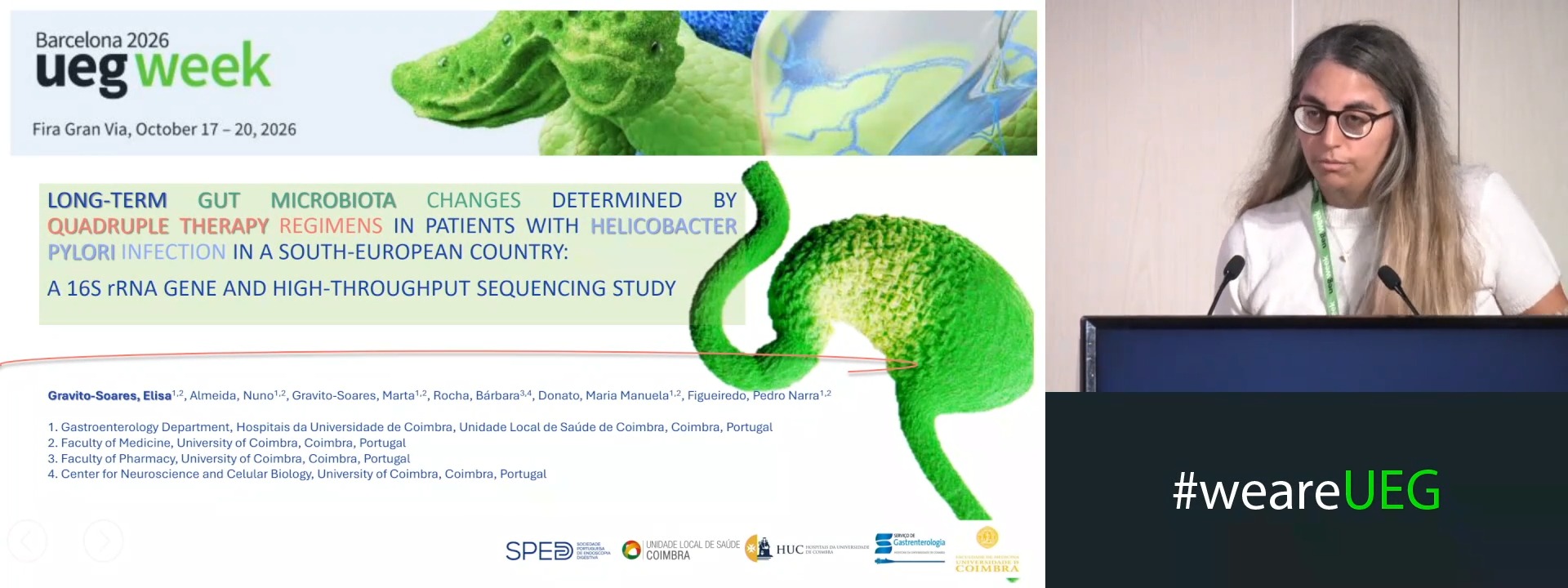
Helicobacter pylori (H. pylori) infection remains a major public health problem. Given the high antibiotic resistance worldwide, quadruple regimens have emerged as first-line therapies for H. pylori infection, though their long-term consequences remain unclear.
Aims & Methods
Aim: To evaluate if quadruple therapies determine gut microbiota changes after H. pylori eradication.
Methods: All patients were submitted to H. pylori eradication with five quadruple therapies (A: Concomitant with metronidazole tid, 14-days; B: Concomitant with metronidazole bid, 14-days; C: Bismuth-containing Quadruple, 10-days; D: Sequential, 14-days; E: Hybrid, 14-days) in a blind, randomized trial. Esomeprazole was the proton-pump inhibitor of choice. Efficacy and safety rates after 2- and 12-months post-treatment were evaluated. Safety included gut microbiota analysis performed by sequencing bacterial 16S-rRNA genes (V1-3 region) of fecal samples by Illumina-MiSeq, including taxonomic composition (OTUs), alpha(Shannon)-diversity and beta-diversity (Bray-Curtis distances, PERMANOVA-adonis2 community diferences and MaAsLin3 differential abundance).
Results
A total of 233 patients (52.8%males; mean age: 57.6±16.2years) completed the protocol (A:46, B:47, C:47, D:47, E:46). Overall efficacy and adverse events rates were 97.9% and 53.6%, respectively. Regarding taxonomic composition for all regimens, Bacteroidota (42.1%; Bacteroides-25.3%, Prevotella_9-11.5%) was the most frequent, followed by Firmicutes (23.9%; Faecalibacterium-11.5%), with a Firmicutes-Bacteroidota Ratio (F-BR) of 0.57. Comparing the different regimens, there was a significant increase in Firmicutes and F-BR for regimen D and regimen E (D:χ2-10.00;p=0.017/χ2-12.00;p=0.004; E:χ2-12.00;p=0.004/χ2-10.00;p=0.017). Concerning alpha-diversity, regimen D showed significant enrichment relative to regimen B (B-D:χ2-0.38;p=0.048), 2-months post-treatment. Regarding beta-diversity, regimen D showed a significant increase compared to other regimens (A-D:r2(1,2.13)=0.023;p=0.003; B-D:r2(1,2.49)=0.026;p=0.002; C-D:r2(1,2.88)=0.030;p=0.001). Two-months post-treatment, by-genus-taxonomic diversity was significant for Firmicutes, namely a decrease of Flavonifractor (A-D:-1.95;p<0.003; B-D:-2.32;p<0.001; C-D:-1.97;p=0.003), UCG-003/UCG-005 (A-D:-1.84;p<0.001/ B-D:-2.63;p=0.005) and Subdoligranulum (B-D:-1.96;p=0.022), and an increase of Oscillibacter (A-D:1.55;p=0.021) and UC5-1-2E3 (A-E:3.33;p<0.001; B-D:2.86;p<0.001); Actinobacteriota, with Bifidobacterium (A-D:1.94;p=0.004) increasing; and Bacteroidota, with Prevotellaceae (A-D:-4.25;p<0.001) decreasing. Twelve-months post-treatment, by-genus-taxonomic diversity was significant for Firmicutes, with Lachnoclostridium (A-D:1.29;p<0.001) and Oscillibacter (A-D:1.42;p<0.001) increasing. An increase of Lachnospiraceae_UCG-004 in Firmicutes diversity denotes a microbiota signature for successful eradication.
Conclusion
Quadruple therapies are highly effective in eradicating H. pylori, although associated with long-term adverse events, including gut microbiota changes. Gut dysbiosis was significant for regimens D and E, with an increase in Firmicutes and F-BR. In long-term post-eradication, microbiota diversity showed a significant change in Firmicutes, with an increase of Lachnoclostridium and Oscillibacter. Lachnospiraceae_UCG-004 increasing embodies a microbiota signature for successful eradication. These findings highlight the potential of microbiota profiling in risk stratification and need for microbiota-modifying strategies alongside the currently standard treatment for H. pylori eradication.
References
Zamani M, et al. Systematic review with meta-analysis: the worldwide prevalence of Helicobacter pylori infection. Aliment Pharmacol Ther 2018;47(7):868-876.
Malfertheiner P, et al. Management of Helicobacter pylori infection – the Maastricht V/Florence Consensus Report. Gut 2017;66(1):6-30.
Savoldi A, et al. Prevalence of antibiotic resistance in Helicobacter pylori: a systematic review and meta-analysis in World Health Organization Regions. Gastroenterology 2018;155(5):1372-1382.
Lopo I, et al. Helicobacter pylori antibiotic resistance in Portugal: Systematic review and metaanalysis. Helicobacter 2018;23(4):e12493.
Albush A, et al. The impact of Helicobacter pylori infection and eradication therapies on gut microbiota: a systematic review of microbial dysbiosis and its implications in gastric carcinogenesis. Front Cell Infect Microbiol 2025;15:1592977.
Sitkin S, et al. Gastrointestinal microbiome and Helicobacter pylori: Eradicate, leave it as it is, or take a personalized benefit-risk approach? World J Gastroenterol 2022;28(7):766-774.
Du L, et al. Effects of Helicobacter pylori Therapy on Gut Microbiota: A Systematic Review and Meta-Analysis. Dig Dis 2024;42(1):102-112.
Ye Q, et al. Changes in the human gut microbiota composition caused by Helicobacter pylori eradication therapy: A systematic review and meta-analysis. Helicobacter 2020;25(4):e12713.
Disclosure
None of the authors have anything to declare with regard to personal or financial interests in carrying out this work.