Introduction
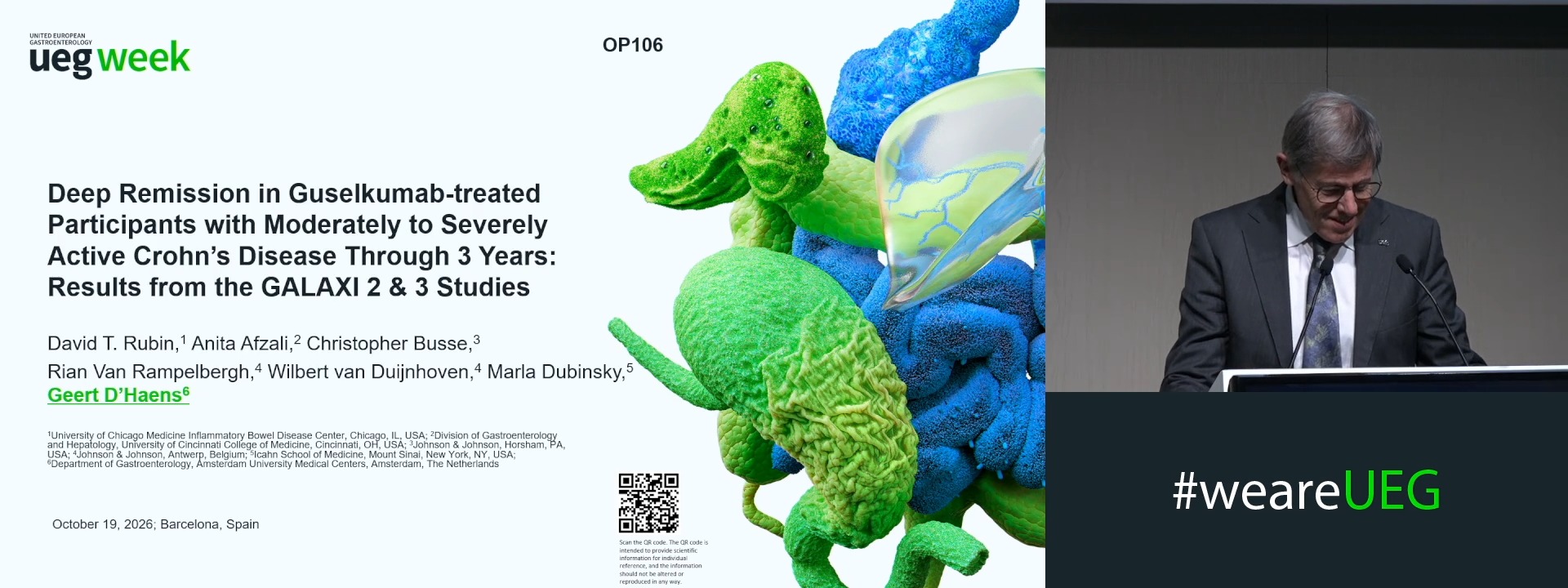
Crohn’s disease(CD) treatment goals have evolved from managing symptoms to achieving clinical remission and endoscopic healing.1 Improvements in clinical and endoscopic outcomes often result in more controlled disease, which may lead to improved quality of life. The phase 3 GALAXI 2&3(GAL2/3) studies evaluated guselkumab(GUS), a dual acting IL-23p19 subunit inhibitor, in participants(pts) with moderately to severely active CD.2 Achievement of deep remission and other outcomes in GUS-treated pts from the pooled GAL2/3 studies through Wk144 were assessed.
Aims & Methods
In GAL2/3, 582 pts received GUS. At Wk48, pts benefiting from study treatment(per investigator) entered the LTE. All pts with an inadequate response(not in clinical response & CDAI ≥220) from Wks 52-80 could dose adjust to GUS 200mg q4w. Deep remission(clinical remission [CDAI<150] & endoscopic remission[SES-CD≤4 & ≥2-point reduction from Wk0 & no subscore>1]) was evaluated in the overall, bionaive, & BIO-IR(inadequate response/intolerance to biologic therapies) populations at Wks48/96/144. IBDQ remission(IBDQ≥170) and CD-related hospitalizations and/or surgeries rates were also assessed.
Results
Among 184 pts in deep remission at Wk48, maintenance of deep remission at Wks96 & 144 was similar, also across subgroups(Table). Greater proportions of GUS pts in deep remission at Wk48 achieved IBDQ remission at Wks96 & 144(68.5%, 67.4%) vs pts not in deep remission(40.5%, 40.2%), respectively. Rates of hospitalizations/surgeries through Wks96 & 144(2.2%; 2.7%) were lower among GUS pts in deep remission at Wk48 vs pts not in deep remission(10.8%, 14.6%), respectively.
CDAI, Crohn’s Disease Activity Index; CI, confidence interval; GUS, guselkumab; IV, intravenous; q4w/q8w, every 4 or 8 weeks; SC, subcutaneous; SES-CD, Simple Endoscopic Score for Crohn's Disease
aDeep remission is defined as achieving both clinical remission and endoscopic remission. Clinical remission is defined as CDAI <150. Endoscopic remission is defined as SES-CD Score ≤4 and at least a 2-point reduction from baseline and no subscore greater than 1 in any individual component.
bParticipants who had a CD-related surgery, discontinued study agent due to lack of efficacy, an adverse event (AE) of worsening CD, or Week 20/24 nonresponder, discontinued study agent for any other reason other than COVID-19 related reasons, regional crisis, lack of efficacy, an AE of worsening CD, or Week 20/24 nonresponder as specified at treatment discontinuation, had a dose adjustment (including "sham") during Weeks 52-80, between Week 48 and the analysis timepoint, had a prohibited change in CD medications prior to Week 48, or did not discontinue study treatment but did not enter the long-term extension period were considered not to have met the endpoint criteria. Participants who discontinued study agent due to COVID-19 related reasons (excluding COVID-19 infection), regional crisis, and placebo participants who discontinued due to study unblinding had their observed data used, if available, to determine responder and nonresponder status at the analysis timepoint.
cMissing data imputation: after accounting for the strategies, participants randomized to an active treatment group who were missing CDAI or SES-CD score at the analysis timepoint were considered as not having achieved deep remission at the analysis timepoint.
dThe confidence intervals for the proportion of participants meeting the endpoint in each treatment group were based on the normal approximation confidence limits. In cases of rare events, the exact confidence limits were provided.
|
Table. Outcomes Among Pooled GALAXI 2/3 Participants in Deep Remission at Week 48; Primary analysis set
|
| GUS 200 mg IV q4w→
100 mg SC q8w
(N=286)
| GUS 200 mg IV q4w→
200 mg SC q4w
(N=296)
| GUS Combined
(N=582)
|
Participants in Deep Remissiona,b,c at Week 48 (Overall), n (%)
95% CId
Among Participants in Deep Remissiona,b,c at Week 48
Deep remissiona,b,c at Week 96, n (%)
95% CId
Deep remissiona,b,c at Week 144, n (%)
95% CId
|
85 (29.7%)
(24.4, 35.0)
48 (56.5%)
(45.9, 67.0)
57 (67.1%)
(57.1, 77.1)
|
99 (33.4%)
(28.1, 38.8)
57 (57.6%)
(47.8, 67.3)
60 (60.6%)
(51.0, 70.2)
|
184 (31.6%)
(27.8, 35.4)
105 (57.1%)
(49.9, 64.2)
117 (63.6%)
(56.6, 70.5)
|
Bionaive participants in Deep Remissiona,b,c at Week 48, n/N (%)
95% CId
Among Participants in Deep Remissiona,b,c at Week 48
Deep remissiona,b,c at Week 96, n (%)
95% CId
Deep remissiona,b,c at Week 144, n (%)
95% CId
|
45/116 (38.8%)
(29.9, 47.7)
25 (55.6%)
(41.0, 70.1)
31 (68.9%)
(55.4, 82.4)
|
56/128 (43.8%)
(35.2, 52.3)
33 (58.9%)
(46.0, 71.8)
34 (60.7%)
(47.9, 73.5)
|
101/244 (41.4%)
(35.2, 47.6)
58 (57.4%)
(47.8, 67.1)
65 (64.4%)
(55.0, 73.7)
|
BIO-IR participants in Deep Remissiona,b,c at Week 48, n (%)
95% CId
Among Participants in Deep Remissiona,b,c at Week 48
Deep remissionab.c at Week 96, n (%)
95% CId
Deep remissiona,b,c at Week 144, n (%)
95% CId
|
39/153 (25.5%)
(18.6, 32.4)
23 (59.0%)
(43.5, 74.4)
26 (66.7%)
(51.9, 81.5)
|
35/147 (23.8%)
(16.9, 30.7)
17 (48.6%)
(32.0, 65.1)
20 (57.1%)
(40.7, 73.5)
|
74/300 (24.7%)
(19.8, 29.5)
40 (54.1%)
(42.7, 65.4)
46 (62.2%)
(51.1, 73.2)
|
Conclusion
In the pooled GAL2/3 studies, GUS was effective in maintaining the high-bar endpoint of deep remission through up to 3 years in pts with moderately to severely active CD, regardless of prior biologic history. Improved HRQoL and fewer hospitalizations/surgeries were reported through 3 years in GUS pts in deep remission at Wk48.
References
1. Turner D, Ricciuto A, Lewis A, et al. Gastroenterology 2021;160:1570-1583.
2. Panaccione R, Feagan BG, Afzali A, et al. Lancet 2025;406:358-375.
Disclosure
DTR reports consulting and/or speaker fees and/or advisory board participation for AbbVie, Altrubio, Apex, Avalo, Bristol Myers Squibb, Buhlmann Diagnostics, Celgene, Connect BioPharma, Intouch Group, Iterative Health, Johnson & Johnson, Lilly, Pfizer, Samsung Neurologica, and Takeda; Altrubio, Datos Health, and Iterative Health stock options; grants from Takeda; and membership on the Board of Directors of Cornerstones Health, Inc and on the Crohn’s & Colitis Foundation’s Board of Trustees.
AA reports serving as a speaker for AbbVie, Bristol Myers Squibb, Johnson & Johnson, Pfizer, and Takeda; a consultant for AbbVie, Bristol Myers Squibb, Eli Lilly, Johnson & Johnson, Pfizer, and Takeda; an advisory board member for AbbVie, Bristol Myers Squibb, Eli Lilly, Gilead, Johnson & Johnson, Pfizer, and Takeda; received educational/research grants from AbbVie, Bristol Myers Squibb, Eli Lilly, Johnson & Johnson, Pfizer, and Takeda; and Co-Founder and Board Member of Scrubs & Heels Foundation.
CB, RVR, and WvD are employees of Johnson & Johnson and may own company stock/stock options.
MD reports serving as a consultant and advisor for AbbVie, Abivax, Astra Zeneca, Boehringer Ingelheim International GmbH, Bristol-Meyer Squibb, Celltrion, Eli Lilly and Company, F. Hoffmann-La Roche Ltd, Janssen Pharmaceuticals, Johnson and Johnson, Merck, Pfizer Inc, Prometheus Labs, Sanofi, Spyre, and Takeda Pharmaceuticals.
GDH reports consultancy activities for AbbVie, Agomab, Alimentiv, AstraZeneca, AMT, Bristol Meyers Squibb, Boehringer Ingelheim, Celltrion, Eli Lilly, Exeliom, Galapagos, GlaxoSmithKline, Gossamerbio, Immunic, Index, Johnson & Johnson, Kaleido, Origo, Pfizer, Polpharma, Procise Diagnostics, Prometheus Laboratories, Prometheus Biosciences, Progenity, and Protagonist Therapeutics Inc.; speaker’s bureau for AbbVie, Bristol Meyers Squibb, Galapagos, Pfizer, and Takeda; and data monitoring board activities for AbbVie, AstraZeneca, Galapagos, and Seres Health.