Introduction
Crohn's disease (CD) is thought to result from complex interactions between genetic susceptibility, environmental factors, gut dysbiosis, and aberrant immune activation, in which CD4+ T helper cells play a central pathogenic role. Monozygotic twins provide a unique model to investigate disease-associated immune alterations while controlling for genetic background and (early-life) environmental exposures. Moreover, unaffected co-twins of CD-discordant pairs are at increased risk of developing CD, offering an opportunity to study potential preclinical immune signatures.
Aims & Methods
We compared peripheral CD4+ T cell profiles in monozygotic twins from the IBD-TWIN cohort1 and unrelated healthy controls. Single-cell RNA sequencing with paired T-cell receptor (TCR) profiling was performed on naive and gut-homing (integrin β7+) memory CD4+ T cell subsets from CD-concordant (n=4) and CD-discordant (n=4) monozygotic twin pairs, as well as unrelated healthy controls (n=4). DNA methylation profiling was performed on gut-homing memory and both gut- and non-gut-homing naive CD4+ T cells from CD-concordant (n=2) and CD-discordant (n=9) monozygotic twin pairs and healthy controls (n=11).
Results
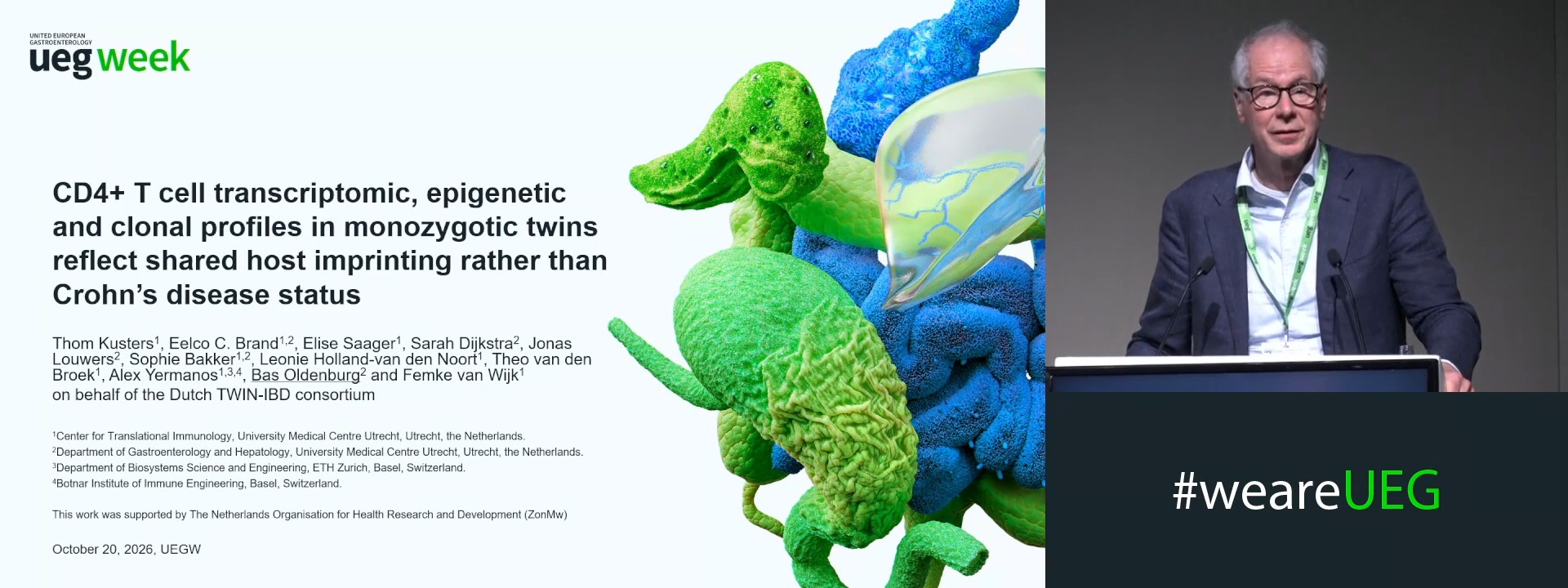
Transcriptomes and methylomes of naive and gut-homing memory CD4+ T cells were highly similar between monozygotic co-twins irrespective of disease concordance, whereas both affected and unaffected co-twins differed from unrelated healthy controls. In addition, TCR repertoires of co-twins displayed greater overlap in paired αβ complementarity-determining region 3 (CDR3) sequences compared to unrelated individuals.
Conclusion
CD4+ T cell profiles and repertoires appear strongly shaped by shared host-related factors, including genetics and (early-life) environment, whereas disease concordance had limited impact on transcriptional, epigenetic and clonal profiles.
References
- Brand, E. C., Klaassen, M. A., Gacesa, R., Vila, A. V., Ghosh, H., De Zoete, M. R., ... & Oldenburg B, Weersma RK. Healthy cotwins share gut microbiome signatures with their inflammatory bowel disease twins and unrelated patients. Gastroenterology. 2021;160(6):1970-1985.
Disclosure
Dr E.C. Brand was co-applicant on an unrestricted Investigator Initiated Research Grant of Pfizer
Prof. B Oldenburg: unrestricted grants: Abbvie, Takeda, Pfizer, Galapagos Advisory boards: Abbvie, Takeda, Pfizer, Lilly, Galapagos, Janssen
Prof. F. van Wijk: has been a speaker and/or consultant for Janssen, Johnson & Johnson, and Takeda and has received grants fromRegeneron Pharmaceuticals, Leo Pharma, Sanofi, BMS, Galapagos, and Takeda.