UEG's educational platform for gastroenterology education bringing recordings, courses, guidelines, and more together in one place.
Most popular content
Rate for better recommendations!
Your feedback helps us show you more of what you like and less of what you dislike!
Log in to access this content.
Free for all myUEG account holders. Your access level is set automatically based on your occupation. Medical professionals get full access to all content. If you are a non-medical user, you can only access UEG Week content from congresses you attended.
Not sure what you can access? Learn more about account types.
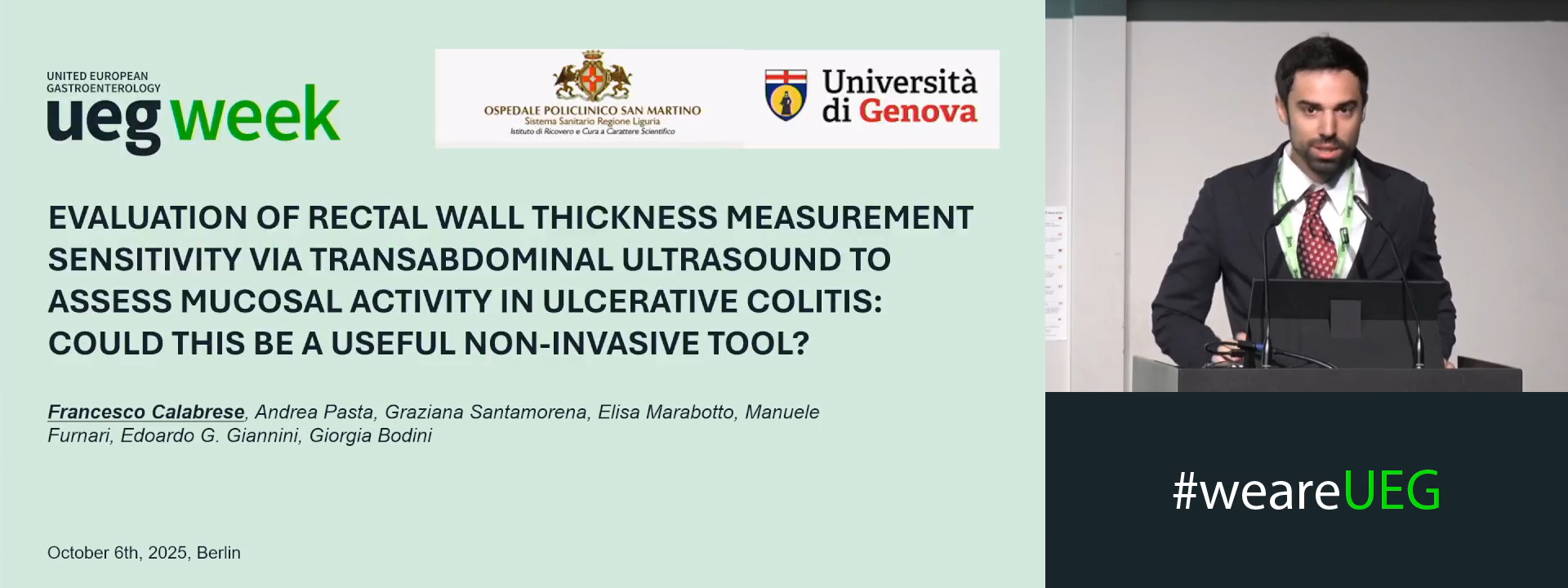
EVALUATION OF RECTAL WALL THICKNESS MEASUREMENT SENSITIVITY VIA TRANSABDOMINAL ULTRASOUND TO ASSESS MUCOSAL ACTIVITY IN ULCERATIVE COLITIS: COULD THIS BE A USEFUL NON-INVASIVE TOOL?
Francesco Calabrese 1, ANDREA PASTA 1, Graziana Santamorena 1, Elisa Marabotto 1, Manuele Furnari 1, Edoardo G. Giannini 1, Giorgia Bodini 1
1 Università Degli Studi Di Genova/irccs Policlinico San Martino, Genova, Italy
Event
Topics
Submission format
Session
Citation
Published
Log in to access this content.
Free for all myUEG account holders. Your access level is set automatically based on your occupation. Medical professionals get full access to all content. If you are a non-medical user, you can only access UEG Week content from congresses you attended.
Not sure what you can access? Learn more about account types.
Log in to access this content.
Free for all myUEG account holders. Your access level is set automatically based on your occupation. Medical professionals get full access to all content. If you are a non-medical user, you can only access UEG Week content from congresses you attended.
Not sure what you can access? Learn more about account types.
The future of immunotherapy → are surgeons obsolete soon? with Jeroen Dekervel
Topics
Published
Log in to access this content.
Free for all myUEG account holders. Your access level is set automatically based on your occupation. Medical professionals get full access to all content. If you are a non-medical user, you can only access UEG Week content from congresses you attended.
Not sure what you can access? Learn more about account types.
Log in to access this content.
Free for all myUEG account holders. Your access level is set automatically based on your occupation. Medical professionals get full access to all content. If you are a non-medical user, you can only access UEG Week content from congresses you attended.
Not sure what you can access? Learn more about account types.
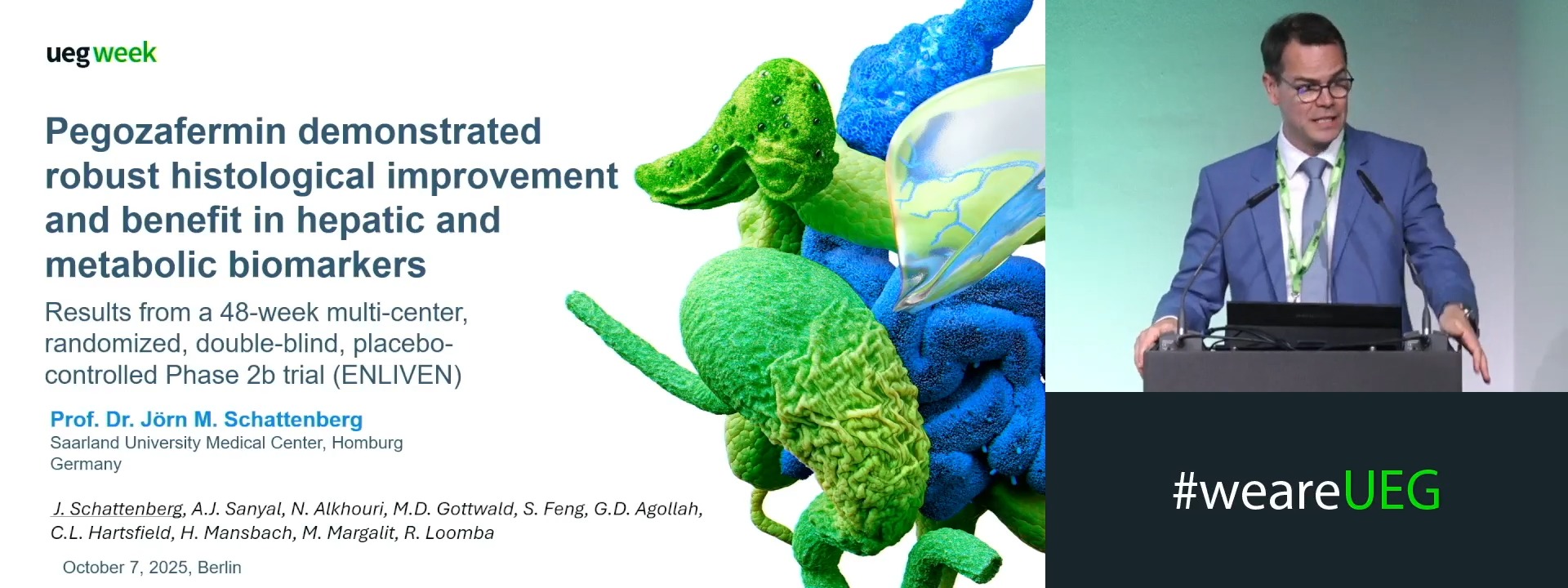
PEGOZAFERMIN DEMONSTRATED ROBUST HISTOLOGICAL IMPROVEMENT AND BENEFIT IN HEPATIC AND METABOLIC BIOMARKERS: RESULTS FROM A 48-WEEK MULTI-CENTER, RANDOMIZED, DOUBLE-BLIND, PLACEBO-CONTROLLED PHASE 2B TRIAL (ENLIVEN)
Jörn Schattenberg 1, Arun J Sanyal 2, Naim Alkhouri 3, Mildred D. Gottwald 4, Shibao Feng 4, Germaine D. Agollah 4, Cynthia L Hartsfield 4, Hank Mansbach 4, Maya Margalit 5, Rohit Loomba 6
1 Universitätsklinikum des Saarlandes und Medizinische Fakultät der Universität des Saarlandes, Homburg, Germany
2 Virginia Commonwealth University School of Medicine, Richmond, United States
3 Arizona Liver Health, Phoenix, United States
4 89bio, San Francisco, United States
5 89bio, Rehovot, Israel
6 University of California San Diego MASLD Research Center, San Diego, United States
Event
Topics
Submission format
Citation
Published
Log in to access this content.
Free for all myUEG account holders. Your access level is set automatically based on your occupation. Medical professionals get full access to all content. If you are a non-medical user, you can only access UEG Week content from congresses you attended.
Not sure what you can access? Learn more about account types.
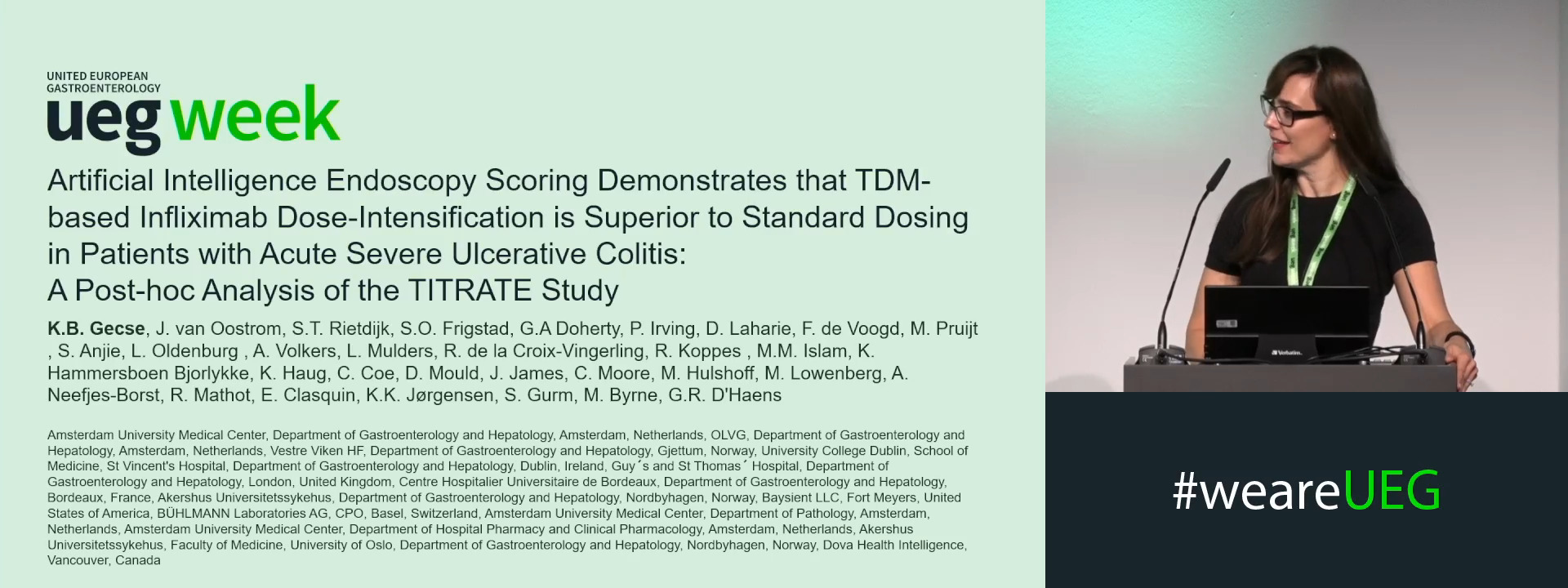
ARTIFICIAL INTELLIGENCE ENDOSCOPY SCORING DEMONSTRATES THAT TDM-BASED INFLIXIMAB DOSE-INTENSIFICATION IS SUPERIOR TO STANDARD DOSING IN PATIENTS WITH ACUTE SEVERE ULCERATIVE COLITIS: A POST-HOC ANALYSIS OF THE TITRATE STUDY
Krisztina Barbara Gecse 1, Joep van Oostrom 1, Svend T. Rietdijk 2, Svein Oskar Frigstad 3, Glen A Doherty 4, Peter Irving 5, David Laharie 6, Floris de Voogd 1, Maarten Pruijt 1, Suzanne Anjie 1, Lotte Oldenburg 1, Adriaan Volkers 1, Lieven Mulders 1, Rossana de la Croix-Vingerling 2, Renza Koppes 2, Md Monirul Islam 3, Kristin Hammersboen Bjorlykke 7, Kine Haug 7, Carolann Coe 4, Diane Mould 8, John James 8, Chris Moore 9, Melanie Hulshoff 1, Mark Lowenberg 1, Andra Neefjes-Borst 1, Ron Mathôt 1, Esmé Clasquin 1, Kristin Kaasen Jørgensen 10, Sunny Gurm 11, Michael Byrne 11, Geert R. D'Haens 1
1 Amsterdam University Medical Center, Amsterdam, Netherlands
2 Onze Lieven Vrouwen Gasthuis, Amsterdam, Netherlands
3 Vestre Viken HF, Gjettum, Norway
4 University College Dublin, School of Medicine, St Vincent's Hospital, Dublin, Ireland
5 Guy´s and St Thomas´ Hospital, London, United Kingdom
6 Centre Hospitalier Universitaire de Bordeaux, Bordeaux, France
7 Akershus Universitetssykehus, Nordbyhagen, Norway
8 Baysient LLC, Fort Meyers, United States
9 BÜHLMANN Laboratories AG, Basel, Switzerland
10 Akershus Universitetssykehus, Faculty of Medicine, University of Oslo, Nordbyhagen, Norway
11 Dova Health Intelligence, Vancouver, Canada
Event
Submission format
Session
Citation
Published
Log in to access this content.
Free for all myUEG account holders. Your access level is set automatically based on your occupation. Medical professionals get full access to all content. If you are a non-medical user, you can only access UEG Week content from congresses you attended.
Not sure what you can access? Learn more about account types.
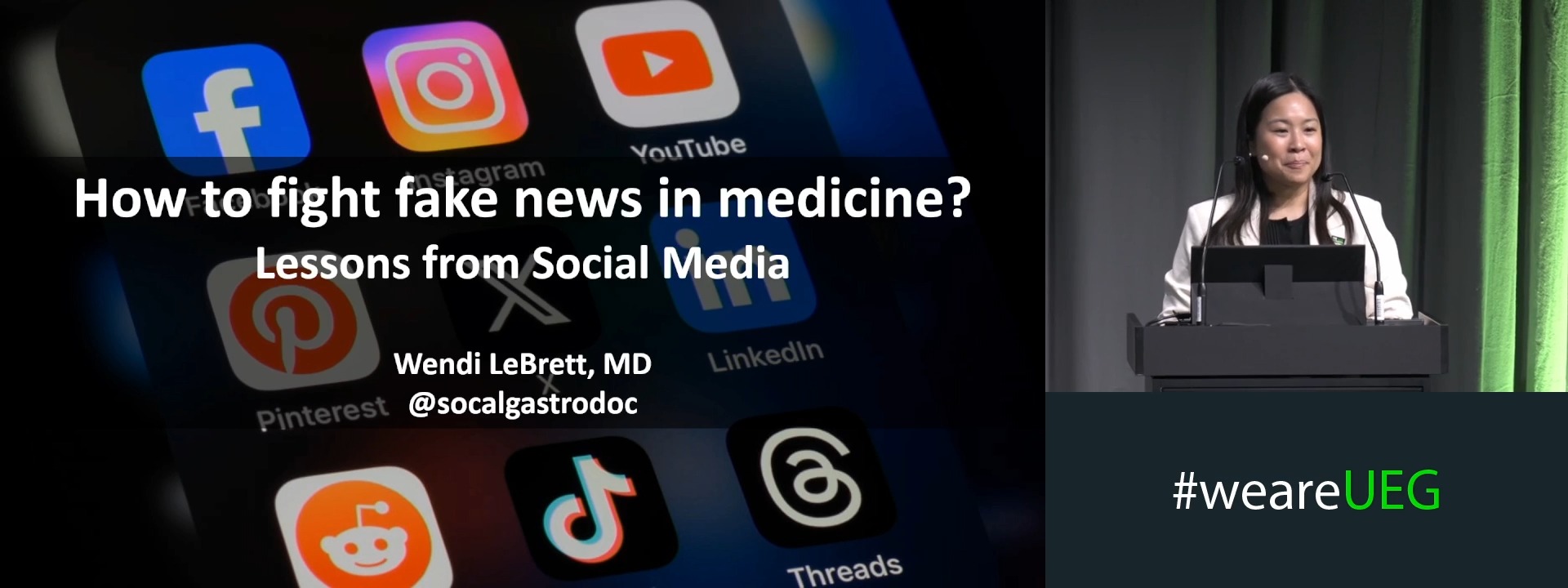
How to fight fake news in medicine?
1 David Geffen School of Medicine, Los Angeles, United States of America
Event
Topics
Session