UEG's content platform for gastroenterology education bringing recordings, courses, guidelines, and more together in one place.
Trending on Gutflix
Rate for better recommendations!
Your feedback helps us show you more of what you like and less of what you dislike!
Log in to continue.
This content is part of Gutflix. Log in with your myUEG account, or create one free, to watch it.
Not sure what you can access? Learn more about account types.
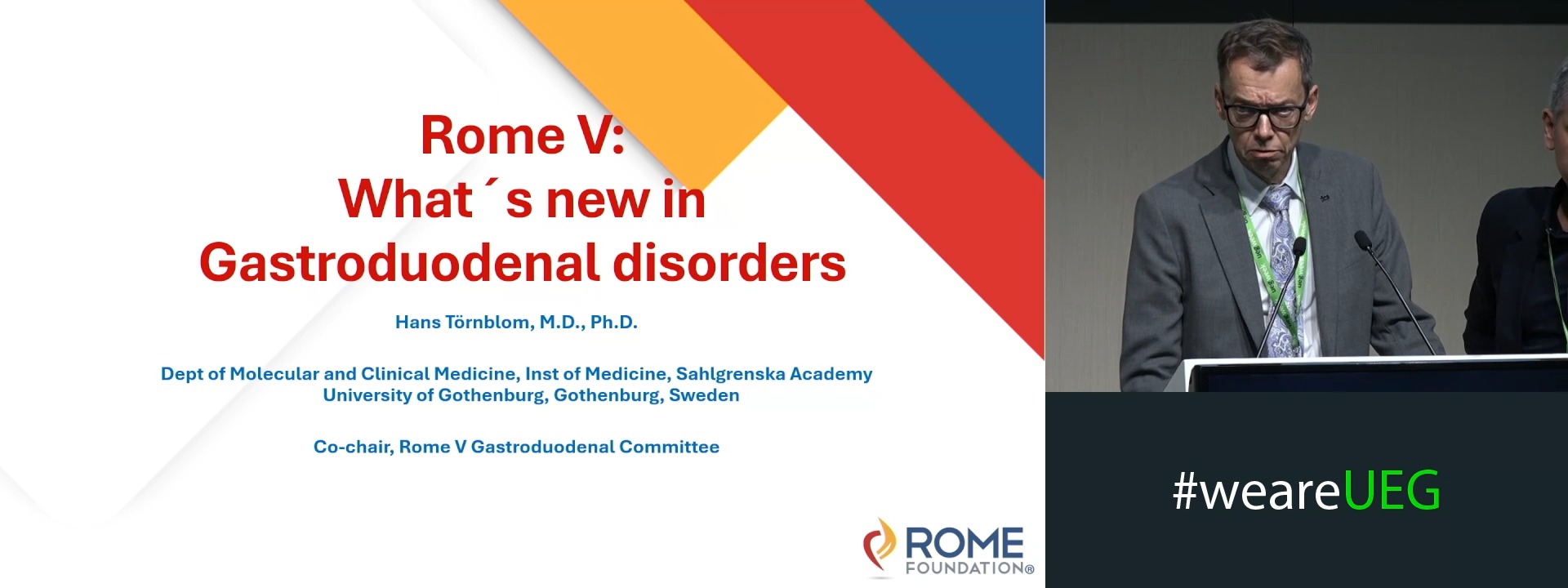
Upper GI disorders
Affiliations
1 Inst of medicine, Gothenburg, Sweden
Log in to continue.
This content is part of Gutflix. Log in with your myUEG account, or create one free, to watch it.
Not sure what you can access? Learn more about account types.
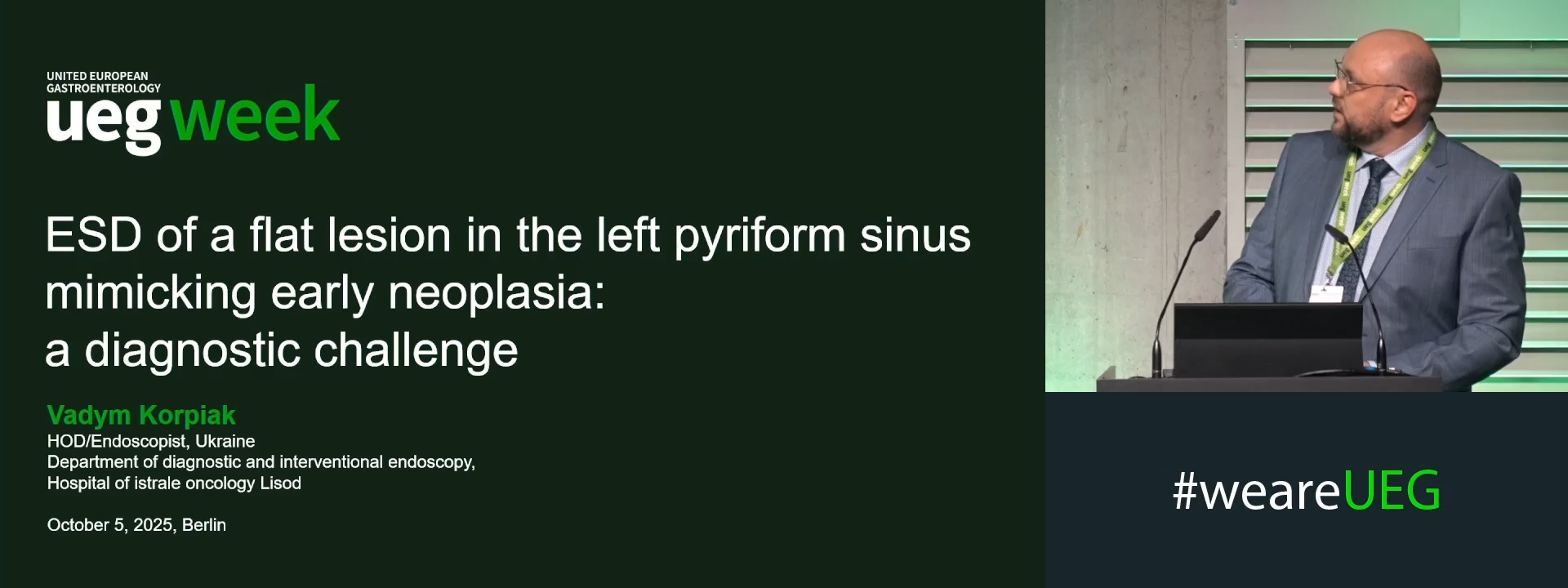
ESD OF A FLAT LESION IN THE LEFT PYRIFORM SINUS MIMICKING EARLY NEOPLASIA: A DIAGNOSTIC CHALLENGE
Affiliations
1 LLC "Gastrocenter", Olymed, Kyiv, Ukraine
2 National University of Kyiv Mohyla Academy, Kyiv, Ukraine
3 CSD Lab Medical Laboratory, Kyiv, Ukraine
4 Lisod Hospital, Kyiv, Ukraine
Log in to continue.
This content is part of Gutflix. Log in with your myUEG account, or create one free, to watch it.
Not sure what you can access? Learn more about account types.
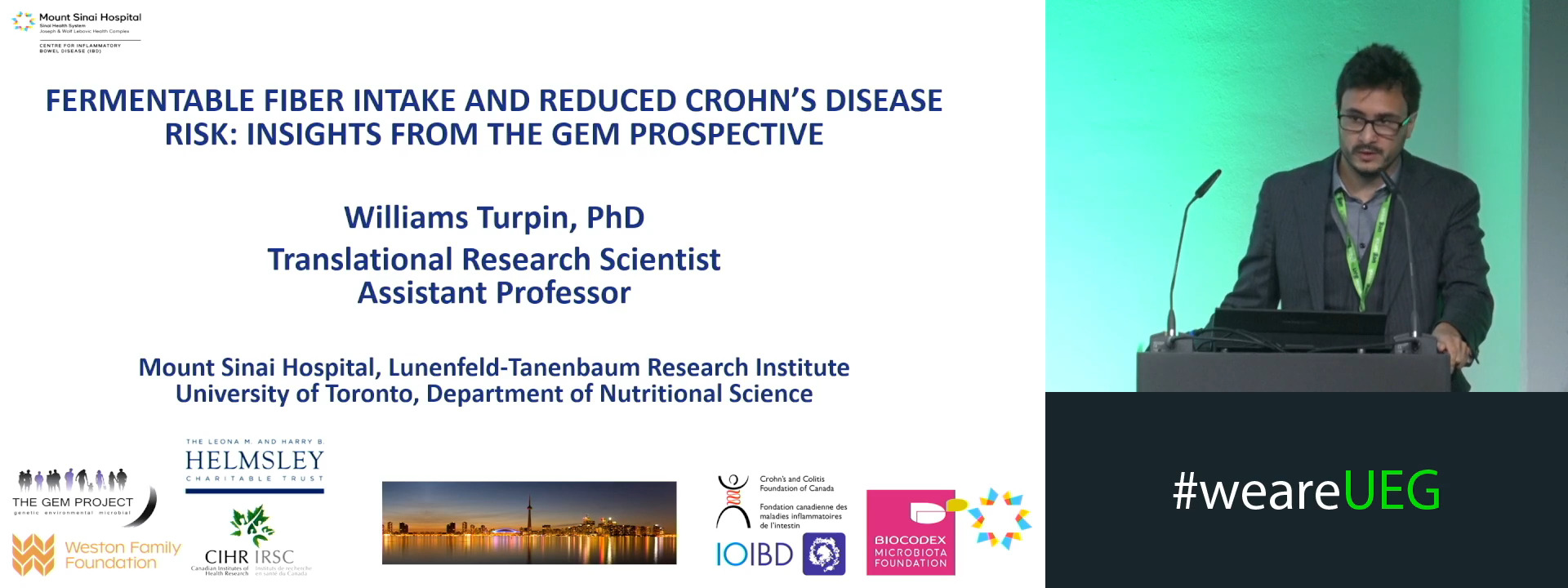
FERMENTABLE FIBER INTAKE AND REDUCED CROHN’S DISEASE RISK: INSIGHTS FROM THE GEM PROSPECTIVE COHORT
Mingyue Xue 1, Catherine Mcshane 2, Kim Jeongseok 2, Haim Leibovitzh 3, Jingcheng Shao 2, Qilong Li 2, Karen Madsen 4, Reihane Khorasaniha 2, Anne Griffiths 5, Thomas D Walters 5, Allan Hillary Steinhart 1, Mark S. Silverberg 2, Levinus Dieleman 6, Hien Huynh 6, Remo Panaccione 7, Paul Beck 7, Guy Aumais 8, Iwona Wrobel 7, Alain Bitton 9, John K. Marshall 10, Charles N. Bernstein 11, Jeffrey Hyams 12, Paul Moayyedi 13, Sun-Ho Lee 2, Heather Armstrong 6, Ken Croitoru 14, Williams Turpin 2
Affiliations
1 Mount Sinai Hospital Dept. of Medicine, Toronto, Canada
2 Mount Sinai Hospital, Toronto, Canada
3 Mount-Sinai Hospital, Toronto, Toronto, Canada
4 University of Alberta, Alberta, Canada
5 Hospital for Sick Children, Toronto, Canada
6 University of Alberta Division of Gastroenterology Dept. of Medicine, Edmonton, Canada
7 University of Calgary, Calgary, Canada
8 University of Montreal / Maisonneuve Hospital, Montreal, QC, Canada
9 Royal Victoria Hospital Dept. of Gastroenterology, Montreal, Canada
10 McMaster University, Burlington, Canada
11 University of Manitoba, Winnipeg, Canada
12 CT Children's, Hartford, United States
13 McMaster University Dept. of Medicine Dept. of Gastroenterology - McMaster University Dept. of Medic, Hamilton, Canada
14 Mt Sinai Hospital, Toronto, Canada

Log in to continue.
This content is part of Gutflix. Log in with your myUEG account, or create one free, to watch it.
Not sure what you can access? Learn more about account types.
The pregnant IBD patient (Complete Session)
Log in to continue.
This content is part of Gutflix. Log in with your myUEG account, or create one free, to watch it.
Not sure what you can access? Learn more about account types.
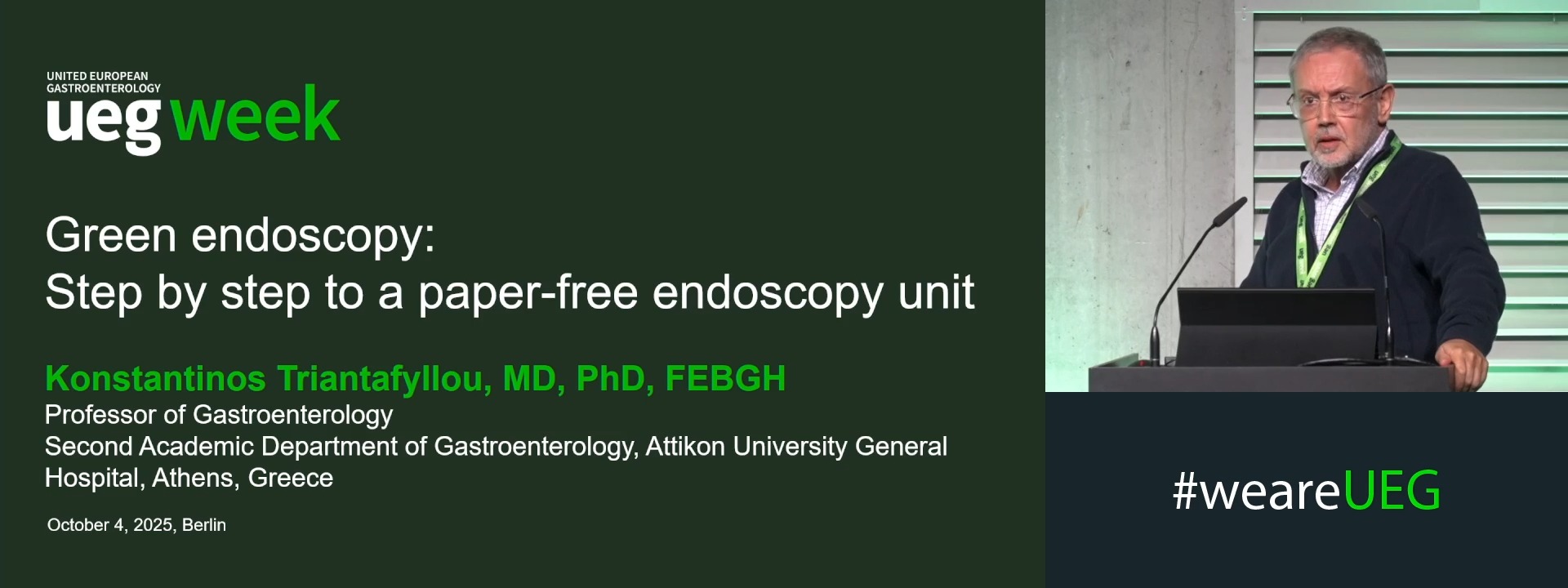
Green endoscopy: Step by step to a paper free endoscopy unit
Affiliations
1 Attikon University General Hospital, Athens, Greece

Log in to continue.
This content is part of Gutflix. Log in with your myUEG account, or create one free, to watch it.
Not sure what you can access? Learn more about account types.
MOLECULAR AND SYSTEMIC ROLE OF GUT-ADIPOSE TISSUE INTERACTIONS IN CHRONIC INTESTINAL INFLAMMATION
Annie Naujoks 1, Tina Krammel 1, Hildigunnur Hermannsdóttir 1, Annalisa Buck 2, Philipp-alexander Neumann 2, Matthieu Allez 3, Doriane Aguanno 1, Martin Klingenspor 1, Dirk Haller 4
Affiliations
1 TUM School of Life Sciences, Technical University of Munich, Freising, Germany
2 Clinic and Polyclinic for Surgery, Munich, Germany
3 Hopital Saint-Louis APHP, Université Denis Diderot Paris 7, Paris, France
4 TUM School of Life Sciences; ZIEL Institute for Food & Health, Technical University of Munich, Freising, Germany