UEG's educational platform for gastroenterology education bringing recordings, courses, guidelines, and more together in one place.
Trending on Gutflix
Rate for better recommendations!
Your feedback helps us show you more of what you like and less of what you dislike!
Log in to continue.
This content is part of Gutflix. Log in with your myUEG account, or create one free, to watch it.
Not sure what you can access? Learn more about account types.
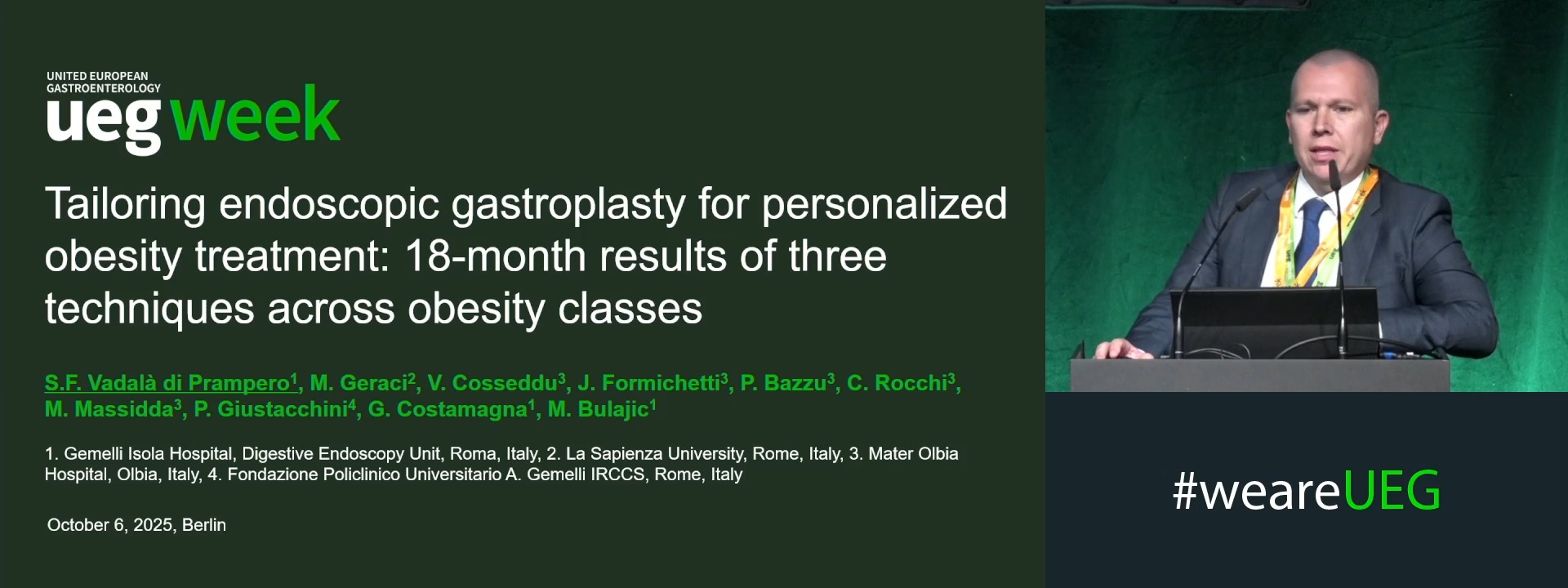
TAILORING ENDOSCOPIC GASTROPLASTY FOR PERSONALIZED OBESITY TREATMENT: 18-MONTH RESULTS OF THREE TECHNIQUES ACROSS OBESITY CLASSES
Salvatore Francesco Vadalà di Prampero 1, Marco Geraci 2, Valentina Cosseddu 3, Jessica Formichetti 3, Paola Bazzu 3, Chiara Rocchi 3, Marco Massidda 3, Piero Giustacchini 4, Guido Costamagna 1, Milutin Bulajic 1
Affiliations
1 Gemelli Isola Hospital, Roma, Italy
2 La Sapienza University, Rome, Italy
3 Mater Olbia Hospital, Olbia, Italy
4 Fondazione Policlinico Universitario A. Gemelli IRCCS, Rome, Italy
Log in to continue.
This content is part of Gutflix. Log in with your myUEG account, or create one free, to watch it.
Not sure what you can access? Learn more about account types.
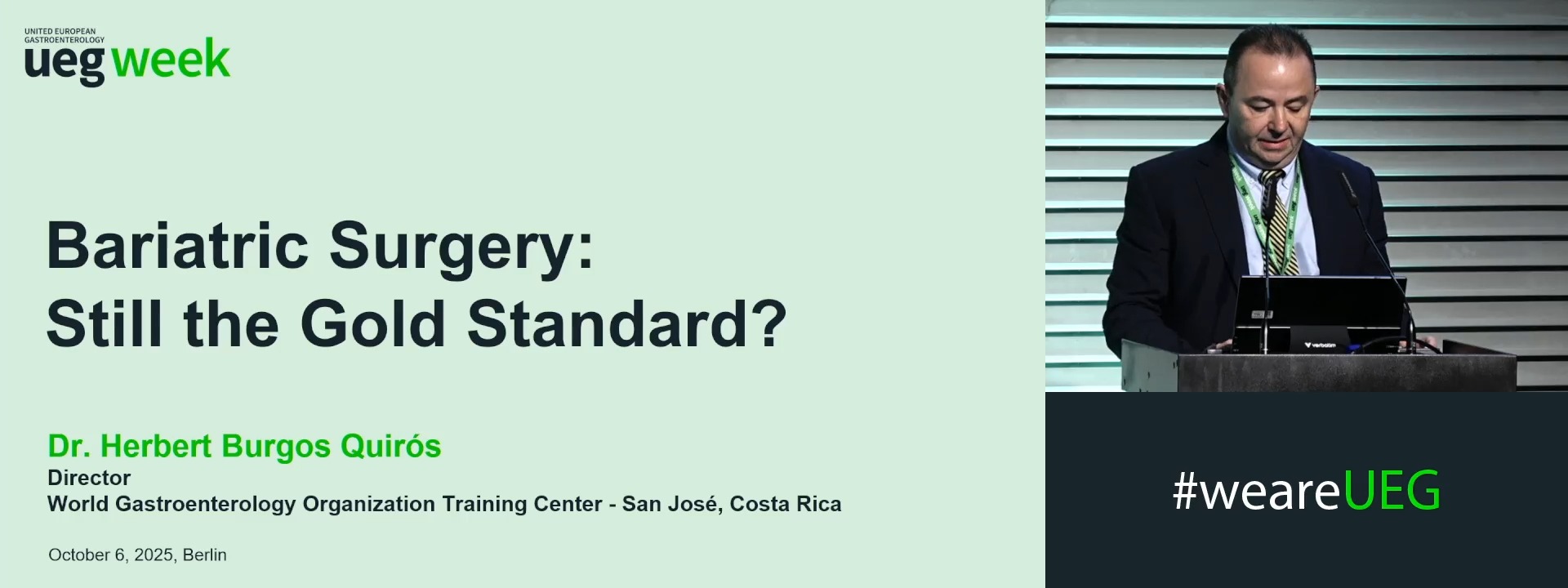
Bariatric surgery: Still the gold standard?
Affiliations
1 GastroClinica, San Jose, Costa Rica
Log in to continue.
This content is part of Gutflix. Log in with your myUEG account, or create one free, to watch it.
Not sure what you can access? Learn more about account types.
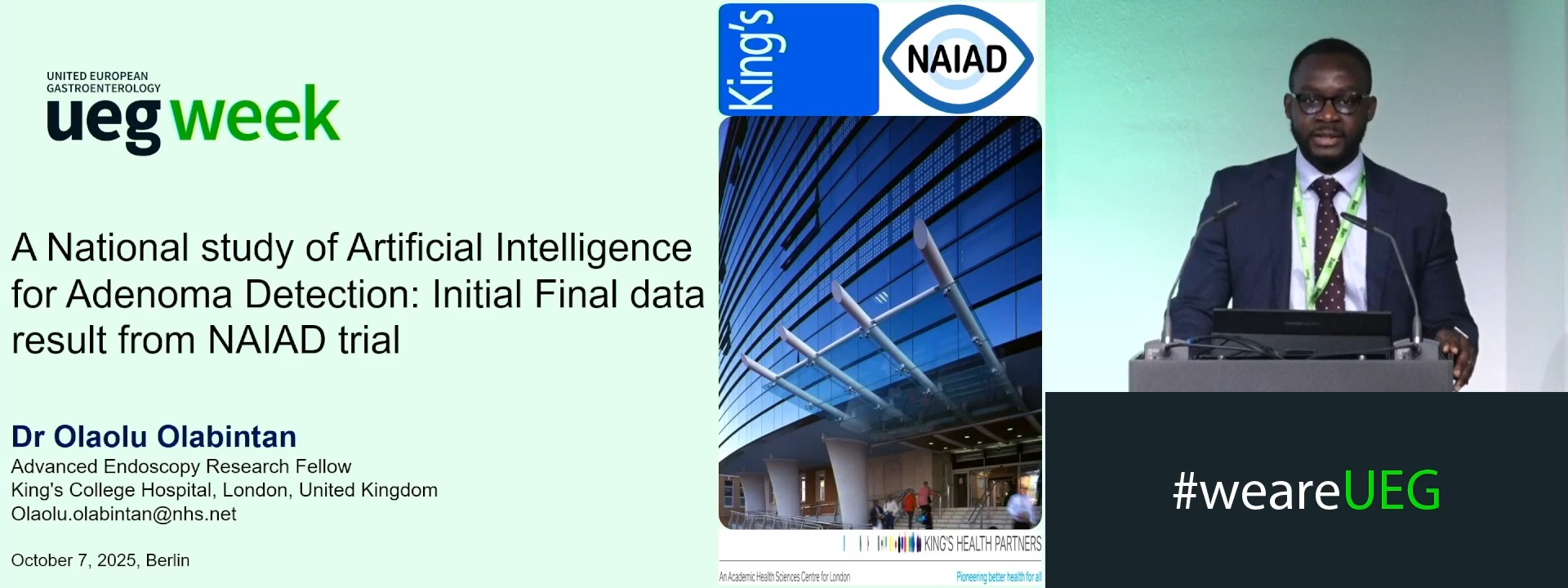
INTERIM RESULTS FROM NAIAD: A NATIONWIDE STUDY OF ARTIFICIAL INTELLIGENCE IN ADENOMA DETECTION (ANALYSIS FROM THE FIRST 1418 PATIENTS AND 34 COLONOSCOPISTS)
Olaolu Olabintan 1, Olayinka Arimoro 2, Alena Marynina 1, Lee Meng Choong 1, Amyn Haji 1, Shraddha Gulati 3, Andrew Emmanuel 3, Bu Hayee 4
Affiliations
1 King’s College Hospital NHS Foundation Trust, London, United Kingdom
2 University of Calgary, Calgary, Canada
3 King's College Hospital, London, United Kingdom
4 Kings College Hospital, London, United Kingdom
Log in to continue.
This content is part of Gutflix. Log in with your myUEG account, or create one free, to watch it.
Not sure what you can access? Learn more about account types.
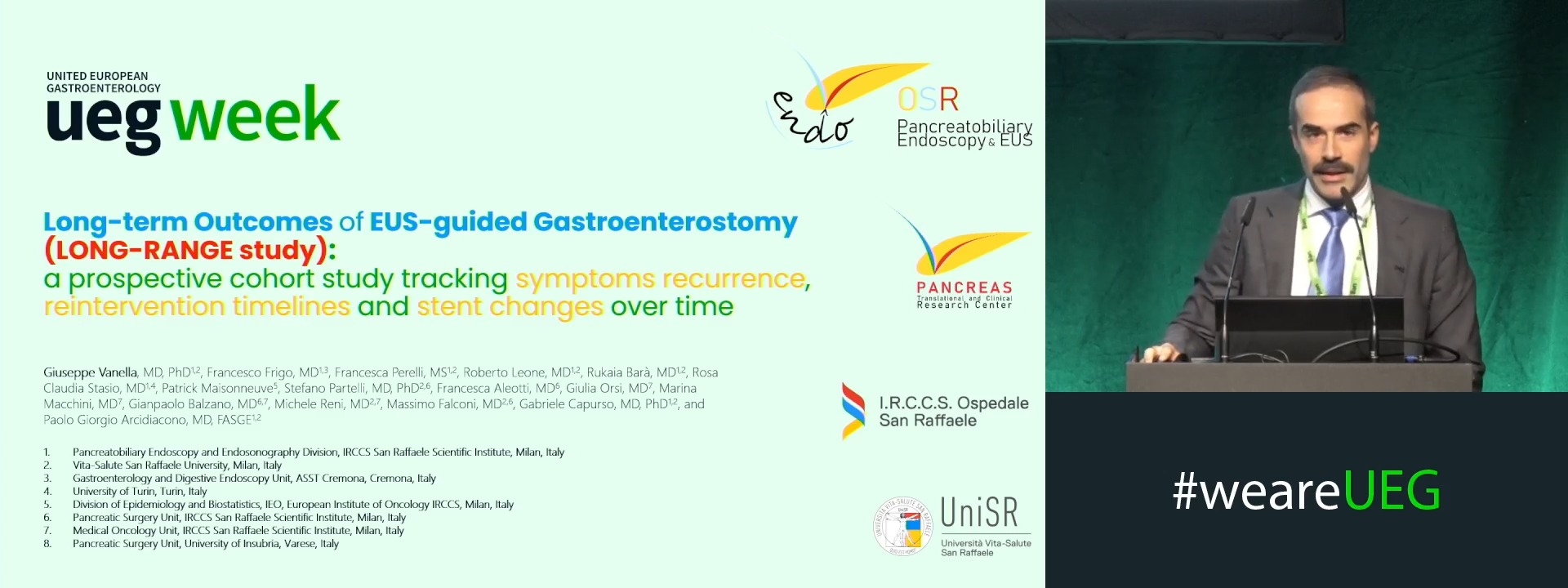
LONG-TERM OUTCOMES OF EUS-GUIDED GASTROENTEROSTOMY (LONG-RANGE STUDY): A PROSPECTIVE COHORT STUDY TRACKING SYMPTOMS RECURRENCE, REINTERVENTION TIMELINES AND STENT CHANGES OVER TIME
Giuseppe Vanella 1, Francesco Frigo 2, Francesca Perelli 3, Roberto Leone 1, Rukaia Barà 1, Rosa Claudia Stasio 4, Patrick Maisonneuve 5, Stefano Partelli 1, Francesca Aleotti 6, Giulia Orsi 6, Marina Macchini 6, Gianpaolo Balzano 7, Michele Reni 1, Massimo Falconi 8, Gabriele Capurso 1, Paolo Giorgio Arcidiacono 1
Affiliations
1 IRCCS San Raffaele Institute, Milan, Italy|||Vita-Salute San Raffaele University, Milan, Italy
2 IRCCS San Raffaele Institute, Milan, Italy|||ASST Cremona, Cremona, Italy
3 Vita-Salute San Raffaele University, Milan, Italy
4 IRCCS San Raffaele Institute, Milan, Italy|||University of Turin, Turin, Italy
5 IRCCS European Institute of Oncology, Milan, Italy
6 IRCCS San Raffaele Institute, Milan, Italy
7 IRCCS San Raffaele Institute, Milan, Italy|||University of Insubria, Varese, Italy
8 Vita-Salute San Raffaele University, Milan, Italy|||IRCCS San Raffaele Institute, Milan, Italy