UEG's educational platform for gastroenterology education bringing recordings, courses, guidelines, and more together in one place.
Most popular content
Rate for better recommendations!
Your feedback helps us show you more of what you like and less of what you dislike!
Log in to access this content.
Free for all myUEG account holders. Your access level is set automatically based on your occupation. Medical professionals get full access to all content. If you are a non-medical user, you can only access UEG Week content from congresses you attended.
Not sure what you can access? Learn more about account types.

ROLE OF PROPHYLACTIC BILIARY STENT IN REDUCING RECURRENCE OF STONES AND BILIARY COMPLICATIONS AFTER STONE CLEARANCE IN PATIENTS AWAITING CHOLECYSTECTOMY-A RANDOMIZED CONTROLLED TRIAL
Arpit Sasani 1, Harshal Mandavdhare 1, Vishal Sharma 1, Jimil Shah 1, Amol Patil 1, Pankaj Gupta 1, Jayanta Samanta 1, Harjeet Singh 1, Usha Dutta 1
1 Post Graduate Institute of Medical Education and Research, Chandigarh, Chandigarh, India
Conference
Topics
Submission format
Citation
Published
Log in to access this content.
Free for all myUEG account holders. Your access level is set automatically based on your occupation. Medical professionals get full access to all content. If you are a non-medical user, you can only access UEG Week content from congresses you attended.
Not sure what you can access? Learn more about account types.
INVESTIGATION OF ABCC6 GENETIC VARIANTS IN A COHORT OF CHOLESTATIC LIVER DISEASE PATIENTS USING WHOLE EXOME SEQUENCING
Somayeh Alinaghi Arjas 1, Lisa Knopp 1, Kerstin Stein 2, Denny Schanze 1, Unknown Unknown 1, Marko Rak 1, Verena Keitel-Anselmino 1, Carola Dröge 1
1 University Hospital, Medical Faculty, Otto von Guericke University, Magdeburg, Germany
2 Hepatologie, Magdeburg, Germany
Conference
Topics
Submission format
Citation
Published
Log in to access this content.
Free for all myUEG account holders. Your access level is set automatically based on your occupation. Medical professionals get full access to all content. If you are a non-medical user, you can only access UEG Week content from congresses you attended.
Not sure what you can access? Learn more about account types.
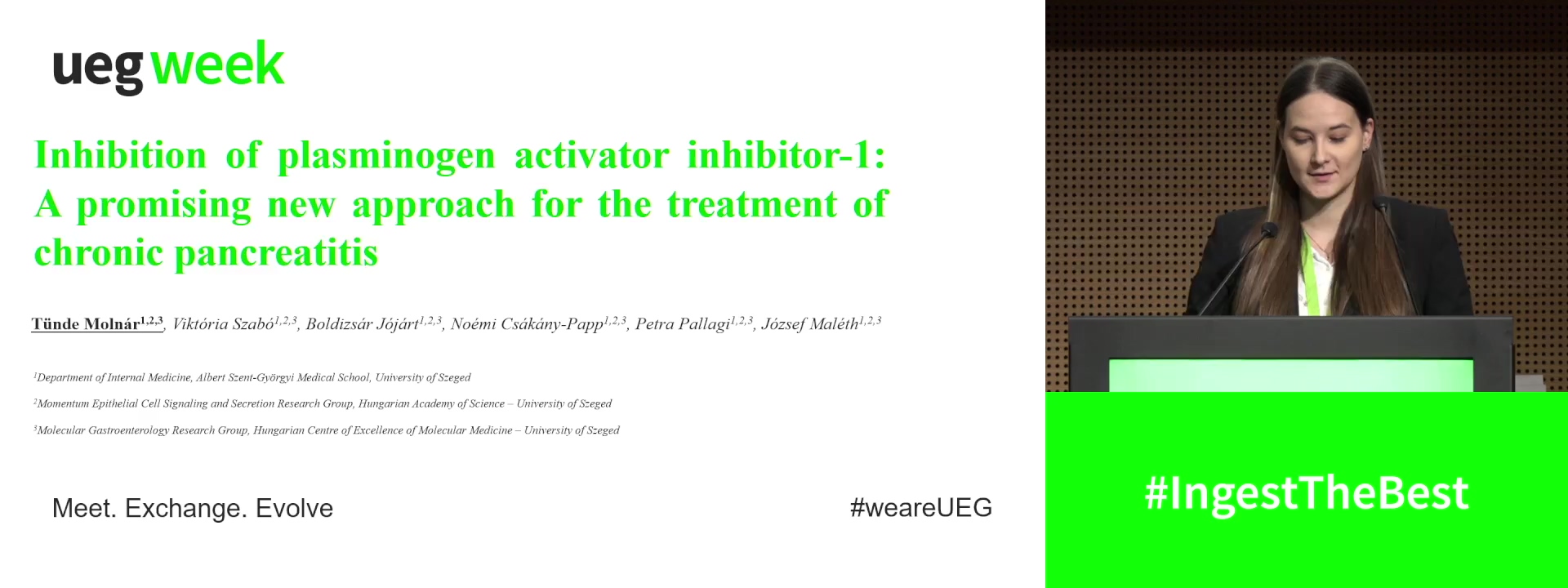
INHIBITION OF PLASMINOGEN ACTIVATOR INHIBITOR-1: A PROMISING NEW APPROACH FOR THE TREATMENT OF CHRONIC PANCREATITIS
Tünde Molnár 1, Viktória Szabó 1, Boldizsár Jójárt 1, Noémi Csákány-Papp 1, Petra Pallagi 1, József Maléth 1
1 University of Szeged, Szeged, Hungary|||ELKH-USz Momentum Epithelial Cell Signaling and Secretion Research Group, Szeged, Hungary|||University of Szeged, Szeged, Hungary
Event
Submission format
Citation
Published
Log in to access this content.
Free for all myUEG account holders. Your access level is set automatically based on your occupation. Medical professionals get full access to all content. If you are a non-medical user, you can only access UEG Week content from congresses you attended.
Not sure what you can access? Learn more about account types.
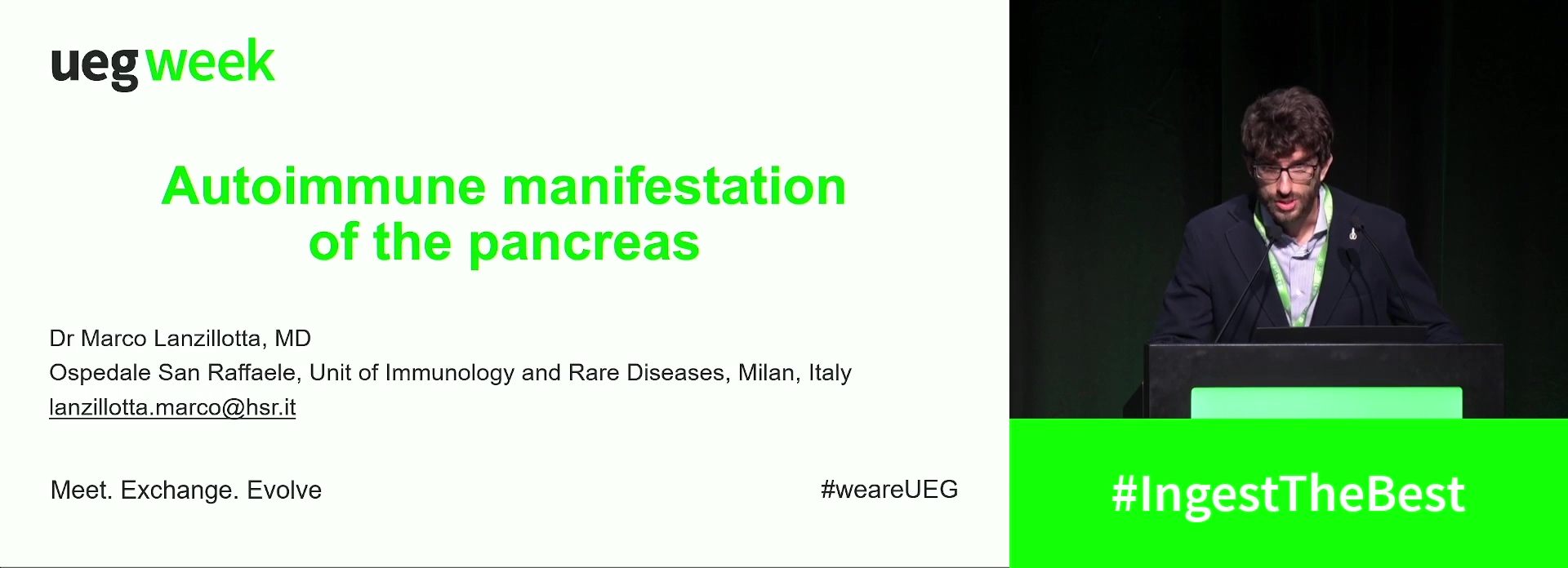
Autoimmune manifestation of the pancreas
1 San Raffaele Hospital: IRCCS Ospedale San Raffaele, Milan, Italy
Event
Topics
Session
Published
Log in to access this content.
Free for all myUEG account holders. Your access level is set automatically based on your occupation. Medical professionals get full access to all content. If you are a non-medical user, you can only access UEG Week content from congresses you attended.
Not sure what you can access? Learn more about account types.
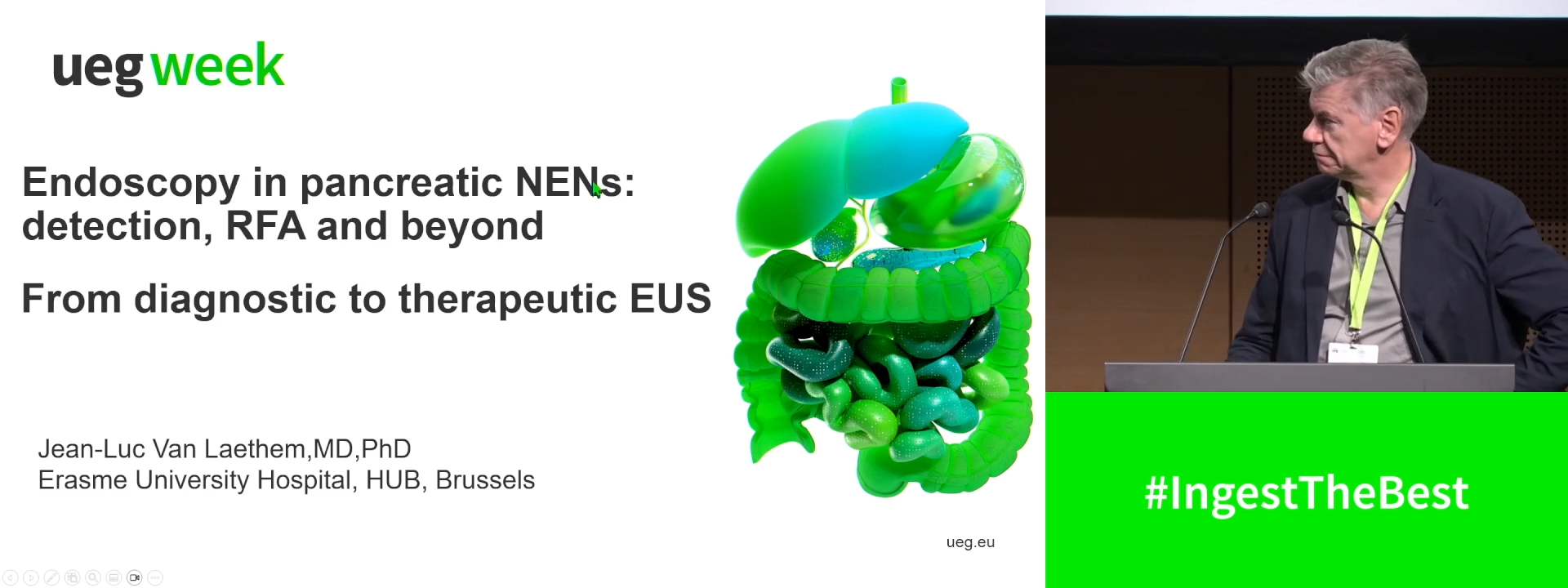
Endoscopy in pancreatic NENs: Detection, RFA and beyond
1 Erasme University Hopsital-ULB, Bruxelles, Belgium
Event
Topics
Citation
Published
Log in to access this content.
Free for all myUEG account holders. Your access level is set automatically based on your occupation. Medical professionals get full access to all content. If you are a non-medical user, you can only access UEG Week content from congresses you attended.
Not sure what you can access? Learn more about account types.
USEFULNESS OF PAN-PROMISE SYMPTOM SCORE AS AN ENDPOINT IN RANDOMIZED TRIALS IN ACUTE PANCREATITIS, A VALIDATION STUDY
Lucía Guilabert 1, Karina Cárdenas-Jaén 1, James L. Buxbaum 2, Ana Garcia Garcia de Paredes 3, Lorena Bernal 1, Jose Alberto Andreu Viseras 1, Sara Pérez-Brotons 1, Alicia Vaillo-Rocamora 1, Jesús Donate Ortega 3, Eduardo Tavío Hernández 3, Édgar E. Lozada Hernández 4, Diego Hinojosa Ugarte 4, Alba Lira Aguilar 5, Patricia Pedregal-Pascual 5, Rajiv Mehta 6, Dhvani D. Adhvaryu 6, Pablo Navarro Cortés 7, Isabel Pascual-Moreno 7, Claudia Sánchez-Marin 8, Marina Cobreros del Caz 8, Idaira Fernández Cabrera 9, Fernando Casals Seoane 10, Diego Casas Deza 11, Eugenia Lauret-Braña 12, Andrea García Gómez 13, Laura María Camacho-Montaño 14, David Ruiz-Clavijo Garcia 15, Belen GONZÁLEZ DE LA HIGUERA CARNICER 15, Federico Bolado Concejo 15, Rodrigo Jover 16, José J. Mira 17, Enrique de-Madaria 18
1 Dr. Balmis General University Hospital, ISABIAL, Alicante, Spain
2 University of Southern California, Los Angeles, United States
3 Hospital Universitario Ramon y Cajal, Madrid, Spain
4 Servicios de Salud del Instituto Mexicano del Seguro Social para el Bienestar (IMSS-BIENESTAR), León-Guanajuato, Mexico
5 Corporació Sanitària Parc Taulí, Sabadell, Spain
6 Surat Institute of Digestive Science (SIDS) Hospital and Research Centre, Surat, India
7 Hospital Clinico Universitario, Valencia, Spain
8 Marqués de Valdecilla University Hospital, Santander, Spain
9 Dr. Negrín Hospital, Las Palmas, Spain
10 Hospital Universitario de La Princesa, Madrid, Spain
11 Hospital Universitario Miguel Servet, Zaragoza, Spain
12 Central de Asturias University Hospital,Institute of Health Research of the Principality of Asturias ISPA, Oviedo, Spain
13 Lucus Augusti University Hospital, Lugo, Spain
14 Puerta del Mar University Hospital, Cadiz, Spain
15 Complejo Hospitalario Navarra, Pamplona, Spain
16 Dr. Balmis General University Hospital, ISABIAL, Alicante, Spain|||Miguel Hernández University, Elche, Spain
17 Miguel Hernández University of Elche, Elche, Spain|||Atenea Research Group, Foundation for the Promotion of Health and Biomedical Research of Valencia Region, FISABAO, San Juan, Spain
18 Miguel Hernández University, Elche, Spain|||Dr. Balmis General University Hospital, ISABIAL, Alicante, Spain
Conference
Topics
Submission format
Citation
Published
Log in to access this content.
Free for all myUEG account holders. Your access level is set automatically based on your occupation. Medical professionals get full access to all content. If you are a non-medical user, you can only access UEG Week content from congresses you attended.
Not sure what you can access? Learn more about account types.
PANCREATIC CANCER SCREENING IN HIGH-RISK PATIENTS: CAN WE DETECT RELEVANT FINDINGS?
Luisa Adán-Merino 1, Ana María Mora-Soler 1, Olivia Crivillén-Anguita 1, Celia Zaera-De la Fuente 1, Marta Roldán-Fernández 1, Francisco Garrido Gallego 1, Ángel Ponferrada-Díaz 1
1 Infanta Leonor University Hospital, Madrid, Spain
Conference
Topics