UEG's content platform for gastroenterology education bringing recordings, courses, guidelines, and more together in one place.
Trending on Gutflix
Rate for better recommendations!
Your feedback helps us show you more of what you like and less of what you dislike!
Log in to continue.
This content is part of Gutflix. Log in with your myUEG account, or create one free, to watch it.
Not sure what you can access? Learn more about account types.
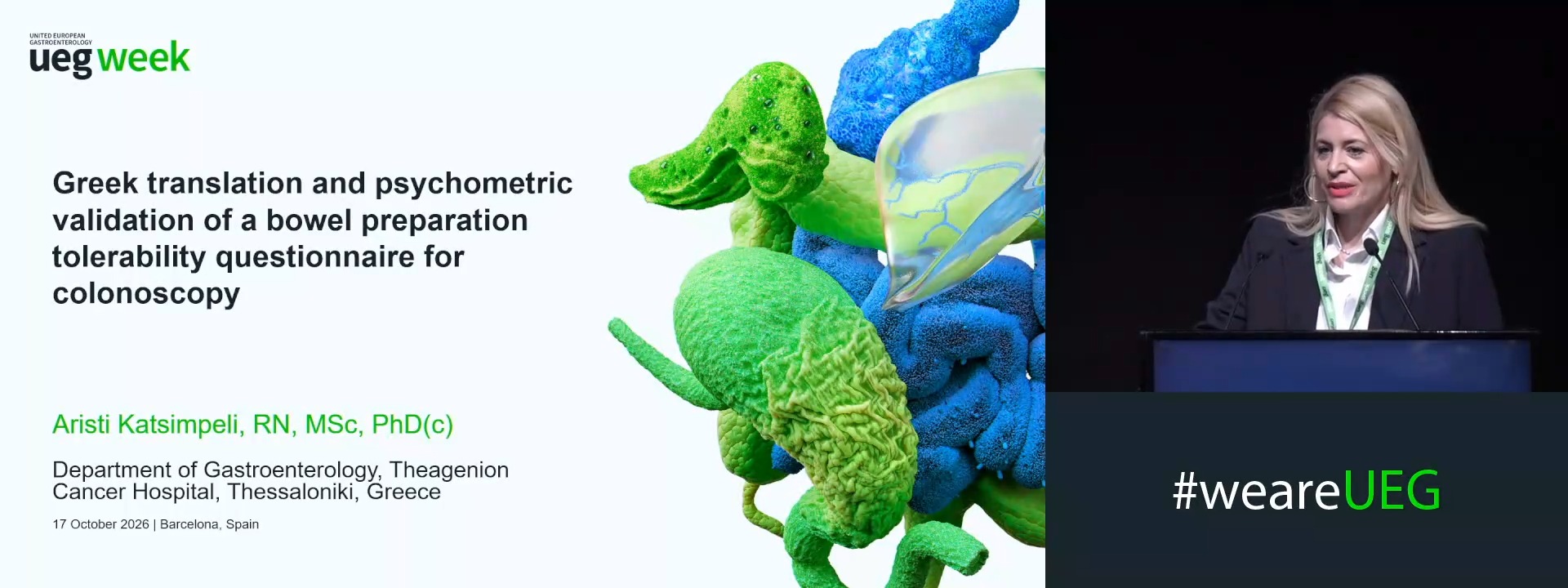
GREEK TRANSLATION AND PSYCHOMETRIC VALIDATION OF A BOWEL PREPARATION TOLERABILITY QUESTIONNAIRE FOR COLONOSCOPY
Aristi Katsimpeli 1, Georgia Lazaraki 2, Konstantinos Soufleris 3, Maria Lavdaniti 4, Ioannis Moschos 5, George Axiaris 6, Ilias Vachliotis 3, Areti Tsaloglidou 4
Affiliations
1 Theageneio Cancer Hospital of Thessaloniki, Thessaloniki, Greece
2 Theaghenion Cancer Hospital of Thessaloniki, Thessaloniki, Greece
3 Theagenion Anticancer Hospital of Thessaloniki, Thessaloniki, Greece
4 International Hellenic University, Sindos, Greece
5 Private Practice - Gastroenterology, Kalamaria, Greece
6 Theageneio Anticancer Hospital of Thessaloniki, Thessaloniki, Greece