UEG's content platform for gastroenterology education bringing recordings, courses, guidelines, and more together in one place.
Trending on Gutflix
Rate for better recommendations!
Your feedback helps us show you more of what you like and less of what you dislike!
Log in to continue.
This content is part of Gutflix. Log in with your myUEG account, or create one free, to watch it.
Not sure what you can access? Learn more about account types.
INTEGRATING MUCOSAL TRANSCRIPTOMIC AND MICROBIAL SIGNATURES TO DEFINE COMPREHENSIVE DISEASE CONTROL IN ULCERATIVE COLITIS AT MOLECULAR RESOLUTION
Finn Hinrichsen 1,2, Joana P. Bernardes 1, Víctor A. López-Agudelo 1, Neha Mishra 1, Lina Wehkamp 1,2, Florian Tran 1,2, Konrad Aden 1,2, Stefan Schreiber 1,2, Philip Rosenstiel 1,2
Affiliations
1 University Hospital Schleswig-Holstein UKSH, Kiel, Kiel, Germany
2 University Hospital Schleswig-Holstein UKSH, Campus Kiel, Kiel, Germany
Log in to continue.
This content is part of Gutflix. Log in with your myUEG account, or create one free, to watch it.
Not sure what you can access? Learn more about account types.
EFFICACY AND SAFETY OF DUVAKITUG MAINTENANCE THERAPY IN PATIENTS WITH CROHN’S DISEASE (CD): RESULTS FROM THE PHASE 2B RELIEVE UCCD LONG-TERM EXTENSION STUDY
Vipul Jairath 1, Alessandro Armuzzi 2,3, Silvio Danese 4, Bruce E. Sands 5, Bogdan Ratiu-Duma 6, Phillip Levine 7, Rajendra Singh 8, Nicholas Gross 8, Ken Abrams 9, Walter Reinisch 10
Affiliations
1 Department of Medicine, Schulich School of Medicine & Dentistry I Western University, Room A10-219, University Hospital, London, Canada
2 Department of Biomedical Sciences, Humanitas University, Milan, Italy
3 IBD Center, Department of Gastroenterology, IRCCS Humanitas Research Hospital, Milan, Italy
4 IRCCS Ospedale San Raffaele - University Vita-Salute, Milan, Italy
5 Dr. Henry D. Janowitz Division of Gastroenterology, Icahn School of Medicine at Mount Sinai, New York, United States
6 Teva Pharmaceuticals S.R.L, Bucharest, Romania
7 Sanofi, Cambridge, United States
8 Teva Branded Pharmaceutical Products R&D, Inc., West Chester, United States
9 Teva Branded Pharmaceutical Products R&D LLC., Parsippany, United States
10 Department of Internal Medicine III, Medical University of Vienna, Vienna, Austria
Log in to continue.
This content is part of Gutflix. Log in with your myUEG account, or create one free, to watch it.
Not sure what you can access? Learn more about account types.
BIOPSY-BASED SINGLE-CELL PROFILING OF ULCERATIVE COLITIS AND CROHN’S DISEASE REVEALS SHARED INFLAMMATORY ARCHITECTURE AND DISEASE-SPECIFIC IMMUNE PATHWAYS
E.A.M. (Noortje) Festen 1, Paola Pibiri 2, Roy Oelen 2, Werna T. C. Uniken Venema 3, Emilia Bigaeva 1, Monique G.P. Van der Wijst 2, Maria Paraskevopoulou 4, Klaas Nico Faber 2
Affiliations
1 UMCG, Groningen, Netherlands
2 University Medical Center Groningen, Groningen, Netherlands
3 Zuyderland Medisch Centrum, Leuven, Belgium
4 Takeda Pharmaceuticals, Acton, United States
Log in to continue.
This content is part of Gutflix. Log in with your myUEG account, or create one free, to watch it.
Not sure what you can access? Learn more about account types.
TOWARD PRECISION THERAPY IN ULCERATIVE COLITIS: GENOTYPE-BASED SINGLE-NUCLEOTIDE POLYMORPHISM (SNPS) SIGNATURES PREDICT DEEP RESPONSE TO USTEKINUMAB - A POST-HOC ANALYSIS OF THE UNIFI TRIAL
Affiliations
1 University College Cork, Cork, Ireland
Log in to continue.
This content is part of Gutflix. Log in with your myUEG account, or create one free, to watch it.
Not sure what you can access? Learn more about account types.
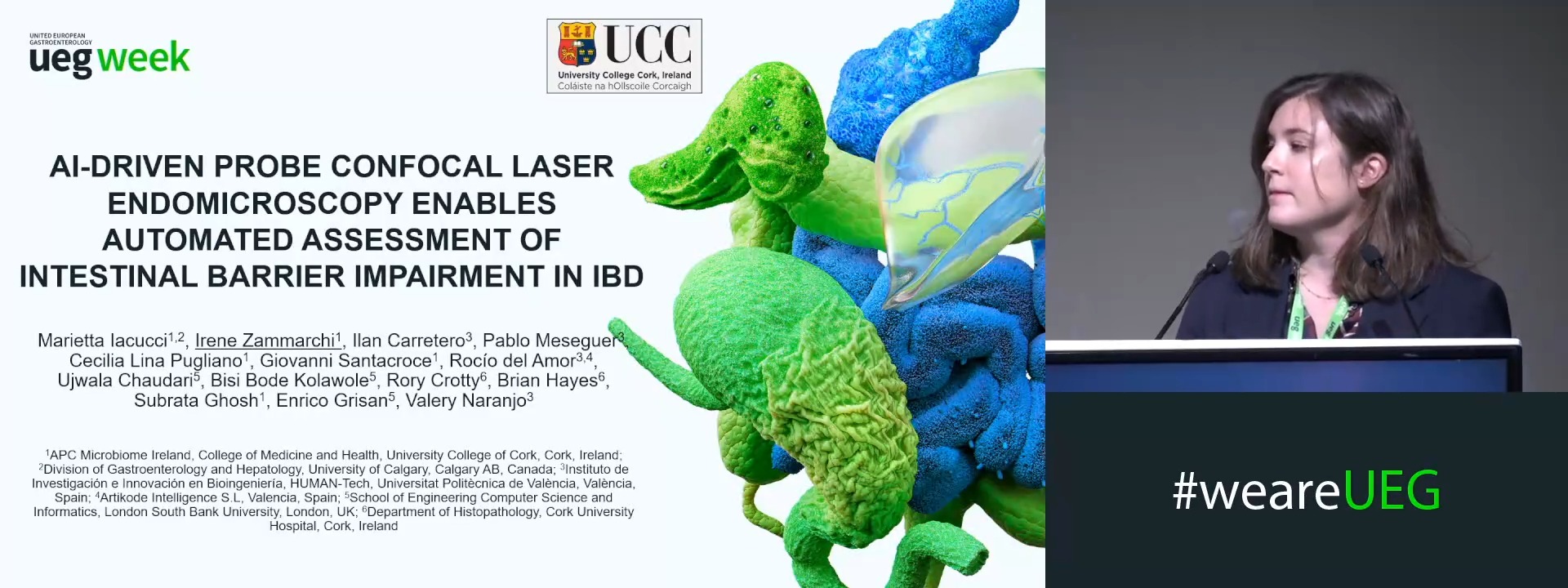
AI-DRIVEN PROBE CONFOCAL LASER ENDOMICROSCOPY ENABLES AUTOMATED ASSESSMENT OF INTESTINAL BARRIER IMPAIRMENT IN IBD
Marietta Iacucci 1,2, Irene Zammarchi 1, Ilan Carretero 3, Pablo Meseguer 3, Cecilia Lina Pugliano 1, Giovanni Santacroce 1, Rocio Del Amor 3,4, Ujwala Chaudhari 5, Bisi Bode Kolawole 5, Rory Crotty 6, Brian Hayes 6, Subrata Ghosh 1, Enrico Grisan 5, Valery Naranjo 3,4
Affiliations
1 University College Cork, Cork, Ireland
2 University of Calgary, Calgary, Canada
3 Universitat Politècnica de València, Valencia, Spain
4 Artikode Intelligence S.L., Valencia, Spain
5 London South Bank University, London, United Kingdom
6 Cork University Hospital, Cork, Ireland
Log in to continue.
This content is part of Gutflix. Log in with your myUEG account, or create one free, to watch it.
Not sure what you can access? Learn more about account types.
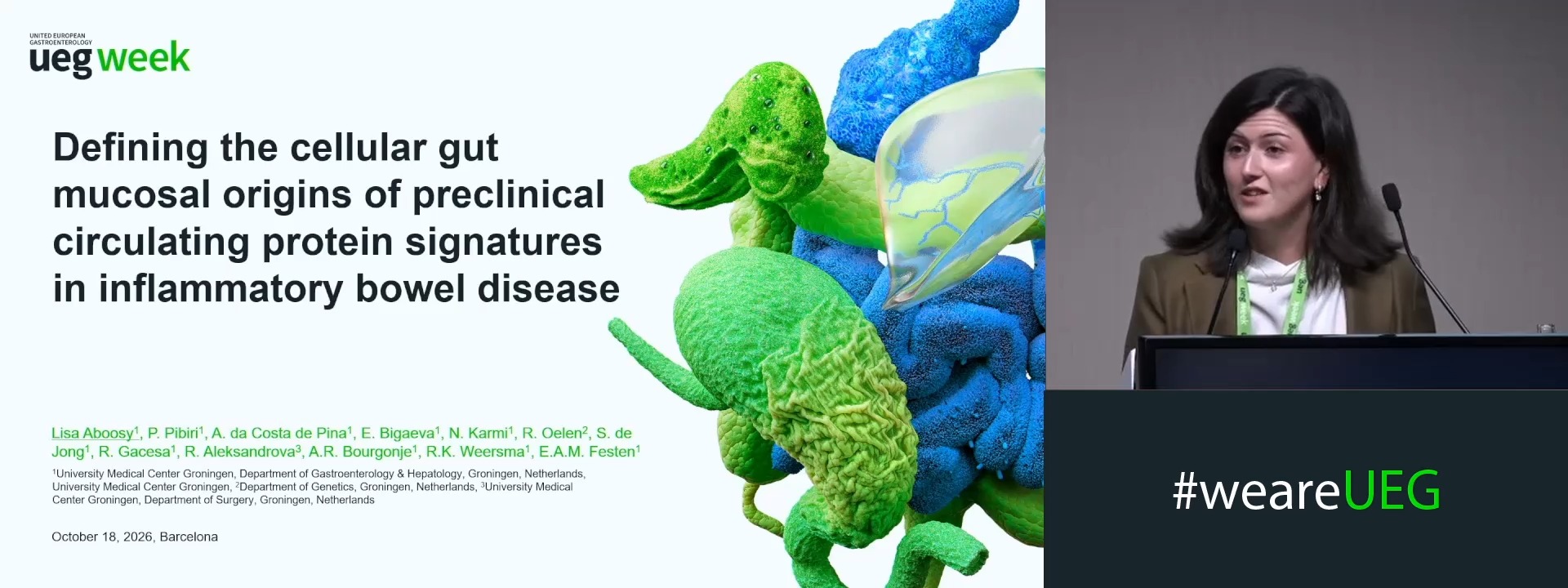
DEFINING THE CELLULAR GUT MUCOSAL ORIGINS OF PRECLINICAL CIRCULATING PROTEIN SIGNATURES IN INFLAMMATORY BOWEL DISEASE
Lisa Aboosy 1, Paola Pibiri 1, Antonio da Costa de Pina 1, Emilia Bigaeva 1, Naomi Karmi 1, Roy Oelen 1, Sofie de Jong 1, Rali Aleksandrova 1, Arno R. Bourgonje 1, Rinse K. Weersma 1, E.A.M. (Noortje) Festen 1
Affiliations
1 University Medical Center Groningen, Groningen, Netherlands