UEG's content platform for gastroenterology education bringing recordings, courses, guidelines, and more together in one place.
Trending on Gutflix
Rate for better recommendations!
Your feedback helps us show you more of what you like and less of what you dislike!
Log in to continue.
This content is part of Gutflix. Log in with your myUEG account, or create one free, to watch it.
Not sure what you can access? Learn more about account types.
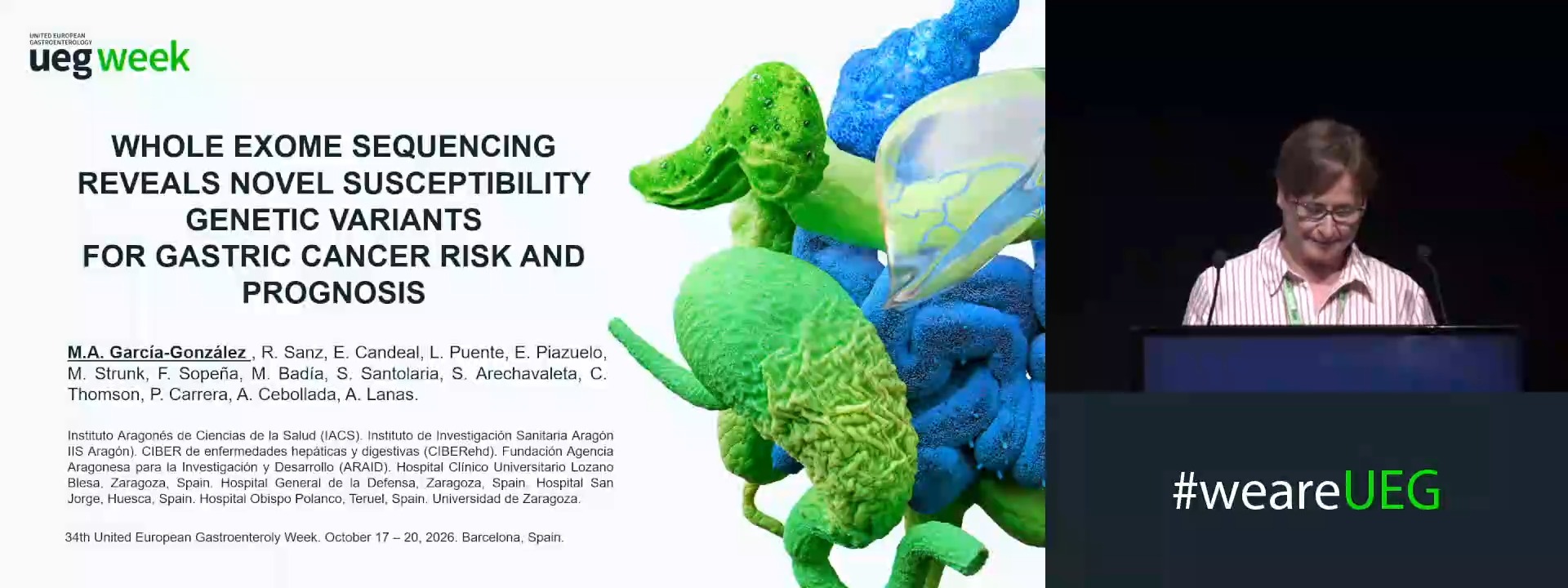
WHOLE EXOME SEQUENCING REVEALS NOVEL SUSCEPTIBILITY GENETIC VARIANTS FOR GASTRIC CANCER RISK AND PROGNOSIS
María Asunción García-González 1,2,3, Rebeca Sanz Pamplona 2,4, Eduardo Candeal Núñez 2, Laura Puente Santamaría 1, Elena Piazuelo Ortega 1,2,3, Mark Strunk 1, Federico Sopena 2,5,3, MARIA BADIA 6, Santos Santolaria Piedrafita 7, Samanta Arechavaleta 3,2, Concha Thomson Llisterri 8, Patricia Carrera-Lasfuentes 3, Alberto Cebollada 1, Angel Lanas 2,3,9
Affiliations
1 Instituto Aragonés de Ciencias de la Salud, Zaragoza, Spain
2 Instituto de Investigación Sanitaria Aragón, Zaragoza, Spain
3 CIBER de enfermedades hepáticas y digestivas (CIBERehd), Zaragoza, Spain
4 Fundación Agencia Aragonesa para la Investigación y Desarrollo (ARAID), Zaragoza, Spain
5 Hospital Clínico Universitario Lozano Blesa, Zaragoza, Spain
6 Hospital General de la Defensa, Zaragoza, Spain
7 Hospital San Jorge, Huesca, Spain
8 Hospital Obispo Polanco, Teruel, Spain
9 Universidad de Zaragoza, Zaragoza, Spain
Log in to continue.
This content is part of Gutflix. Log in with your myUEG account, or create one free, to watch it.
Not sure what you can access? Learn more about account types.
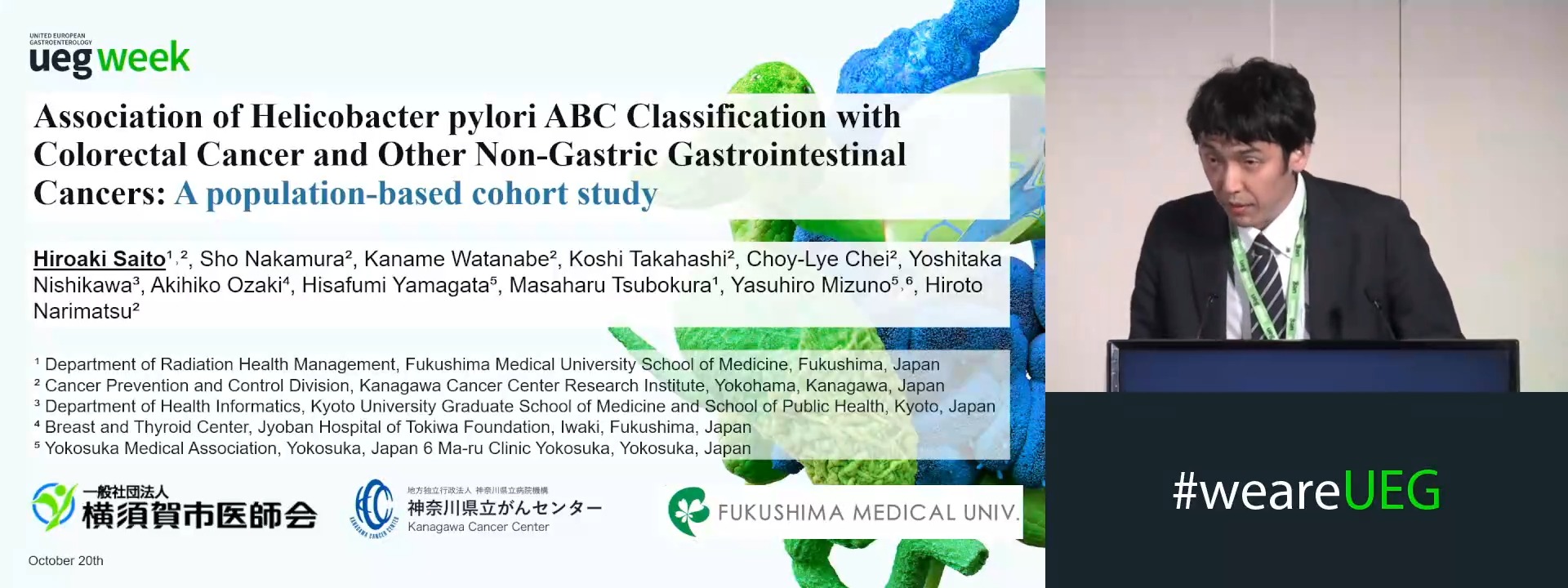
ASSOCIATION OF HELICOBACTER PYLORI ABC CLASSIFICATION WITH COLORECTAL CANCER AND OTHER NON-GASTRIC GASTROINTESTINAL CANCERS: A POPULATION-BASED COHORT STUDY
HIROAKI SAITO 1,2, Sho Nakamura 2, Kaname Watanabe 2, Koshi Takahashi 2, Choy-Lye Chei 2, Yoshitaka Nishikawa 3, Akihiko Ozaki 2,4, Hisafumi Yamagata 5, Masaharu Tsubokura 1, Yasuhiro Mizuno 6,5, Hiroto Narimatsu 2
Affiliations
1 Fukushima Medical University School of Medicine, Fukushima, Japan
2 Kanagawa Cancer Center Research Institute, Yokohama, Japan
3 Kyoto University Graduate School of Medicine and School of Public Health, Kyoto, Japan
4 Jyoban Hospital of Tokiwa Foundation, Iwaki, Japan
5 Yokosuka Medical Association, Yokosuka, Japan
6 Ma-ru Clinic Yokosuka, Yokosuka, Japan
Log in to continue.
This content is part of Gutflix. Log in with your myUEG account, or create one free, to watch it.
Not sure what you can access? Learn more about account types.
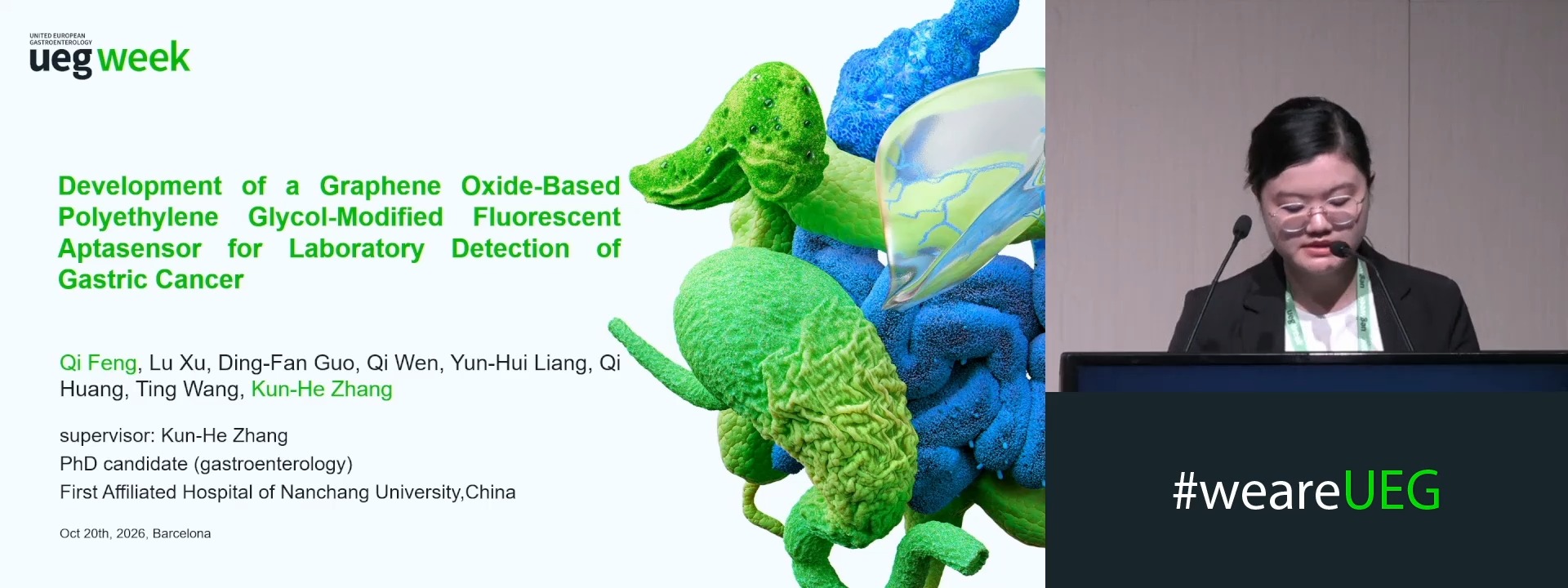
DEVELOPMENT OF A GRAPHENE OXIDE-BASED POLYETHYLENE GLYCOL-MODIFIED FLUORESCENT APTASENSOR FOR LABORATORY DETECTION OF GASTRIC CANCER
Qi Feng 1, Lu Xu 1, Ding-Fan Guo 1, Qi Wen 1, Yun-Hui Liang 1, Qi Huang 1, Ting Wang 1, Kun-He Zhang 1
Affiliations
1 First Affiliated Hospital of Nanchang University, Nanchang, China