UEG's educational platform for gastroenterology education bringing recordings, courses, guidelines, and more together in one place.
Most popular content
Rate for better recommendations!
Your feedback helps us show you more of what you like and less of what you dislike!
Log in to access this content.
Free for all myUEG account holders. Your access level is set automatically based on your occupation. Medical professionals get full access to all content. If you are a non-medical user, you can only access UEG Week content from congresses you attended.
Not sure what you can access? Learn more about account types.

EFFICACY OF ARGON PLASMA COAGULATION (APC) IN THE REDUCTION OF GASTROJEJUNAL ANASTOMOSIS FOR WEIGHT REGAIN AFTER ROUX-EN-Y GASTRIC BYPASS
Clara Rodriguez Carrillo 1, Sara Mera-Carreiro 1, Blanca Bernaldo-Madrid 1, Rafael Sánchez del Hoyo 2, Miguel Angel Rubio-Herrera 1, Jose Miguel Esteban López-Jamar 1
1 Hospital Clinico San Carlos, Madrid, Spain
2 Hospital Clínico San Carlos, IdISSC, Madrid, Spain
Conference
Topics
Submission format
Citation
Published
Log in to access this content.
Free for all myUEG account holders. Your access level is set automatically based on your occupation. Medical professionals get full access to all content. If you are a non-medical user, you can only access UEG Week content from congresses you attended.
Not sure what you can access? Learn more about account types.
OLGA STAGE II IS A SIGNIFICANT RISK FACTOR FOR GASTRIC CANCER: A SYSTEMATIC REVIEW AND META-ANALYSIS EMPHASISING INTERMEDIATE HISTOLOGICAL STAGES
Juan Frias-Ordoñez 1, Sebastián Fernando Niño Ramirez 2, Hernando Marulanda 3, Juan Camilo Perez 4, Katherine Caita 4, Elder Otero 5, Lina Otero 6, william Otero 6
1 Hospital Internacional de Colombia, Bucaramanga, Colombia|||National University of Colombia, Bogota, Colombia
2 Universidad CES, Medellin, Colombia
3 National University of Colombia, Bogota, Colombia|||Centro de Gastroenterología y Endoscopia, Bogota, Colombia
4 CES University, Medellin, Colombia
5 Centro de Gastroenterología y Endoscopia, Bogota, Colombia
6 Centro de Gastroenterología y Endoscopia, Bogota, Colombia|||National University of Colombia, Bogota, Colombia
Conference
Topics
Submission format
Citation
Published
Log in to access this content.
Free for all myUEG account holders. Your access level is set automatically based on your occupation. Medical professionals get full access to all content. If you are a non-medical user, you can only access UEG Week content from congresses you attended.
Not sure what you can access? Learn more about account types.
ROLE OF ENDOSCOPIC BILIARY STENTING IN ACCESS TO CHEMOTHERAPY IN PATIENTS WITH UNRESECTABLE MALIGNANT OBSTRUCTION
1 Medical University of Silesia, Katowice, Poland
2 Univeristy of Silesia, Katowice, Poland
Conference
Topics
Submission format
Session
Citation
Published
Log in to access this content.
Free for all myUEG account holders. Your access level is set automatically based on your occupation. Medical professionals get full access to all content. If you are a non-medical user, you can only access UEG Week content from congresses you attended.
Not sure what you can access? Learn more about account types.
PAPILLARY LARGE BALLOON DILATATION VERSUS ENDOSCOPIC COMPLETE SPHINCTEROTOMY IN PATIENTS WITH LARGE COMMON BILE DUCT STONE(S) AND PERIAMPULLARY DIVERTICULUM
Ibrahim M. Ibrahim 1, Tarek I. Zaher 1, Soha E. Khorshed 1, mahmoud sheded 2, Tarek Mostafa Ibrahim Mohammed 2, Ahmed Atya 1, Mohamed Hassan Emara Elzanan 3, Mohammed Ahmed Hasuna Hemeda 1
1 Zagazig University, Zagazig, Egypt
2 Suez University, Suez, Egypt
3 Kafrelsheikh University, Kafr Elshiekh, Egypt|||Alyousif Hospital, Alkhobar, Saudi Arabia
Conference
Topics
Submission format
Citation
Published
Log in to access this content.
Free for all myUEG account holders. Your access level is set automatically based on your occupation. Medical professionals get full access to all content. If you are a non-medical user, you can only access UEG Week content from congresses you attended.
Not sure what you can access? Learn more about account types.
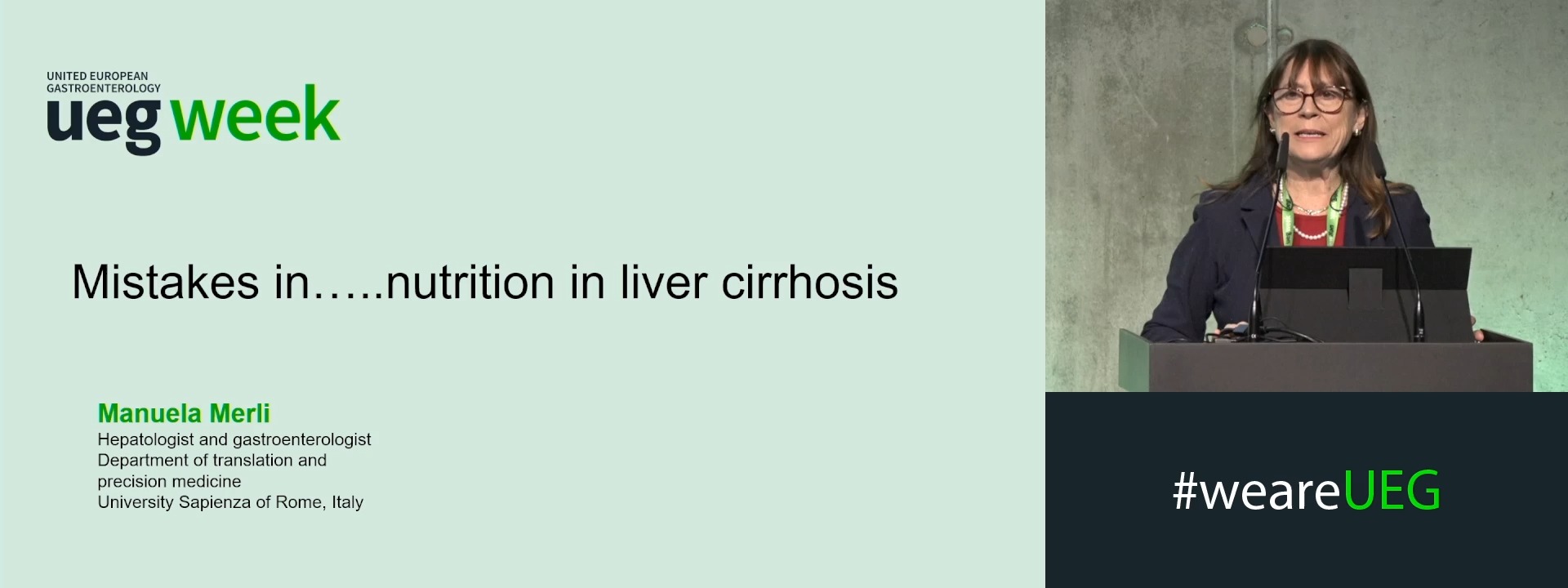
Nutrition in chronic liver disease
1 Sapienza University of Rome, Rome, Italy
Event
Citation
Published
Log in to access this content.
Free for all myUEG account holders. Your access level is set automatically based on your occupation. Medical professionals get full access to all content. If you are a non-medical user, you can only access UEG Week content from congresses you attended.
Not sure what you can access? Learn more about account types.
HISTOPATHOLOGICAL CORRELATIONS OF TISSUE SOUND SPEED IN HEPATOCELLULAR CARCINOMA: A QUANTITATIVE ASSESSMENT USING ACOUSTIC MICROSCOPY
1 Graduate School of Medicine, Tohoku University, Sendai, Japan|||Saitama Cooperative Hospital, Kawaguchi, Japan
2 Graduate School of Medicine, Tohoku University, Sendai, Japan
3 Honda Electronics, Co., Ltd., Toyohashi, Japan
4 Saitama Cooperative Hospital, Kawaguchi, Japan
Conference
Topics
Submission format
Session
Citation
Published
Log in to access this content.
Free for all myUEG account holders. Your access level is set automatically based on your occupation. Medical professionals get full access to all content. If you are a non-medical user, you can only access UEG Week content from congresses you attended.
Not sure what you can access? Learn more about account types.
IMPACT OF PROBIOTICS ON GUT MICROBIOTA AND METABOLOME DURING HIGH-DOSE DUAL THERAPY WITH VONOPRAZAN AND AMOXICILLIN AS HELICOBACTER PYLORI RESCUE THERAPY: A PROSPECTIVE, MULTICENTER, RANDOMIZED CONTROLLED STUDY
1 Zhongshan Hospital (Xiamen), Fudan University, Xiamen, China
2 Third Hospital of Xiamen, Xiamen, China
3 Second Affiliated Hospital of Xiamen Medical College, Xiamen, China
4 Zhongshan Hospital Fudan University, Shanghai, China
Conference
Topics