Introduction
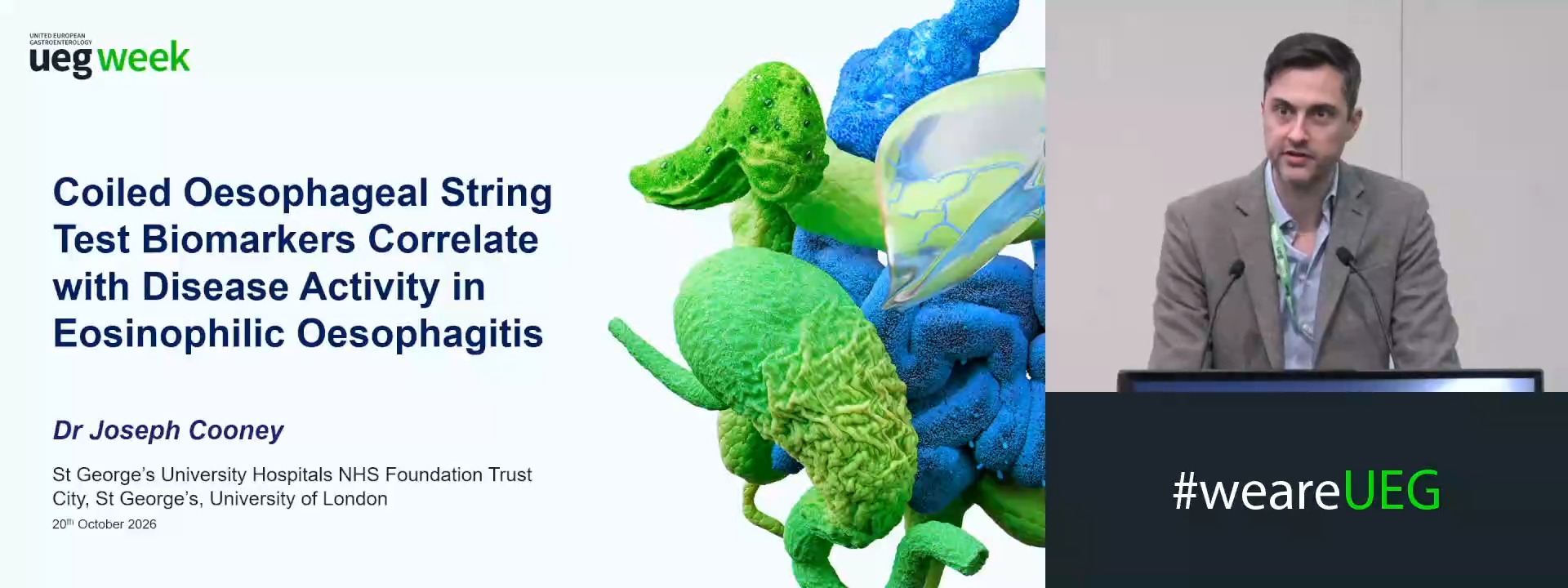
Eosinophilic oesophagitis (EoE) is a chronic inflammatory condition causing dysphagia. Endoscopic features of inflammation and fibrostenosis may be present but diagnosis requires symptoms alongside eosinophils of >15/0.3mm2 on mucosal biopsy. Monitoring disease activity relies on endoscopy and biopsy, however this is a costly and invasive approach. Minimally invasive luminal sampling of biomarkers using a swallowed oesophageal string test offers a potential alternative to determine disease activity. We aimed to evaluate the relationship between string test derived biomarkers and disease activity, and to compare their relative performance across validated histological, endoscopic and symptom domains.
Aims & Methods
Adult patients with EoE were prospectively recruited as part of a research study (EoEAST, IRAS 303427). Patients underwent gastroscopy (OGD) with histological assessment (peak eosinophil count and EoE Histology Scoring System [EoE-HSS]), endoscopic grading using EREFS, and symptom evaluation using validated patient reported outcome measures (RDQ, HODQ, and EoE-QoL). Same day oesophageal luminal sampling was performed using a swallowed coiled oesophageal string test (CEST), with protein extraction and quantification of eosinophil cationic protein (ECP), eosinophil-derived neurotoxin (EDN), periostin and plasminogen activator inhibitor-1 (PAI-1) by ELISA.
Results
70 patients were included; median age 42 years [range 20–67]), 46 underwent repeat testing following treatment.
ECP correlated with peak eos/0.3mm2 (r=0.2745, p<0.0001) and with EoE-HSS (r=0.3253, p=0.0002). EDN also correlated with eos/0.3mm2 (r=0.2943, p=0.0008) and EoE-HSS (r=0.3165, p=0.0064). Periostin showed weaker associations and PAI-1 showed no significant relationships.
log-transformed ECP independently predicted >15eos/0.3mm2 (OR 2.59, 95% CI 1.44–4.67, p=0.002). Periostin demonstrated a statistically significant but minimal effect size (OR 1.001, 95% CI 1.000–1.001, p=0.011), while EDN and PAI-1 were not significant predictors.
ROC analysis for >15eos/0.3mm2 demonstrated moderate discrimination for ECP (AUC 0.6411, p=0.0070), EDN (AUC 0.6473, p=0.0341) and periostin (AUC 0.6449, p=0.0056), but not PAI-1 (AUC 0.5952, p=0.0696).
ECP showed the strongest correlation with endoscopic severity (EREFS; r=0.31, p<0.001), with weaker associations for EDN and periostin, and no association with PAI-1.
Peak eos/0.3mm2, EoE-HSS and EREFS demonstrated moderate inter-correlation, whereas symptom scores showed weak or absent associations, and treatment related changes were reflected in objective measures but not symptoms. Biomarkers correlated more closely with histological and endoscopic disease activity than with symptom scores, which showed only weak associations.
CEST sampled biomarker comparisons with EoE severity measures
|
|---|
Biomarker
| Peak eos/mm2 Spearman r
| >15eos/0.3mm2 Binary logistic regression OR
| >15eos/0.3mm2 AUC (ROC)
| EoE-HSS Spearman r
| EREFS Spearman r
|
ECP
| 0.27 p=0.002
| 2.59 (1.44–4.67), p=0.002
| 0.64 (0.54–0.74), p=0.007
| 0.33 p=0.0002
| 0.31 p=0.0003
|
EDN
| 0.25 p=0.031
| OR 2.83, (NS)
| 0.65 (0.51–0.78), p=0.034
| 0.32 p=0.006 | 0.31 p=0.009
|
| Periostin | 0.24 p=0.006
| OR 1.001, p=0.018
| 0.64 (0.55–0.74), p=0.006
| 0.22 p=0.014
| 0.1325 (NS)
|
PAI-1
| −0.13 (NS)
| OR 0.993 (0.98–1.00), (NS)
| 0.60 (0.49–0.70), (NS) | −0.09 (NS) | -0.06953 (NS) |
Conclusion
CEST captures luminal biomarkers associated with objective disease activity in EoE. ECP was the most robust and consistent biomarker of disease activity, independently predicting active disease and outperforming other markers. It represents a promising non-invasive tool for objectively assessing disease activity, correlating more closely with endoscopic and histological severity than symptom based measures. Identification of further biomarkers is required to optimise assessment, particularly when monitoring response to treatment.