Introduction
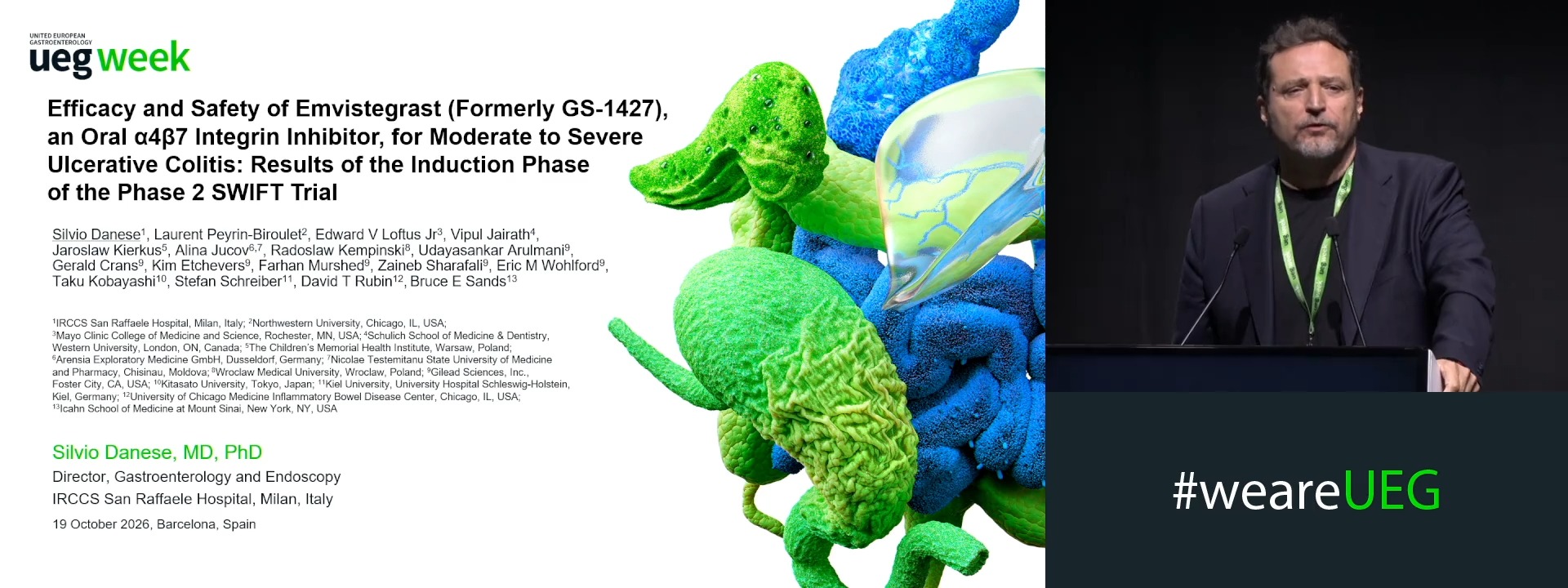
Emvistegrast (formerly GS‑1427) is an investigational, once-daily, oral, small molecule therapy for inflammatory bowel disease. Following absorption, emvistegrast is converted to its active metabolite, GS-1069518, which selectively inhibits the gut-specific α4β7 integrin receptor, thereby blocking immune cell trafficking to the gut and reducing intestinal inflammation.
Aims & Methods
SWIFT was a Phase 2, randomised, double‑blind, placebo‑controlled, multicentre, dose‑ranging study evaluating the efficacy and safety of emvistegrast in adults aged 18-75 years with moderately to severely active ulcerative colitis (UC; determined by endoscopy at screening with a total modified Mayo Clinic Score [mMCS] of 5-9 points, including a centrally-read endoscopic subscore of ≥2) who had inadequate response, loss of response, or intolerance to ≥1 UC treatment and <3 advanced therapy (AT) mechanisms of action for UC. Participants were randomised 1:1:1:1 to receive once-daily oral emvistegrast (200 mg, 75 mg, or 25 mg) or placebo. The study comprised 3 sequential phases: a 12‑week placebo-controlled induction phase (Part A); a blinded, placebo rerandomised maintenance phase through Week 52 (Part B); and a continued blinded treatment extension through Week 116 (Part C). Primary endpoint was the proportion of participants achieving clinical response at Week 12. Key secondary endpoints included safety and clinical remission, histologic endoscopic mucosal improvement (HEMI), mucosal healing, and endoscopic improvement. Here we present results from the Part A induction phase.
Results
Overall, 238 participants (emvistegrast: 25 mg, 60; 75 mg, 59; 200 mg, 59; placebo: 60) were enrolled. Of these, 92% completed through Week 12. Baseline characteristics were well balanced across groups. 78% of participants were naive to AT, while 22% had previously failed ≤2 ATs of distinct mechanisms of action. At Week 12, clinical response was achieved by 66% of participants receiving emvistegrast 200 mg and 37% of participants receiving placebo (P <0.001; Table). Clinical remission was achieved in 31% and 8% of participants receiving emvistegrast 200 mg and placebo, respectively (P <0.05).
At Week 12, the 200 mg emvistegrast group was significantly different from placebo for all secondary endpoints assessed (P <0.05). HEMI was achieved by 26% of emvistegrast 200 mg participants versus 9% for placebo. Mucosal healing was achieved by 24% of emvistegrast 200 mg participants versus 9% of placebo participants. A total of 39% of 200 mg emvistegrast participants versus 12% of placebo participants had endoscopic improvement.
Emvistegrast was generally well tolerated. Adverse events (AEs) occurred in 86/238 participants (emvistegrast: 64/178 [36%]; placebo: 22/60 [37%]) and were largely Grade ≤2. Serious AEs occurred in 4 (2%) participants receiving emvistegrast and no participants receiving placebo; all were deemed unrelated to study drug. Overall, 3/238 (1%) patients discontinued the study due to AEs. No cases of progressive multifocal leukoencephalopathy were reported.
Conclusion
Emvistegrast 200 mg met the primary endpoint and all secondary endpoints assessed, with a favourable safety profile, supporting its Phase 3 development for both forms of inflammatory bowel disease.
Key Efficacy Endpoint, n (%)
| Emvistegrast 200 mg
(N = 59)
| Emvistegrast
75 mg
(N = 59)
| Emvistegrast
25 mg
(N = 60)
| PBO
(N = 60)
| Treatment difference (95% CI),
P valuea
|
Clinical responseb
| 39 (66)
| 30 (51)
| 26 (43)
| 22 (37)
| 30.2
(13.5, 46.8);
P = 0.0004
|
Clinical remissionc
| 18 (31)
| 5 (9)
| 12 (20)
| 5 (8)
| 22.6
(8.6, 36.5);
P = 0.0015
|
HEMId
| 14 (26)
| 5 (10)
| 10 (19)
| 5 (9)
| 16.7
(2.3, 31.2);
P = 0.0231
|
Mucosal healinge
| 13 (24)
| 5 (10)
| 9 (17)
| 5 (9)
| 14.9
(0.7, 29.0);
P = 0.0395
|
Endoscopic improvementf
| 23 (39)
| 8 (14)
| 15 (25)
| 7 (12)
| 27.8
(13.0, 42.7);
P = 0.0002
|
aEmvistegrast 200 mg versus placebo; treatment difference, 95% CI, and P values were estimated using stratum-adjusted Mantel-Haenszel approach, where strata were defined by randomization factor endoscopic subscore at baseline (2 vs 3).
bDecrease from baseline in mMCS of ≥2 points, ≥30% reduction from baseline in mMCS, and decrease in rectal bleeding subscore of ≥1 from baseline or an absolute rectal bleeding subscore of 0 or 1.
cmMCS of ≤ 2, including a stool frequency subscore ≤1 and not greater than baseline, rectal bleeding subscore of 0, and centrally read endoscopic subscore ≤1.
dGeboes score ≤3.1 and endoscopic subscore ≤1.
eGeboes score ≤2B.1 and endoscopic subscore ≤1.
fEndoscopic subscore of ≤1.
HEMI, histologic endoscopic mucosal improvement; mMCS, modified Mayo Clinic Score; PBO, placebo. |
Disclosure
SD: speaker, consultant, and advisory board member for AbbVie, Allergan, Biogen, Boehringer Ingelheim, Celgene, Celltrion, Ferring, Hospira, J&J, Merck, MSD, Mundipharma, Pfizer, Sandoz, Takeda, TiGenix, UCB Pharma, and Vifor.
LP-B: consulting services to Abbvie, Abivax, Adacyte, Ailmentiv, Alfasigma, Amgen, Apini, Banook, BMS, Celltrion, Enthera, Ferring, Fresenius Kabi, Galapagos, Genentech/Roche, Gilead, GSK, Hemay, Iterative Health, Janssen, LifeMine, Lilly, Medac, Mirador, Morphic, MSD, Nordic Pharma, Novartis, Oddifact, Oncodesign Precision Medicine, Onco3R, Ono Pharma, OSE Immunotherapeutics, Palisade Bio, Par’Immune, Pfizer, Prometheus, Roche, Roivant, Samsung, Sandoz, Sanofi, Sorriso, Spyre, Takeda, Teva, ThirtyfiveBio, Tillots, VectivBio, Vedanta, and Ventyx; owns stock options in Iterative Health, Oragen, Pharmanest, and Thetis; lecture support from Abbvie, Alfasigma, Amgen, Biogen, Celltrion, Ferring, Fresenius Kabi, Galapagos, Genentech/Roche, Gilead, Iterative Health, Janssen, Lilly, Medac, MSD, Nordic Pharma, Novartis, Pfizer, Roche, Sandoz, Takeda, and Tillots.
ELJr: consulting services to Abbvie, Abivax, Astellas, Avalo, Biocon, BMS, Celltrion, Genentech/Roche, Gilead, Iota Biosciences, Iterative Health, Janssen, Lilly, Merck, Morphic, Ono Pharma, Spyre, Takeda, and TR1X Bio; research support from Abbvie, Gilead, Janssen, Merck, and TR1X Bio; shareholder in Exact Sciences and Moderna.
VJ: consulting/advisory services to AbbVie, Alimentiv Inc, Arena, Asahi Kasei, Asieris, AstraZeneca, Avoro Capital, BMS, Celltrion, Endpoint Health, Ferring, Flagship Pioneering, Fresenius Kabi, Galapagos, Gilde Healthcare, GlaxoSmithKline, Genentech/Roche, Gilead, Janssen, Lilly, Merck, Metacrine, Mylan, Pandion, Pendopharm, Pfizer, Protagonist, Prometheus, Reistone Biopharma, Sandoz, Second Genome, Sorriso, Takeda, Teva, Topivert, Ventyx, Vividion; speaker for Abbvie, Ferring, BMS, Galapagos, Janssen Pfizer Shire, Takeda, Fresenius Kabi; salary support from the John and Susan McDonald Endowed Chair at Western University, Canada.
JK: grant funding from Nestle.
AJ: advisor to Vir and Bluejay.
RK: lecture fees from Abbvie, Aboca, Ferring, J&J, and Lilly; meeting/travel support from J&J and Takeda.
UA, GC, KE, FM, ZS, and EMW: employees and stockholders of Gilead.
TK: advisory board member, consultant, or speaker for Abbvie GK, Alfresa Pharma Corporation, Alimentiv, BMS, Celltrion, Covidien, EA Pharma, Eli Lilly Japan, Ferring, Galapagos, Gilead, Janssen, JIMRO, Kissei, Kowa, Kyorin, Mitsubishi Tanabe Pharma, Mochida, MSD, Nippon Kayaku, Pfizer Japan, Sanofi, Sekisui Medical, Spyre, Takeda, TOPPAN Holdings, and Zeria; and receiving research funding from Abbvie GK, Alfresa Pharma Corporation, BMS, EA Pharma, Gilead, Helmsley Charitable Trust, JIMRO, Kyorin, Miyarisan, Mochida, Nippon Kayaku, Pfizer Japan, Sekisui Medical, Samsung, Takeda, and Zeria.
SS: personal fees from AbbVie, Amgen, Arena, Biogen, BMS, Celgene, Celltrion, Dr Falk Pharma, Ferring, Fresenius, Galapagos, Gilead, Hexal/Sandoz, I‐MAB, Janssen, Lilly, MSD, Mylan, Pfizer, Protagonist Therapeutics, Provention Bio, Takeda, Theravance, and UCB; consulting services to the advisory board of AbbVie and Arena.
DR: grant support from Takeda and Pfizer; consultant for Abbvie, Abivax, Altrubio, Athos Therapeutics, Inc., BMS, Celltrion, Clostrabio, Connect BioPharma, Genentech/Roche, Gilead, Iterative Health, J&J, Lilly, Merck, Mirador, Odyssey, Pfizer, Sanofi, Spyre, Takeda, Throne, Vedanta, and Ventyx.
BES: honoraria for consulting from Aclaris, Adaxion, Adiso, Agomab, Alfasigma, Alimentiv, Amgen, AnaptysBio, AstraZeneca, Attovia, Biolojic Design, BiomeBank, Biora, Boehringer-Ingelheim, Caldera, Cellarity, Cytoki Pharma, Disc Medicine, Ensho, Enthera, Enveda Biosciences, Equilium, Evommune, Ferring, Fzata, Galapagos, Genentech/Roche, Genesis, Gilead, GSK, Ignite Biomedical, Imhotex, Immunitas, Immunyx Pharma, Kallyope, Kyowa Kirin, LifeMine, Lilly, Merck, Merck Sharp & Dohme, Microba, Microbiotica, Mirador, Mitsubishi Tanabe Pharma, Mobius Care, Morphic, MRM Health, Nexus, Nimbus Discovery, Novartis, Numab, Odyssey, Ono Pharma, OSE Immunotherapeutics, Palisade Bio, Pioneering Medicines Explorations, Prometheus Biosciences, Protagonist, Q32 Bio, Quotient, Rasayana, Recludix Pharma, Reistone Biopharma, Sanofi, Slate Bio, Sorriso, Spyre, Synlogic, Target RWE, Televant, Teva, Thetis, SRT, TR1X Bio, Trex Bio, Union, VectivBio, Vedanta, Vividion, and Xencor; honoraria for consulting and speaking and other support from Abbvie, Abivax, BMS, Celltrion, Genentech/Roche, J&J/Janssen, Lilly, Merck, Pfizer, Takeda, and Teva; honoraria for consulting, stock options from Caldera, Mirador Therapeutics, and SRT; and stock from Doximity.