UEG's educational platform for gastroenterology education bringing recordings, courses, guidelines, and more together in one place.
Most popular content
Rate for better recommendations!
Your feedback helps us show you more of what you like and less of what you dislike!
Log in to access this content.
Free for all myUEG account holders. Your access level is set automatically based on your occupation. Medical professionals get full access to all content. If you are a non-medical user, you can only access UEG Week content from congresses you attended.
Not sure what you can access? Learn more about account types.

ALKALINE PHOSPHATASE CHANGES WITH SELADELPAR ACROSS SUBGROUPS OF PRIMARY BILIARY CHOLANGITIS PATIENTS IN THE RESPONSE TRIAL
Kris V. Kowdley 1, Kidist K. Yimam 2, Sonal Kumar 3, Edward Mena 4, Alan Bonder 5, K. Gautham Reddy 6, Christophe Corpechot 7, Jörn Schattenberg 8, Susheela Carroll 9, Ke Yang 9, Daria B. Crittenden 9, Charles A. McWherter 10
1 Liver Institute Northwest, Seattle, United States
2 Sutter Pacific Medical Foundation, California Pacific Medical Center, San Francisco, United States
3 Clinical Hepatology, Weill Cornell Medical College, New York, United States
4 California Liver Research Institute, Pasadena, United States
5 Beth Israel Deaconess Medical Center, Boston, United States
6 University of Chicago Hospitals, Chicago, United States
7 Saint-Antoine Hospital and Research Center, Assistance Publique-Hôpitaux de Paris, Sorbonne University, Paris, France
8 Department of Internal Medicine II, Saarland University Medical Center, Homburg, Germany
9 Gilead Sciences, Inc., Foster City, United States
10 CymaBay Therapeutics, Inc., Fremont, United States
Conference
Topics
Submission format
Citation
Published
Log in to access this content.
Free for all myUEG account holders. Your access level is set automatically based on your occupation. Medical professionals get full access to all content. If you are a non-medical user, you can only access UEG Week content from congresses you attended.
Not sure what you can access? Learn more about account types.
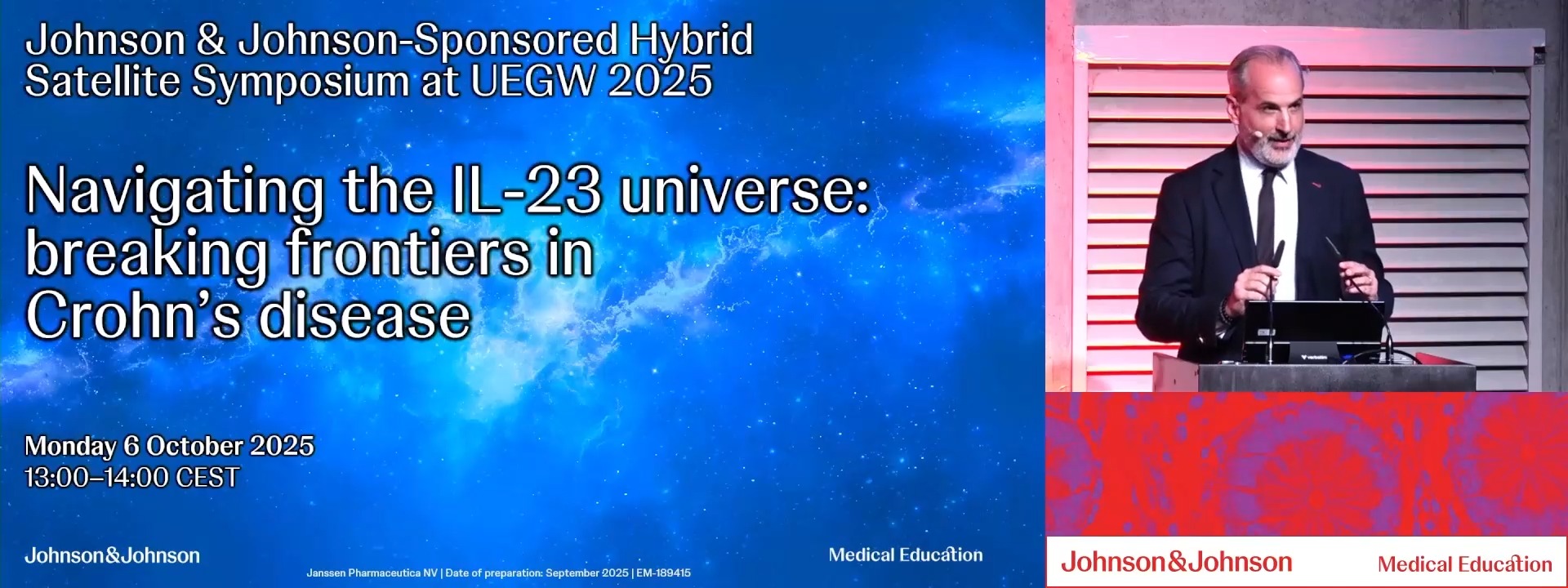
Navigating the IL-23 universe: breaking frontiers in Crohn’s disease (Johnson and Johnson) (Complete Session)
Alessandro Armuzzi 1, Laurent Peyrin-Biroulet 2, David T. Rubin 3, Yamile Zabana 4, Sebastian Zeissig 5
1 IRCCS Humanitas Research Hospital, Rozzano, Italy
2 Inserm NGERE and University of Lorraine, Vandœuvre-lès-Nancy, France
3 The University of Chicago Medicine, Chicago, United States of America
4 Hospital Universitari Mútua Terrassa, Terrassa, Spain
5 Inselspital - Bern University Hospital, Bern, Switzerland
Event
Citation
Published
Log in to access this content.
Free for all myUEG account holders. Your access level is set automatically based on your occupation. Medical professionals get full access to all content. If you are a non-medical user, you can only access UEG Week content from congresses you attended.
Not sure what you can access? Learn more about account types.
Summary: Autoimmune disease of liver and bile ducts
1 Klinikum rechts der Isar, München, Germany
Event
Topics
Citation
Published
Log in to access this content.
Free for all myUEG account holders. Your access level is set automatically based on your occupation. Medical professionals get full access to all content. If you are a non-medical user, you can only access UEG Week content from congresses you attended.
Not sure what you can access? Learn more about account types.
ESGE Live Endoscopy I (Complete Session)
Event
Session
Citation
Published
Log in to access this content.
Free for all myUEG account holders. Your access level is set automatically based on your occupation. Medical professionals get full access to all content. If you are a non-medical user, you can only access UEG Week content from congresses you attended.
Not sure what you can access? Learn more about account types.
INNOVATIVE ERCP TRAINING: BRIDGING EDUCATIONAL GAPS WITH NEXT-GENERATION 3D-PRINTED SIMULATORS
Oguz Ozturk 1, Mucahit Ergul 1, Yavuz Çağır 2, Ali Atay 1, Muhammed bahaddin Durak 3, ilhami yuksel 4
1 Ankara Bilkent City Hospital, Ankara, Türkiye
2 Ankara Yildirim Beyazit University Yenimahalle Training and Research Hospital, Ankara, Türkiye
3 Ankara Hacettepe University, Ankara, Türkiye
4 Ankara Bilkent City Hospital, Ankara, Türkiye|||Ankara Yildirim Beyazit University School of Medicine, Ankara, Türkiye
Conference
Topics
Submission format
Session
Citation
Published
Log in to access this content.
Free for all myUEG account holders. Your access level is set automatically based on your occupation. Medical professionals get full access to all content. If you are a non-medical user, you can only access UEG Week content from congresses you attended.
Not sure what you can access? Learn more about account types.
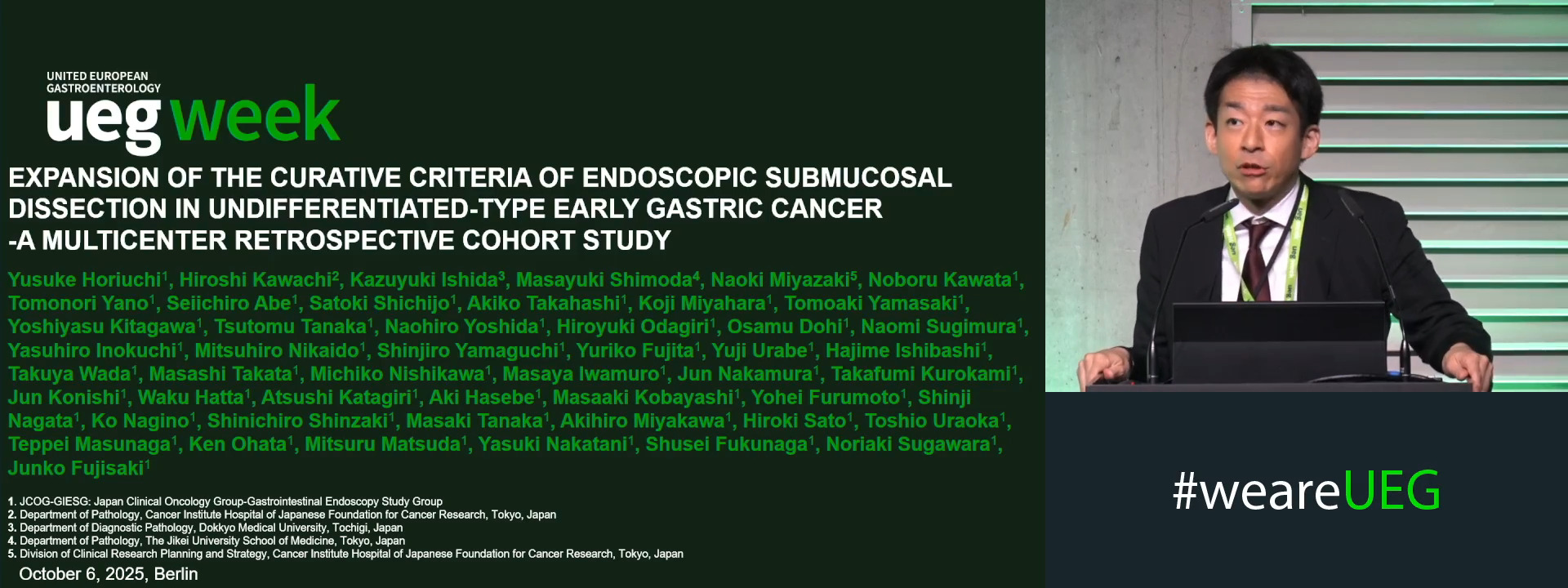
FURTHER EXPANSION OF THE CURATIVE CRITERIA OF ENDOSCOPIC SUBMUCOSAL DISSECTION IN UNDIFFERENTIATED-TYPE EARLY GASTRIC CANCER-A MULTICENTER RETROSPECTIVE COHORT STUDY
Yusuke Horiuchi 1, Hiroshi Kawachi 1, Kazuyuki Ishida 2, Masayuki Shimoda 3, Naoki Miyazaki 4, Noboru Kawata 5, Tomonori Yano 6, Seiichiro Abe 7, Satoki Shichijo 8, Akiko Takahashi 9, Koji Miyahara 10, Tomoaki Yamasaki 11, Yoshiyasu Kitagawa 12, Tsutomu Tanaka 13, Naohiro Yoshida 14, Hiroyuki Odagiri 15, Osamu Dohi 16, Naomi Sugimura 17, Yasuhiro Inokuchi 18, Mitsuhiro Nikaido 19, Shinjiro Yamaguchi 20, Yuriko Fujita 21, Yuji Urabe 22, Hajime Ishibashi 23, Takuya Wada 24, Masashi Takata 25, Michiko Nishikawa 26, Masaya Iwamuro 27, Jun Nakamura 28, Takafumi Kurokami 29, Jun Konishi 30, Waku Hatta 31, Atsushi Katagiri 32, Aki Hasebe 33, Masaaki Kobayashi 34, Yohei Furumoto 35, Shinji Nagata 36, Ko Nagino 37, Shinichiro Shinzaki 38, Masaki Tanaka 39, Akihiro Miyakawa 40, Hiroki Sato 41, Toshio Uraoka 42, Teppei Masunaga 43, Ken Ohata 44, Mitsuru Matsuda 45, Yasuki Nakatani 46, Shusei Fukunaga 47, Noriaki Sugawara 48, Junko Fujisaki 49
1 Cancer Institute Hospital of Japanese Foundation for Cancer Research, Koto, Tokyo, Japan
2 Dokkyo Medical University, Tochigi, Japan
3 The Jikei University School of Medicine, Tokyo, Japan
4 Cancer Institute Hospital of Japanese Foundation for Cancer Research, Tokyo, Japan
5 Shizuoka Cancer Center, Shizuoka, Japan
6 Department Of Gastroenterology and Endoscopy, National Cancer Center Hospital East, Kashiwa, Japan
7 National Cancer Center Hospital, Tokyo, Japan
8 Osaka International Cancer Institute, Osaka, Japan
9 Saku Central Hospital Advanced Care Center, Nagano, Japan
10 Hiroshima City Hiroshima Citizens Hospital, Hiroshima, Japan
11 Osaka City General Hospital Dept. of Gastroenterology, Osaka, Japan
12 Chiba Cancer Center, Chiba, Japan
13 Aichi Cancer Center Hospital, Aichi, Japan
14 Ishikawa Prefectural Central Hosp., Ishikawa, Japan
15 Toranomon Hospital, Tokyo, Japan
16 Kyoto Prefectural University of Medicine, Kyoto, Japan
17 Nagoya City University Graduate School of Medical Sciences, Nagoya, Japan
18 Kanagawa Cancer Center, Yokohama, Japan|||Yokohama Minami Kyosai Hospital, Yokohama, Japan
19 Kyoto University, Kyoto, Japan
20 Kansai Rosai Hospital, Osaka, Japan
21 Yokohama Municipal Citizen's Hospital, Yokohama, Japan
22 Hiroshima University, Hiroshima, Japan
23 Ibaraki Prefectural Central Hospital, Ibaraki, Japan
24 Kitasato University School of Medicine, Sagamihara, Japan
25 Kochi Health Sciences Center, Kochi, Japan
26 Hyogo Cancer Center, Hyogo, Japan
27 Okayama University Graduate School of Medicine Gastroenterology and Hepatology, Okayama, Japan
28 Fukushima Medical University Hospital, Fukushima, Japan
29 Shizuoka General Hospital, Shizuoka, Japan
30 Tochigi Cancer Center, Tochigi, Japan
31 Tohoku University, Graduate School of Medicine, Dept. of Gastroenterology, Sendai, Japan, Sendai, Japan
32 Showa University School of Medicine, Tokyo, Japan
33 National Hospital Organization Shikoku Cancer Center, Ehime, Japan
34 Niigata Cancer Center Hospital, Niigata, Japan
35 Tokyo Metropolitan Bokutoh Hospital, Tokyo, Japan
36 Hiroshima City North Medical Center Asa Citizens Hospital, Hiroshima, Japan
37 Yamagata Prefectural Central Hospital, Yamagata, Japan
38 Hyogo Medical University School of Medicine, Hyogo, Japan
39 Shimane Prefectural Central Hospital, Izumo, Japan
40 Asahi General Hospital, Asahi, Japan
41 Niigata university Medical and Dental Hospital, Niigata, Japan
42 Gunma University Graduate School of Medicine, Maebashi, Japan
43 Keio University School of Medicine, Tokyo, Japan
44 NTT Medical Center Gastroenterology, Shinagawa-ku, Japan
45 Toyama Prefectural Central Hospital, Toyama, Japan
46 Japanese Red Cross Wakayama Medical Center, Wakayama, Japan
47 Osaka Metropolitan University Graduate School of Medicine, Osaka, Japan
48 Osaka Medical Pharmaceutical University Hospital, Osaka, Japan
49 Cancer Institute Hospital of Japanese Foundation for Cancer Research, Tokyo, Japan|||Cancer Institute Hospital, Tokyo, Japan
Event
Topics
Submission format
Citation
Published
Log in to access this content.
Free for all myUEG account holders. Your access level is set automatically based on your occupation. Medical professionals get full access to all content. If you are a non-medical user, you can only access UEG Week content from congresses you attended.
Not sure what you can access? Learn more about account types.
Introduction
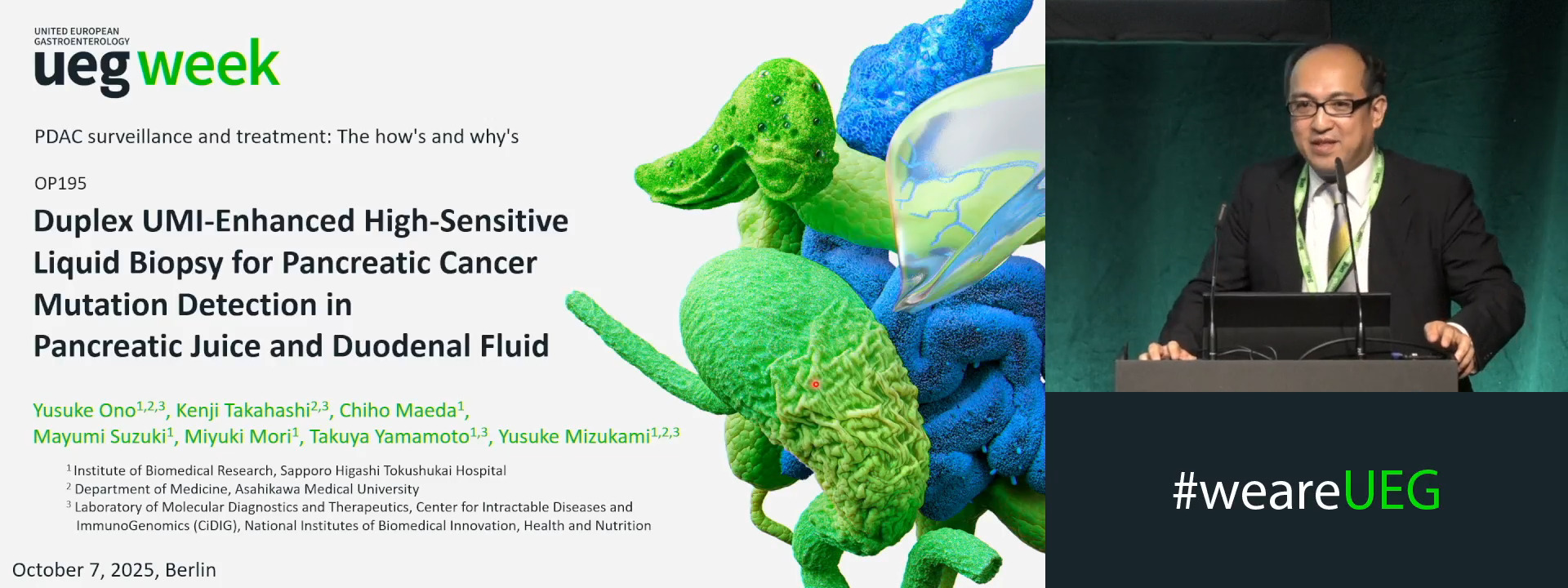
Pancreatic cancer remains a devastating disease with a poor prognosis, and liquid biopsy utilizing minimally invasive biofluids such as blood and duodenal juice has emerged as a promising approach for early detection. Our group has previously accumulated data on plasma- and duodenal fluid-based liquid biopsy, demonstrating potential clinical utility but also highlighting limitations in diagnostic sensitivity. This study aims to establish a robust cancer diagnostic and risk assessment method using plasma, duodenal juice, and pancreatic juice, while also charactering molecular abnormalities in resected tumors and surrounding tissues. To develop a novel clinical diagnostic framework, we comprehensively evaluated to cancer-associated genetic mutations in biofluids and compared these finding with tissue samples obtained via biopsy or surgical resection.
Aims & Methods
This multi-institutional study, initiated in 2021, focuses on developing a liquid biopsy platform for pancreatic cancer detection. Samples were collected as follows: plasma (n=224), duodenal juice (n=102), and pancreatic juice (n=85). Plasma was collected in 10 mL PAXgene Blood ccfDNA tubes (BD); cell-free DNA (cfDNA) was purified and concentrated to a 30 µL eluate. Duodenal fluid was collected through the endoscopic channel, and pancreatic juice was aspirated directly from the pancreatic duct using a catheter during ERP examination. Both fluid were each mixed with a preservation solution validated in a previous study. Digital PCR (dPCR) was performed to screen for KRAS G12/G13 and A59/Q61 mutations, followed by panel-based sequencing. For this study, we designed a Duplex UMI-based pancreatic cancer gene panel targeting 16 genes, including KRAS, TP53, CDKN2A, and SMAD4, to enable high sensitive detection of tumor-specific mutations.
Results
DPCR screening detected KRAS mutations in 75% of pancreatic juice samples and 50% of duodenal juice samples. Validation of the Duplex UMI-based target sequencing panel in a subset of samples (n=16) demonstrated that a minimum input of 20 ng of liquid-derived, non-genomic DNA was necessary to achieve concordance with mutations identified in matched tissue samples. Inputs below this threshold resulted in significantly reduced coverage and uniformity. Notably, duodenal and pancreatic juice exhibited superior sensitivity, reliably detecting tissue-confirmed mutations down to a minimum variant allele frequency (VAF) of 0.1%. Pancreatic juice not only captured a diverse spectrum of genetic alterations across multiple lesions but also identified mutations absent in corresponding tissue samples, suggesting its potential for detecting subclinical molecular changes. These findings underscore the complementary roles of different biofluids in capturing tumor heterogeneity.
Conclusion
Pancreatic juice-derived DNA shows exceptional promise for the accurate prediction of tumorous lesions, offering a powerful tool to prompt further diagnostic evaluation even in the absence of histological evidence. This approach could substantially enhance early detection and risk stratification in pancreatic cancer. Our ongoing study involves comprehensive analysis of all collected samples using the designed 16-gene panel. These efforts aim to establish liquid biopsy as a central component of pancreatic cancer diagnostics, supporting personalized treatment strategy and improving patient outcomes.
Disclosure
Y.O., K.T. and Y.M. receive funding form Hitachi High-Tech Corporation
DUPLEX UMI-ENHANCED HIGH-SENSITIVE LIQUID BIOPSY FOR PANCREATIC CANCER MUTATION DETECTION IN PANCREATIC JUICE AND DUODENAL FLUID
Yusuke Ono 1, Kenji Takahashi 2, Chiho Maeda 3, Mayumi Suzuki 3, Miyuki Mori 3, Hiroki Tanaka 4, Taito Itoh 4, Takuya Yamamoto 4, YUSUKE MIZUKAMI 1
1 Institute of Biomedical Research, Sapporo Higashi Tokushukai Hospital, Sapporo, Japan|||Asahikawa Medical University, Asahikawa, Japan|||Center for Intractable Diseases and ImmunoGenomics (CiDIG), National Institutes of Biomedical Innovation, Health and N
2 Asahikawa Medical University, Asahikawa, Japan|||Center for Intractable Diseases and ImmunoGenomics (CiDIG), National Institutes of Biomedical Innovation, Health and Nutrition, Osaka, Japan
3 Institute of Biomedical Research, Sapporo Higashi Tokushukai Hospital, Sapporo, Japan
4 Center for Intractable Diseases and ImmunoGenomics (CiDIG), National Institutes of Biomedical Innovation, Health and Nutrition, Osaka, Japan