UEG's educational platform for gastroenterology education bringing recordings, courses, guidelines, and more together in one place.
Most popular content
Rate for better recommendations!
Your feedback helps us show you more of what you like and less of what you dislike!
Log in to access this content.
Free for all myUEG account holders. Your access level is set automatically based on your occupation. Medical professionals get full access to all content. If you are a non-medical user, you can only access UEG Week content from congresses you attended.
Not sure what you can access? Learn more about account types.
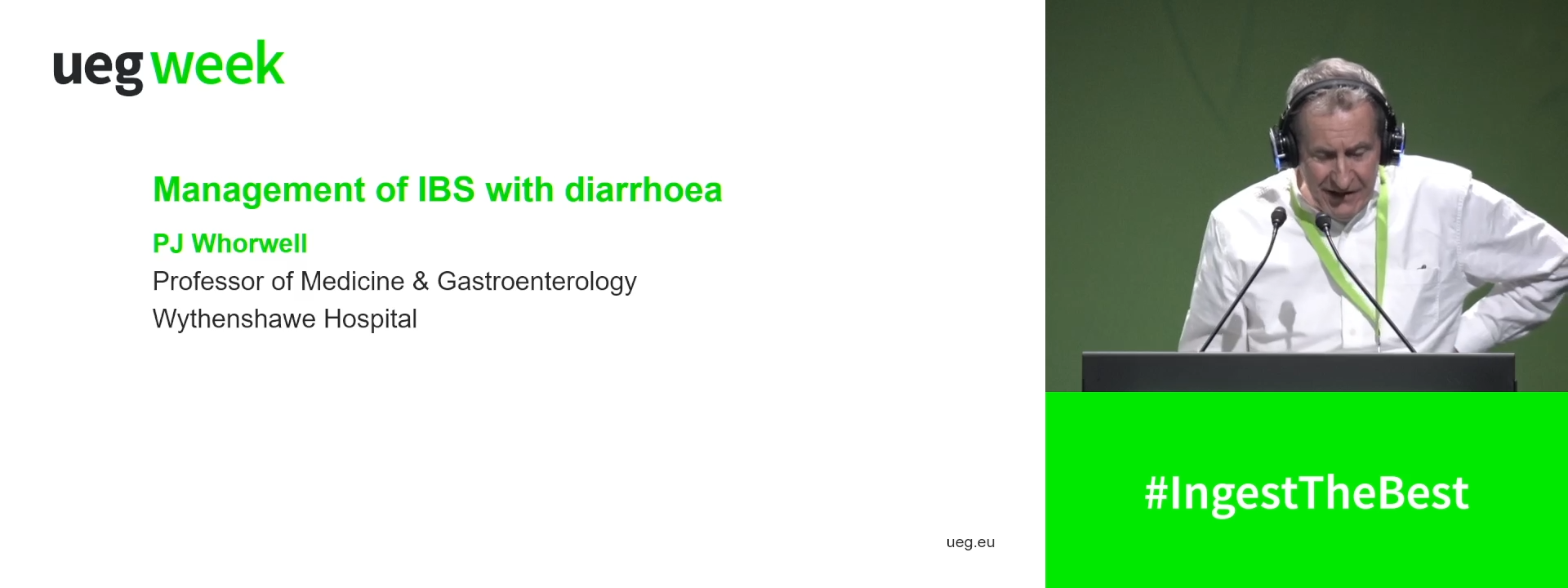
Treatment of IBS diarrhoea
1 University of Manchester Wythenshawe Hospital, Manchester, United Kingdom
Event
Topics
Citation
Published
Log in to access this content.
Free for all myUEG account holders. Your access level is set automatically based on your occupation. Medical professionals get full access to all content. If you are a non-medical user, you can only access UEG Week content from congresses you attended.
Not sure what you can access? Learn more about account types.
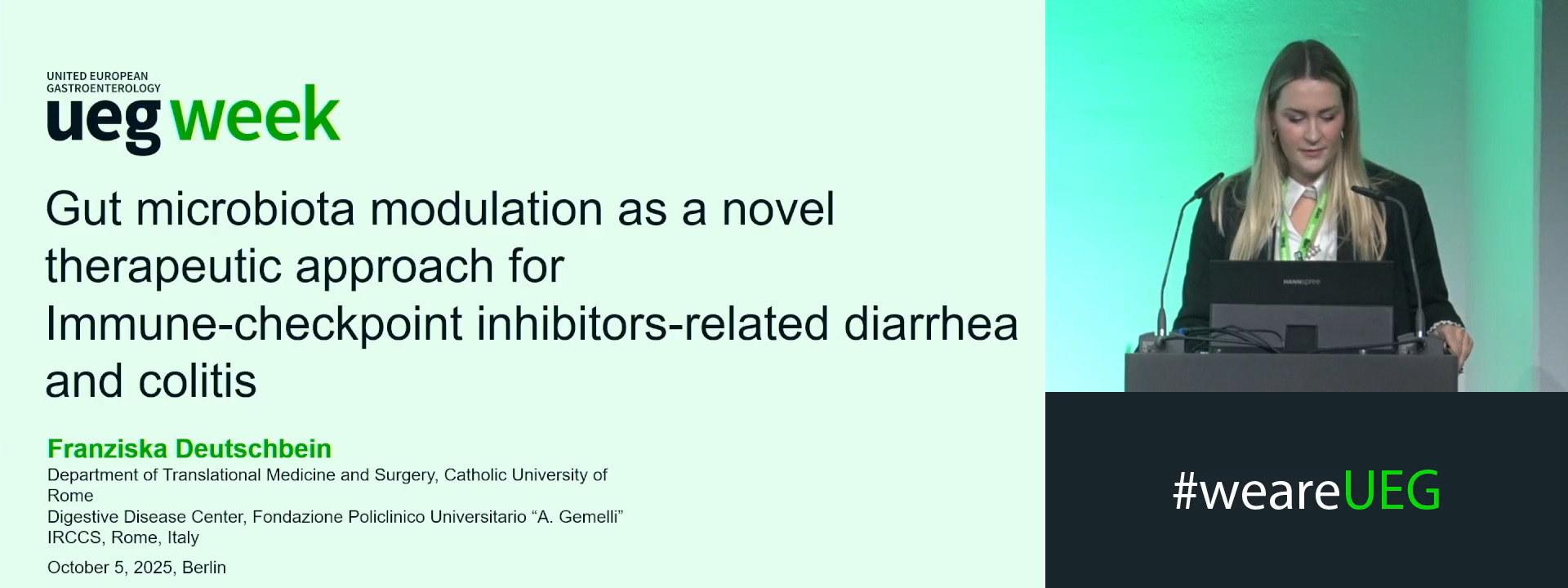
GUT MICROBIOTA MODULATION AS A NOVEL THERAPEUTIC APPROACH FOR IMMUNE-CHECKPOINT INHIBITORS-RELATED DIARRHEA AND COLITIS
Serena Porcari 1, Franziska Deutschbein 1, William Fusco 1, Andrea Severino 1, Debora Rondinella 1, Irene Venturini 1, Antonio Di Sabatino 2, Marco Vincenzo Lenti 2, Ettore D'Argento 1, Emilio Bria 1, Giovanni Schinzari 1, Eleonora Palluzzi 1, Olga Martelli 1, Mariagrazia Distefano 1, Carolina Maria Sassu 1, Serena Maria Boccia 1, Laura Vertechy 1, Ida Paris 1, Roberto Iacovelli 1, Chiara Ciccarese 1, Francesca Romana Ponziani 1, Claudia Marchetti 3, Giampaolo Tortora 1, Antonio Gasbarrini 1, Giovanni Cammarota 1, Gianluca Ianiro 1
1 Fondazione Policlinico Universitario 'A.Gemelli' - IRCCS, Roma, Italy
2 IRCCS Policlinico S. Matteo, Pavia, Italy
3 Fondazione Policlinico Universitario 'A.Gemelli' - IRCCS, Roma, Italy|||Università Cattolica del Sacro cuore, Roma, Italy
Event
Submission format
Session
Citation
Published

Log in to access this content.
Free for all myUEG account holders. Your access level is set automatically based on your occupation. Medical professionals get full access to all content. If you are a non-medical user, you can only access UEG Week content from congresses you attended.
Not sure what you can access? Learn more about account types.
MICROBIAL DYSBIOSIS, INFLAMMATION, AND THE GUT-BRAIN AXIS IN IRRITABLE BOWEL SYNDROME: INSIGHTS FROM THE DISCOVERIE COHORT
Jorge Francisco Vazquez Castellanos 1, Jeroen Raes 1, Javier Santos 2, Amanda Rodriguez 2, Maaike Van Den Houte 3, Dan Lucian Dumitrascu 4, Andrei Pop 5, Jekkel Eva 6, Giovanni Barbara 7, Maria Raffaella Barbaro 8, Magnus Simrén 9, Irina Midenfjord 10, Danique Mulder 11, Michelle Bosman 12, Daisy Mae Jonkers 13, Mareike Aichholzer 14, Juan Garcia 2, Carmen Alonso-Cotoner 15, Stefanie Schmitteckert 16, Arno Lukas 17, Ricardo Brandwijk 18, Lindsey De Commer 1, Muriel Derrien 1, Lindsay Devolder 1, Chloë Verspecht 1, Iris Reniers 1, Ami De Weerdt 1, Daniel Ekhlas 1, Jan Tack 19, Lukas Van Oudenhove 20, Ricard Farré Marti 3, John F. Cryan 21, Gerard Clarke 22
1 KU-Leuven/VIB, Leuven, Belgium
2 Institut de Recerca Vall d`Hebron, Barcelona, Spain
3 KU Leuven, Leuven, Belgium
4 University of Medicine and Pharmacy, Cluj-Napoca, Romania
5 Iuliu Hatieganu University of Medicine and Pharmacy, ClujNapoca, Romania
6 Semmelweis University, Budapest, Hungary
7 University of Bologna, Bologna, Italy
8 University of Bologna Dept. of Medical and Surgical Sciences, Bologna, Italy
9 Sahlgrenska University Hospital - Dept of Internal Medicine, Sahlgrenska University Hospital ; Gothe, Gothenburg, Sweden
10 Institute of Medicine, Gothenburg, Sweden
11 Radboud University Medical Center, Nijmegen, Netherlands
12 Maastricht University Medical Center +, Venlo, Netherlands
13 Maastricht University Medical Center - Department of Internal Medicine, Division of Gastroenterology, Maastricht, Netherlands
14 Goethe University, University Hospital, Frankfurt, Germany
15 Hospital Val Hebron, Barcelona, Spain
16 University Hospital Heidelberg, Heidelberg, Germany
17 emergenTec, Vienna, Austria
18 Hycult Biotech, Uden, Netherlands
19 University of Leuven, University Hospital Gasthuisberg, Leuven, Belgium
20 Katholieke Universiteit Leuven, Leuven, Belgium
21 University College Cork, Cork, Ireland
22 g.clarke@ucc.ie, Corke, Ireland
Event
Topics
Submission format
Citation
Published
Log in to access this content.
Free for all myUEG account holders. Your access level is set automatically based on your occupation. Medical professionals get full access to all content. If you are a non-medical user, you can only access UEG Week content from congresses you attended.
Not sure what you can access? Learn more about account types.
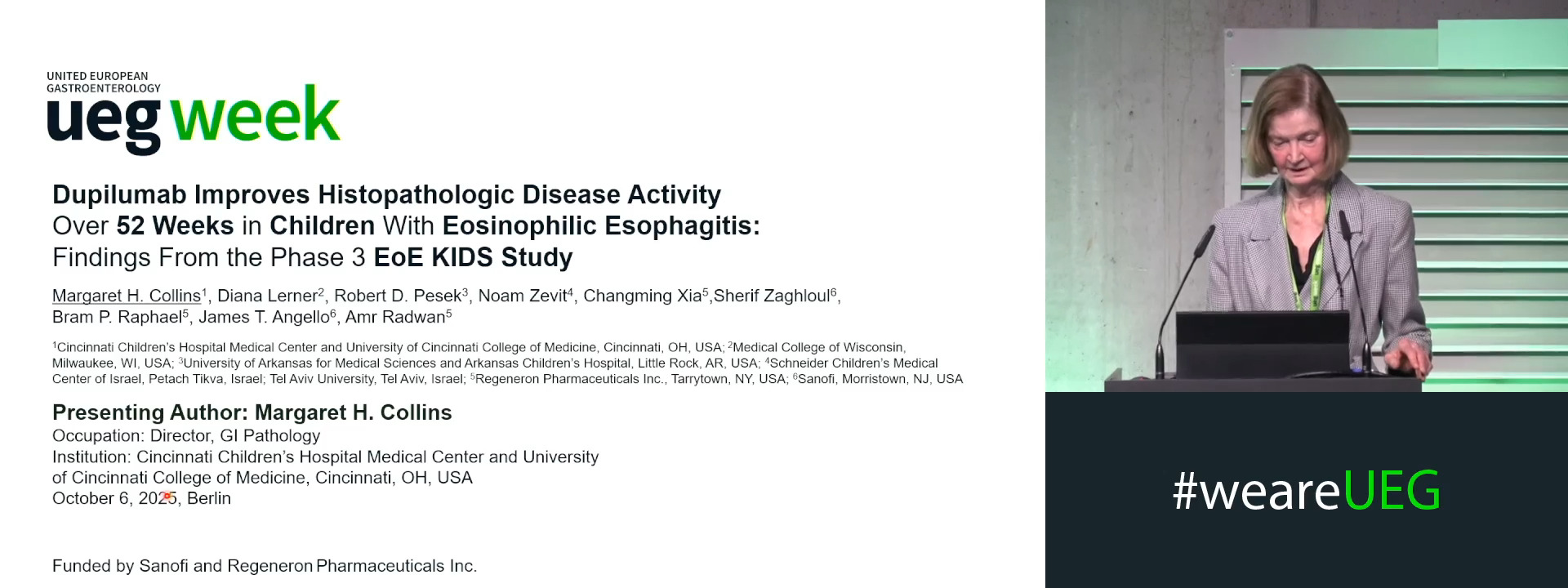
DUPILUMAB IMPROVES HISTOPATHOLOGIC DISEASE ACTIVITY OVER 52 WEEKS IN CHILDREN WITH EOSINOPHILIC ESOPHAGITIS: FINDINGS FROM THE PHASE 3 EOE KIDS STUDY
Margaret H. Collins 1, Diana Lerner 2, Robbie Pesek 3, Noam Zevit 4, Changming Xia 5, Sherif Zaghloul 6, Bram Raphael 5, James T. Angello 6, Amr Radwan 5
1 Cincinnati Children’s Hospital Medical Center and University of Cincinnati College of Medicine, Cincinnati, United States
2 Medical College of Wisconsin, Milwaukee, United States
3 University of Arkansas for Medical Sciences and Arkansas Children’s Hospital, Little Rock, United States
4 Schneider Childrens Medical Center of Israel, Petach Tikva, Israel
5 Regeneron Pharmaceuticals Inc, Tarrytown, United States
6 Sanofi, Morristown, United States
Event
Submission format
Session
Citation
Published
Log in to access this content.
Free for all myUEG account holders. Your access level is set automatically based on your occupation. Medical professionals get full access to all content. If you are a non-medical user, you can only access UEG Week content from congresses you attended.
Not sure what you can access? Learn more about account types.
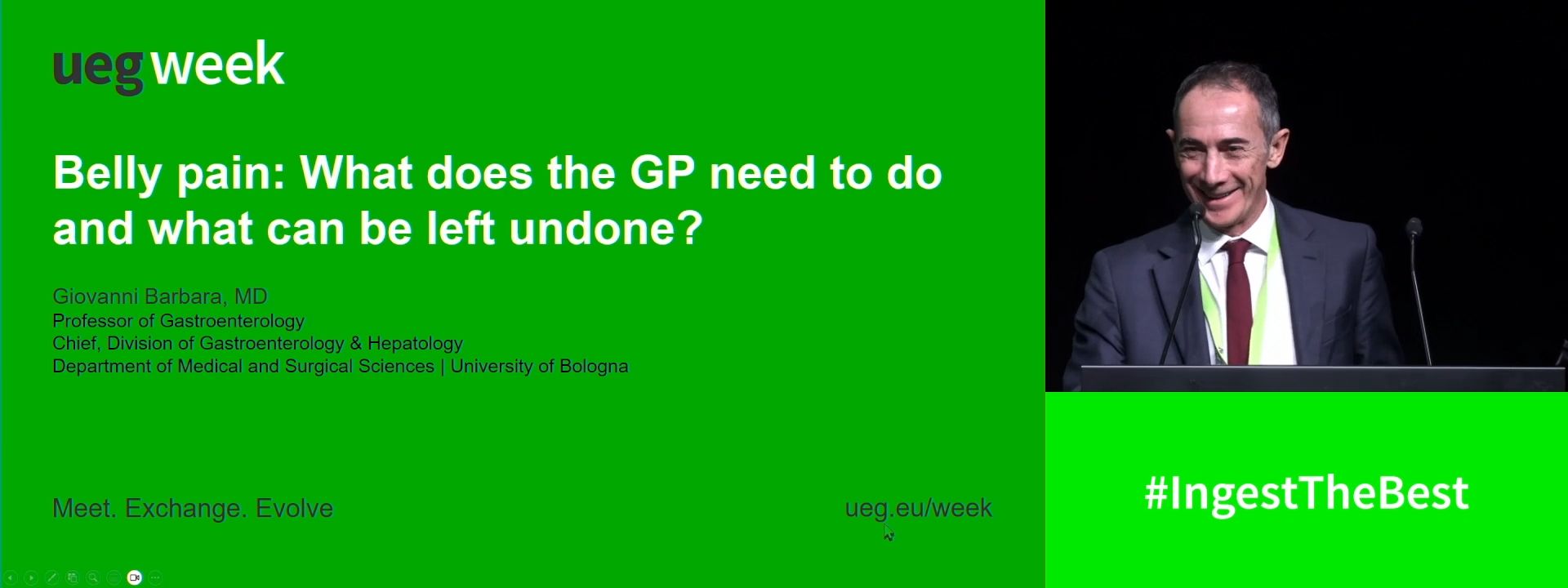
Belly pain: What does the GP need to do and what can be left undone?
1 University of Bologna, Bologna, Italy
Event
Topics
Citation
Published
Log in to access this content.
Free for all myUEG account holders. Your access level is set automatically based on your occupation. Medical professionals get full access to all content. If you are a non-medical user, you can only access UEG Week content from congresses you attended.
Not sure what you can access? Learn more about account types.
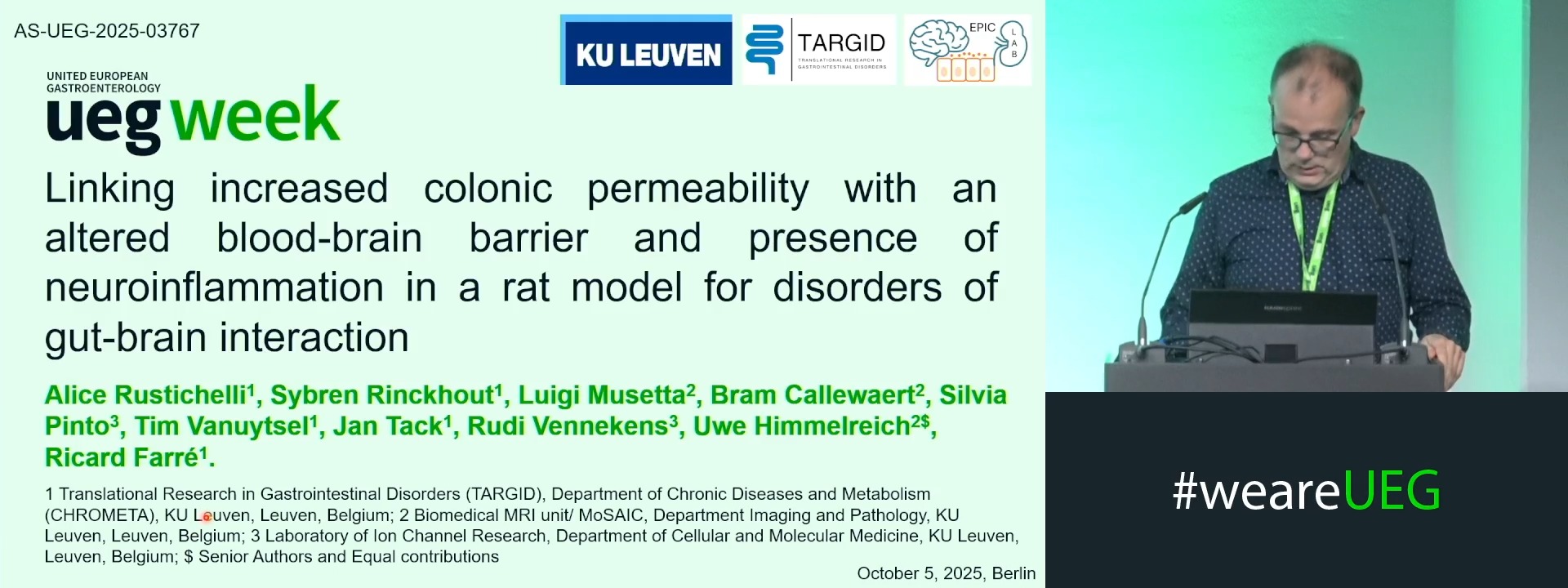
LINKING INCREASED COLONIC PERMEABILITY WITH AN ALTERED BLOOD-BRAIN BARRIER AND PRESENCE OF NEUROINFLAMMATION IN A RAT MODEL FOR DISORDERS OF GUT-BRAIN INTERACTION
Alice Rustichelli 1, Sybren Rinckhout 1, Luigi Musetta 2, Bram Callewaert 2, Silvia Pinto 3, Tim Vanuytsel 1, Jan Tack 1, Rudi Vennekens 3, Uwe Himmelreich 2, Ricard Farré 1
1 KU Leuven, Translational Research Center for Gastrointestinal Disorders (TARGID), Leuven, Belgium
2 KU Leuven, Biomedical MRI unit/ MoSAIC, Leuven, Belgium
3 KU Leuven, Laboratory of Ion Channel Research, Leuven, Belgium
Event
Submission format
Session
Citation
Published
Log in to access this content.
Free for all myUEG account holders. Your access level is set automatically based on your occupation. Medical professionals get full access to all content. If you are a non-medical user, you can only access UEG Week content from congresses you attended.
Not sure what you can access? Learn more about account types.
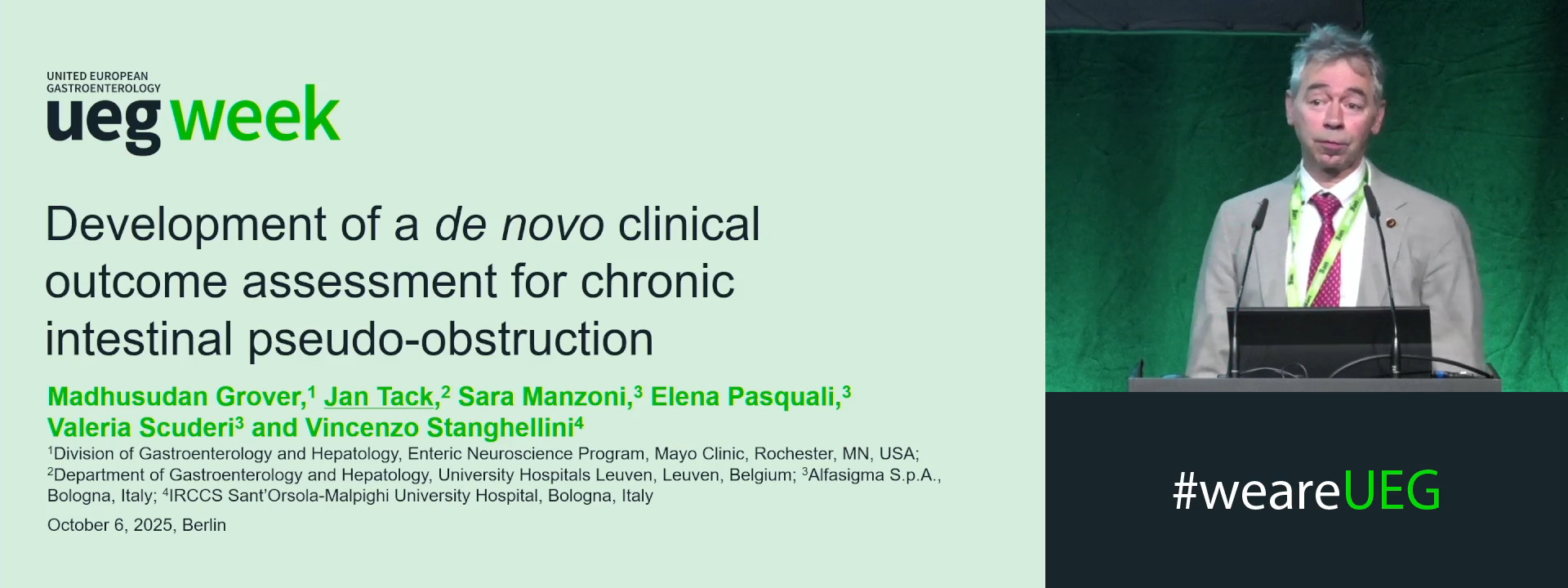
DEVELOPMENT OF A DE NOVO CLINICAL OUTCOME ASSESSMENT FOR CHRONIC INTESTINAL PSEUDO-OBSTRUCTION
Madhusudan Grover 1, Jan Tack 2, Sara Manzoni 3, Elena Pasquali 3, Valeria Scuderi 3, Vincenzo Stanghellini 4
1 Mayo Clinic, Rochester, MN, United States
2 University Hospitals Leuven, Leuven, Belgium
3 Alfasigma S.p.A., Bologna, Italy
4 IRCCS Sant’Orsola-Malpighi University Hospi, Bologna, Italy
Event
Submission format
Session