UEG's educational platform for gastroenterology education bringing recordings, courses, guidelines, and more together in one place.
Most popular content
Rate for better recommendations!
Your feedback helps us show you more of what you like and less of what you dislike!
Log in to access this content.
Free for all myUEG account holders. Your access level is set automatically based on your occupation. Medical professionals get full access to all content. If you are a non-medical user, you can only access UEG Week content from congresses you attended.
Not sure what you can access? Learn more about account types.
ASSESSING ERGONOMICS KNOWLEDGE AMONG GASTROENTEROLOGY FELLOWS: A CALL FOR CURRICULUM INTEGRATION
1 Université Picardie Jules Verne, Amiens, France
2 Amiens University Hospital, Amiens, France
Conference
Submission format
Citation
Published

Log in to access this content.
Free for all myUEG account holders. Your access level is set automatically based on your occupation. Medical professionals get full access to all content. If you are a non-medical user, you can only access UEG Week content from congresses you attended.
Not sure what you can access? Learn more about account types.
GUT MICROBIOTA COMPOSITION AND ARTERIAL HYPERTENSION IN METABOLIC SYNDROME: THE ROLE OF ENTEROCLOSTER AND MICROBIALLY CONJUGATED BILE ACIDS
Raffaella Gadaleta 1, LUCILLA CRUDELE 1, Marica Cariello 1, Carlo De Matteis 1, Marilidia Piglionica 1, Maria Arconzo 1, Silvia Cultrera 1, Marilina Florio 1, Angela Fulvia Tricase 1, Antonio Moschetta 2
1 University Of Bari "Aldo Moro", Bari, Italy
2 University of Bari "Aldo Moro", Bari, Italy
Event
Topics
Submission format
Citation
Published
Log in to access this content.
Free for all myUEG account holders. Your access level is set automatically based on your occupation. Medical professionals get full access to all content. If you are a non-medical user, you can only access UEG Week content from congresses you attended.
Not sure what you can access? Learn more about account types.
SAFETY ASSESSMENT OF ORODISPERSABLE BUDESONIDE ON THE HYPOTHALAMIC-PITUITARY-ADRENAL AXIS AND ON MARKERS OF RESORPTION AND BONE FORMATION IN PATIENTS WITH EOSINOPHILIC ESOPHAGITIS
Jesús Sánchez César 1, Valentin Roales 1, Martín Cuesta 1, Andrea López Rodríguez 1, Constanza Ciriza de Los Rios 1
1 Hospital Clínico San Carlos, Madrid, Spain
Conference
Topics
Submission format
Session
Citation
Published
Log in to access this content.
Free for all myUEG account holders. Your access level is set automatically based on your occupation. Medical professionals get full access to all content. If you are a non-medical user, you can only access UEG Week content from congresses you attended.
Not sure what you can access? Learn more about account types.
EFFICACY OF BUDESONIDE ORODISPERSIBLE TABLETS ON ESOPAGHEAL STENOSIS IN PATIENTS WITH EOSINOPHILIC ESOPHAGITIS: A SINGLE CENTRE EXPERIENCE
Irene Spinelli 1, Francesca Fianchi 1, William Fusco 1, Arianna Aruanno 1, David Longhino 1, Federica Castri 2, Cristiano Caruso 1, Francesca Romana Ponziani 1, Maria Elena Riccioni 3, Antonio Gasbarrini 1, Gianluca Ianiro 1
1 Fondazione Policlinico Universitario Agostino Gemelli IRCCS, Rome, Italy
2 Fondazione Policlinico Universitario A. Gemelli IRCCS, Rome, Italy
3 Policlinico Gemelli, Roma, Italy
Conference
Topics
Submission format
Session
Citation
Published
Log in to access this content.
Free for all myUEG account holders. Your access level is set automatically based on your occupation. Medical professionals get full access to all content. If you are a non-medical user, you can only access UEG Week content from congresses you attended.
Not sure what you can access? Learn more about account types.
THE LINK BETWEEN LEAN WOMEN WITH METABOLIC DYSFUNCTION-ASSOCIATED STEATOTIC LIVER DISEASE AND BREAST CANCER
Carola Dlugosch 1, Karina Sato Espinoza 2, Perapa Chotiprasidhi 2, Niharika Jakhar 1, Mara Sophie Vell 1, Paul Koop 3, Kai Markus Schneider 3, Krik Wangensteen 2, Carolin Schneider 1
1 RWTH Aachen University, Aachen, Germany
2 Mayo Clinic, Rochester, United States
3 TU Dresden, Dresden, Germany
Conference
Topics
Submission format
Citation
Published
Log in to access this content.
Free for all myUEG account holders. Your access level is set automatically based on your occupation. Medical professionals get full access to all content. If you are a non-medical user, you can only access UEG Week content from congresses you attended.
Not sure what you can access? Learn more about account types.
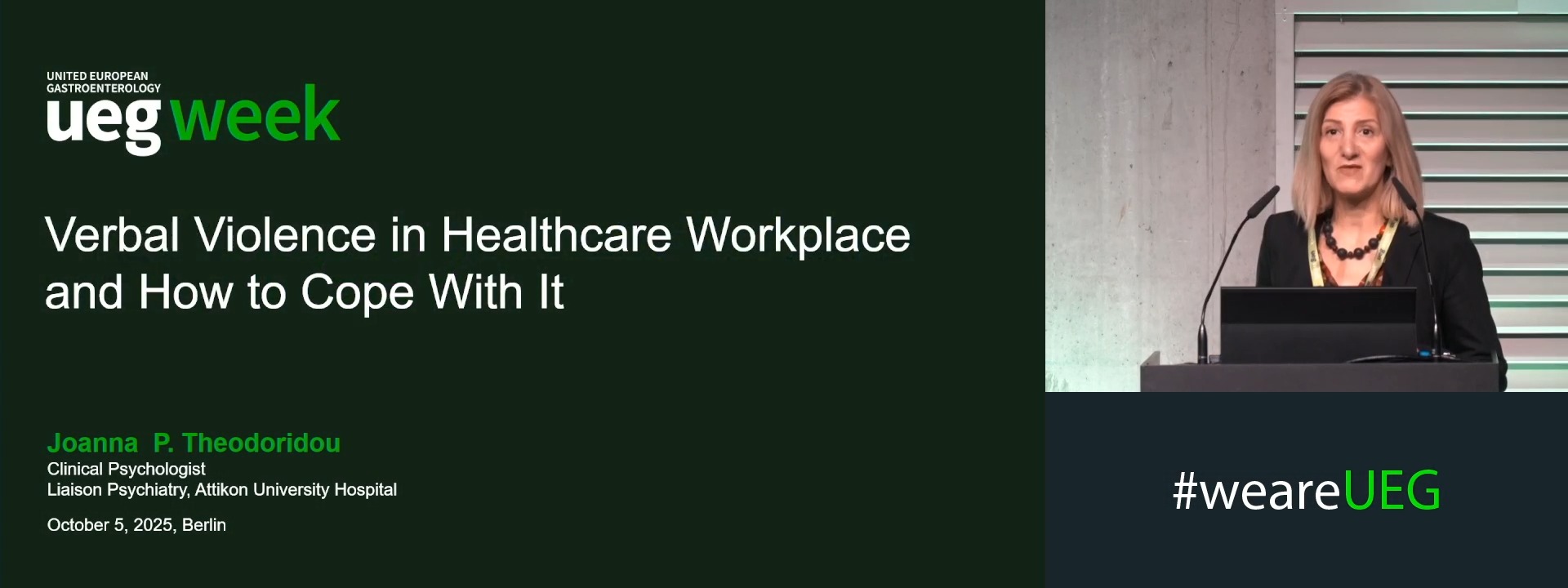
Verbal violence in the healthcare workplace and how to cope with it
1 None, None, Greece
Event
Topics
Session
Citation
Published
Log in to access this content.
Free for all myUEG account holders. Your access level is set automatically based on your occupation. Medical professionals get full access to all content. If you are a non-medical user, you can only access UEG Week content from congresses you attended.
Not sure what you can access? Learn more about account types.
NAVIGATING SELF-EXPANDABLE METALLIC STENT PLACEMENT IN INOPERABLE ESOPHAGEAL MALIGNANCIES: A LANDMARK-BASED TECHNIQUE USING VERTEBRAL COLUMN AND DIAPHRAGM
1 SIAG, Karachi, Pakistan
Conference
Topics