UEG's content platform for gastroenterology education bringing recordings, courses, guidelines, and more together in one place.
Trending on Gutflix
Rate for better recommendations!
Your feedback helps us show you more of what you like and less of what you dislike!
Log in to continue.
This content is part of Gutflix. Log in with your myUEG account, or create one free, to watch it.
Not sure what you can access? Learn more about account types.
LONG-TERM PROTON PUMP INHIBITOR USE AND RISK OF GASTRIC NEUROENDOCRINE NEOPLASMS IN A POPULATION-BASED STUDY FROM THE FIVE NORDIC COUNTRIES
Eivind Ness-Jensen 1,2, Giola Santoni 3, Cecilia Radkiewicz 3, My von Euler-Chelpin 4, Joonas H. Kauppila 5,3, Helgi Birgisson 6, Reidar Fossmark 7,8, Jesper Lagergren 9,3
Affiliations
1 NTNU, Norwegian University of Science and Technology, Levanger, Norway
2 Nord-Trøndelag Hospital Trust, Levanger Hospital, Levanger, Norway
3 Karolinska Institutet & Karolinska University Hospital, Stockholm, Sweden
4 University of Copenhagen, Copenhagen, Denmark
5 University of Oulu and Oulu University Hospital, Oulu, Finland
6 Icelandic Cancer Registry, Reykjavík, Iceland
7 NTNU, Norwegian University of Science and Technology, Trondheim, Norway
8 Oslo University Hospital, Oslo, Norway
9 King's College London and Guy’s and St Thomas Foundation Trust, London, United Kingdom
Log in to continue.
This content is part of Gutflix. Log in with your myUEG account, or create one free, to watch it.
Not sure what you can access? Learn more about account types.
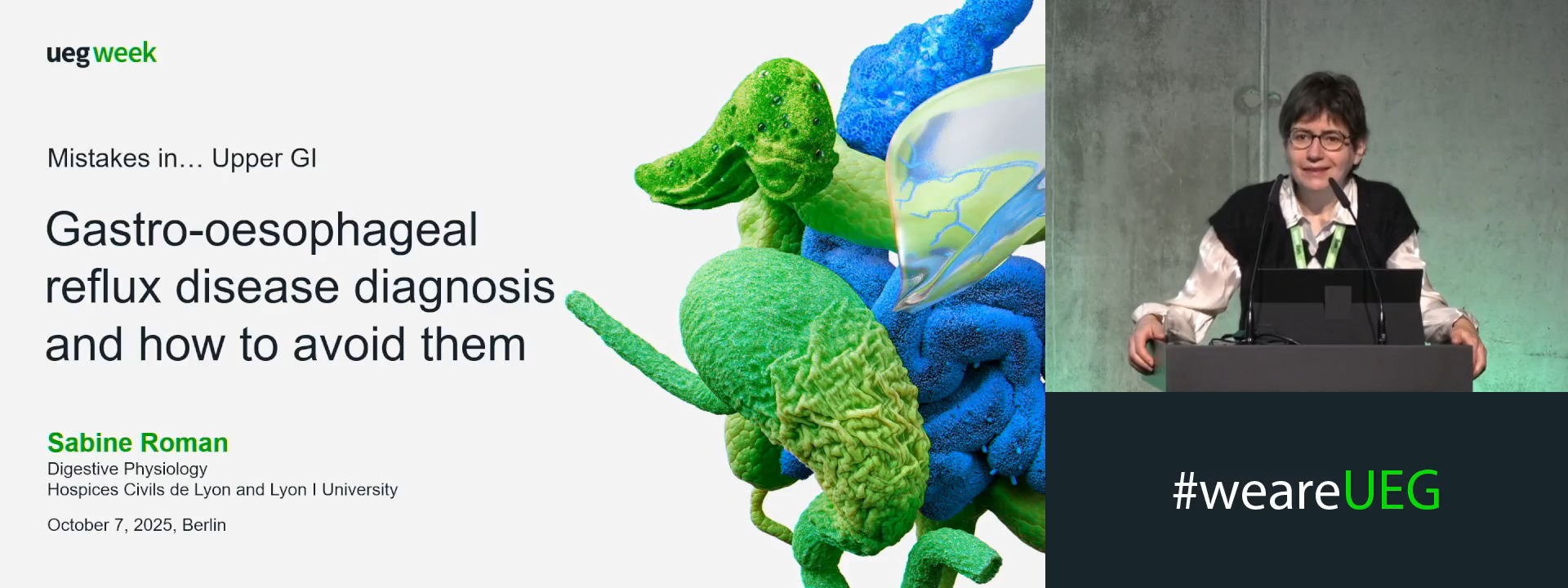
Gastro-oesophageal reflux disease diagnosis and how to avoid them
Affiliations
1 Hôpital Edouard Herriot, Lyon, France

Log in to continue.
This content is part of Gutflix. Log in with your myUEG account, or create one free, to watch it.
Not sure what you can access? Learn more about account types.
EFFICACY AND SAFETY OF THE GLUTENASE TAK-062 IN PATIENTS WITH CELIAC DISEASE ON A GLUTEN-FREE DIET: A PHASE 2, RANDOMIZED, DOUBLE-BLIND, PLACEBO-CONTROLLED STUDY
Luca Elli 1, Maureen M. Leonard 2, Piotr Rozpondek 3, Carolina Ciacci 4, Jocelyn Silvester 5, Joseph Murray 6, David Surendran Sanders 7, Hong Li 8, Joseph R. Maxwell 9, Mahsa Zarei 8, Sonal Ghura 8, Daniel A. Leffler 8
Affiliations
1 Granda Ospedale Maggiore Policlinico, Milano, Italy
2 MassGeneral Hospital for Children, Boston, United States
3 FutureMeds, Krakow, Poland
4 University of Salerno, Salerno, Italy
5 Boston Children’s Hospital, Boston, United States
6 Mayo Clinic, Rochester, United States
7 University of Sheffield, Sheffield, United Kingdom
8 Takeda Development Center Americas, Inc., Cambridge, United States
9 Takeda, Cambridge, United States

Log in to continue.
This content is part of Gutflix. Log in with your myUEG account, or create one free, to watch it.
Not sure what you can access? Learn more about account types.
MANAGEMENT OF SEVERE EROSIVE GASTROESOPHAGEAL REFLUX DISEASE (EGERD) WITH HIGH-DOSE PROTON PUMP INHIBITORS: INTERIM RESULTS FROM A REAL-WORLD OBSERVATIONAL STUDY (POWER 3.0)
Affiliations
1 Apollo Gleneagles Hospitals, Kolkata, India
2 Dr Reddys Laboratories Ltd, Hyderabad, India