UEG's content platform for gastroenterology education bringing recordings, courses, guidelines, and more together in one place.
Trending on Gutflix
Rate for better recommendations!
Your feedback helps us show you more of what you like and less of what you dislike!
Log in to continue.
This content is part of Gutflix. Log in with your myUEG account, or create one free, to watch it.
Not sure what you can access? Learn more about account types.
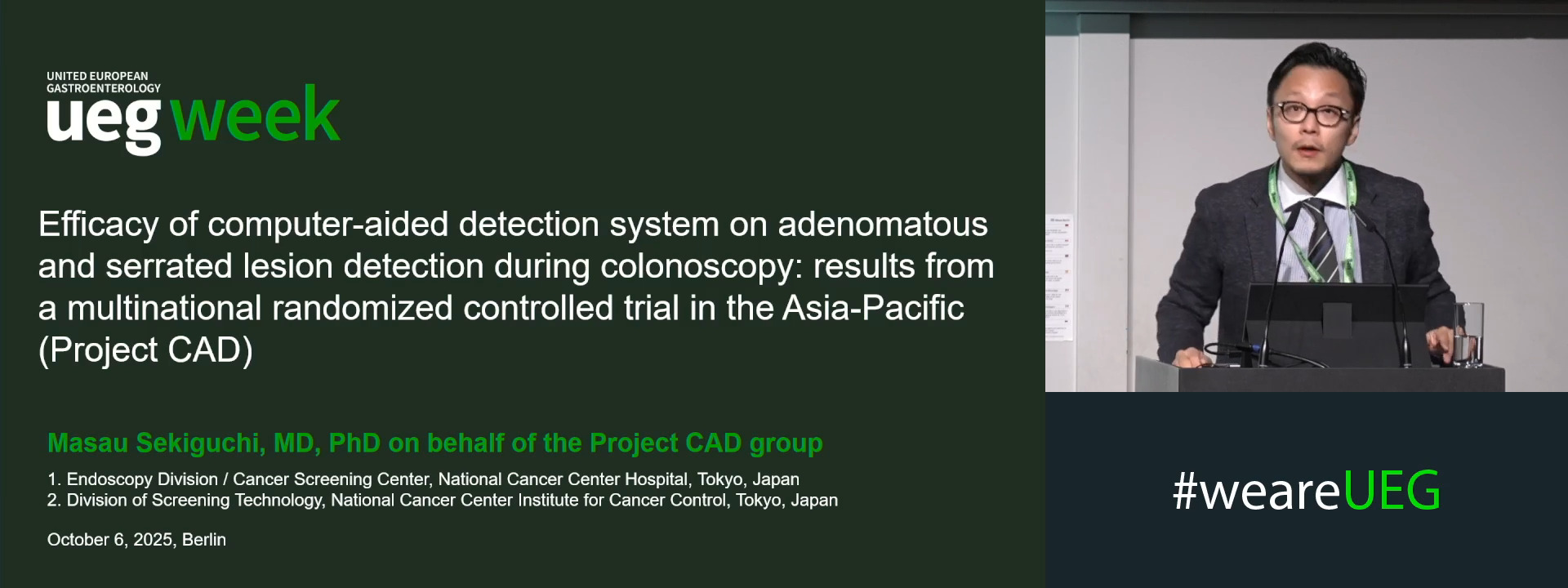
EFFICACY OF COMPUTER-AIDED DETECTION SYSTEM ON ADENOMATOUS AND SERRATED LESION DETECTION DURING COLONOSCOPY: RESULTS FROM A MULTINATIONAL RANDOMIZED CONTROLLED TRIAL IN THE ASIA-PACIFIC (PROJECT CAD)
Masau Sekiguchi 1,2, Chi-Yang Chang 3,4, Kyung Su Han 5, Sukit Pattarajierapan 6, Kazuki Sumiyama 7, Louis Ho-Shing Lau 8,9, Hikari Kobayashi 10, Rashid Lui 8, Christopher Jen Lock Khor 11,12, Kensuke Shinmura 13, Unknown Unknown 14, Jonathan Lee 15, Chen-Ya Kuo 3, B.Ch. Kim 5, Mamoru Ito 7, Keiko Nakamura 1, Yasuo Kakugawa 1, Takeshi Uozumi 1, Yuichiro Hirai 1, Reona Kawamura 1, Fu-Jen Lee 3, Kuan Wei Wu 3, Yu-Tsung Chen 3, Te-Ling Ma 3, Chang Won Hong 5, Bun Kim 5, Dae-Kyung Sohn 5, Supakij Khomvilai 6, Toshiki Futakuchi 7, Long Yan Kelvin Lam 9, Aric Josun Hui 9, Ngai Chi Fung 9, Ai Fujimoto 10, Takahisa Matsuda 10, MIAO SHAN LIM 11, Celia St Clair 1, Taro Shibata 1, Yutaka Saito 16
Affiliations
1 National Cancer Center Hospital, Tokyo, Japan
2 National Cancer Center Institute for Cancer Control, Tokyo, Japan
3 Fu Jen Catholic University Hospital, New Taipei City, Taiwan, Province of China
4 Fu Jen Catholic University, New Taipei City, Taiwan, Province of China
5 Research Institute and Hospital, National Cancer Center, Goyang, Korea, Republic of
6 Chulalongkorn University and King Chulalongkorn Memorial Hospital, Bangkok, Thailand
7 The Jikei University School of Medicine, Tokyo, Japan
8 The Chinese University of Hong Kong, Hong Kong, Hong Kong
9 CUHK Medical Center, Hong Kong, Hong Kong
10 Toho University Omori Medical Center, Tokyo, Japan
11 Singapore General Hospital, Singapore, Singapore
12 Duke-NUS Medical School, Singapore, Singapore
13 National Cancer Center Hospital East, Kashiwa, Japan
14 National Taiwan University Hospital, Taipei, Taiwan, Province of China
15 National University of Singapore, Singapore, Singapore
16 National Cancer Center Hospital Endoscopy Division, Tokyo, Japan