UEG's content platform for gastroenterology education bringing recordings, courses, guidelines, and more together in one place.
Trending on Gutflix
Rate for better recommendations!
Your feedback helps us show you more of what you like and less of what you dislike!
Log in to continue.
This content is part of Gutflix. Log in with your myUEG account, or create one free, to watch it.
Not sure what you can access? Learn more about account types.
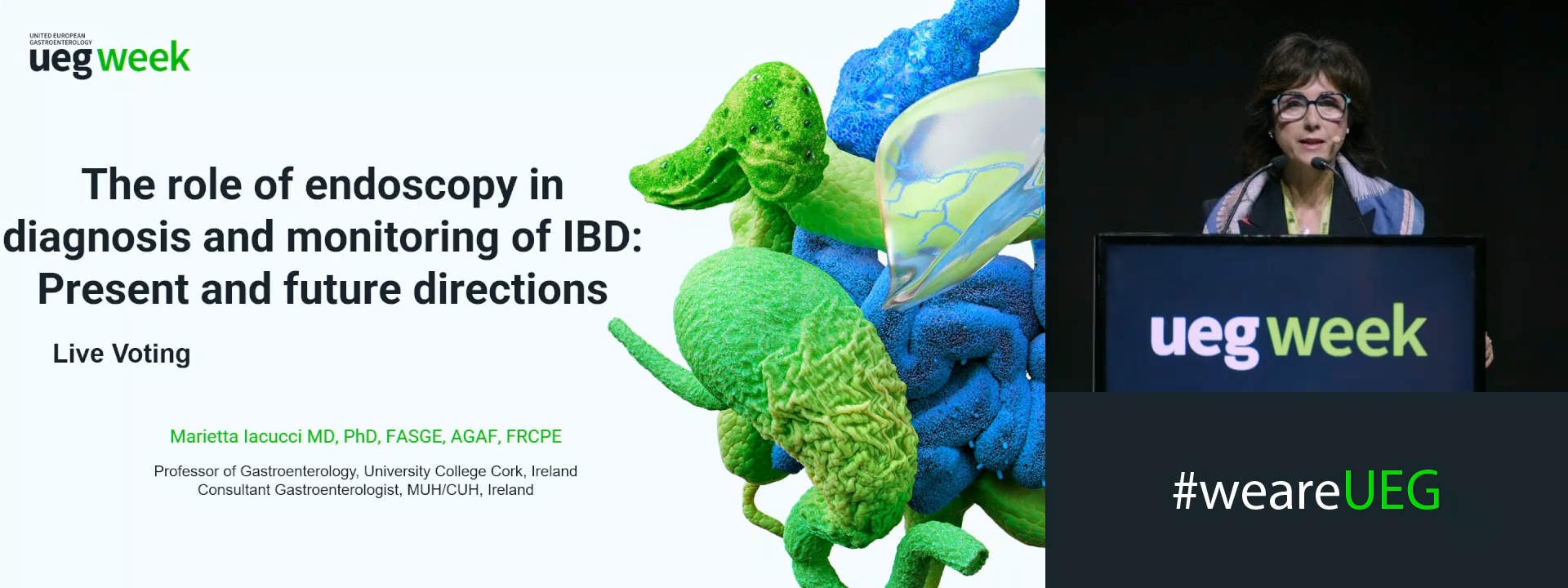
The role of endoscopy in diagnosis and monitoring of IBD: Present and future directions
Affiliations
1 University College Cork, Cork, Ireland

Log in to continue.
This content is part of Gutflix. Log in with your myUEG account, or create one free, to watch it.
Not sure what you can access? Learn more about account types.
THE MEDITERRANEAN DIET FOR IRRITABLE BOWEL SYNDROME
Joy Bamidele 1, Grace Brownlow 1, Rosie Flack 1, Rachel Buckle 2, Christian Shaw 2, Mo Shiha 1, Imran Aziz 1
Affiliations
1 University of Sheffield, Sheffield, United Kingdom
2 Sheffield Teaching Hospitals, Sheffield, United Kingdom

Log in to continue.
This content is part of Gutflix. Log in with your myUEG account, or create one free, to watch it.
Not sure what you can access? Learn more about account types.
Constipation: Paediatric and adult gastroenterologist
Affiliations
1 Academisch Medisch Centrum Onderzoekschool Oncologie Pediatrics and Pediat. Surgery - Dep. Of Pediat, AZ Amsterdam, Netherlands
2 University of Nottingham, Nottingham, United Kingdom

Log in to continue.
This content is part of Gutflix. Log in with your myUEG account, or create one free, to watch it.
Not sure what you can access? Learn more about account types.
UEG Week+ | Burnout in European Gastroenterology - A call to action

Log in to continue.
This content is part of Gutflix. Log in with your myUEG account, or create one free, to watch it.
Not sure what you can access? Learn more about account types.
IBD
Affiliations
1 Waschington University in Saint Louis, Waschington DC, United States of America

Log in to continue.
This content is part of Gutflix. Log in with your myUEG account, or create one free, to watch it.
Not sure what you can access? Learn more about account types.
Nutrition: Getting the best out for the patient!
Affiliations
1 Aarhus University Hospital, Aarhus N, Denmark