UEG's educational platform for gastroenterology education bringing recordings, courses, guidelines, and more together in one place.
Most popular content
Rate for better recommendations!
Your feedback helps us show you more of what you like and less of what you dislike!
Log in to access this content.
Free for all myUEG account holders. Your access level is set automatically based on your occupation. Medical professionals get full access to all content. If you are a non-medical user, you can only access UEG Week content from congresses you attended.
Not sure what you can access? Learn more about account types.

COMPARISON OF RESECTION DEPTH BETWEEN ESD AND EMR OF GASTRIC NEOPLASMS IN A TERTIARY CARE PROGRAM IN THE WESTERN WORLD
1 The University of Chicago Medicine, Chicago, United States
2 Rush Medical University, Chicago, United States|||Digestive Disease Service Line for Rush University System for Health, Chicago, United States
Conference
Topics
Submission format
Citation
Published
Log in to access this content.
Free for all myUEG account holders. Your access level is set automatically based on your occupation. Medical professionals get full access to all content. If you are a non-medical user, you can only access UEG Week content from congresses you attended.
Not sure what you can access? Learn more about account types.
USE OF INTESTINAL ULTRASOUND TO ASSESS FOR POSTOPERATIVE RECURRENCE IN CROHN’S DISEASE: AN INTERNATIONAL RAND/UCLA APPROPRIATENESS STUDY
Kerri L. Novak 1, Siwar Albashir 2, Mariangela Allocca 3, Anthony de Buck van Overstaeten 4, Paulo Gustavo Kotze 5, Cathy Lu 1, Christian Maaser 6, Giovanni Maconi 7, Remo Panaccione 1, Miguel Regueiro 8, Jordi Rimola 9, Antonino Spinelli 10, Stuart A. Taylor 11, Rune Wilkens 12, Wilhelmus A. Bemelman 13, Noa Krugliak Cleveland 14, Krisztina Barbara Gecse 13, Susan Archer 15, Soushyant Kiarasi 15, Linda J. Cornfield 15, Christopher Ma 16
1 University of Calgary, Calgary, Canada
2 McMaster University, Hamilton, Canada
3 IRCCS Hospital San Raffaele and University Vita-Salute San Raffaele, Milan, Italy
4 Mount Sinai Hospital, Toronto, Canada
5 Pontificia Universidade Católica do Paraná, Curitiba, Brazil
6 University Teaching Hospital, Lueneburg, Germany
7 University of Milan, Milan, Italy
8 Cleveland Clinic, Cleveland, United States
9 Hospital Clínic de Barcelona, IDIBAPS, Barcelona, Spain
10 Department of Biomedical Sciences, Humanitas University, Via Rita Levi Montalcini 4, 20072 Pieve Emanuele, Milan, Italy|||IRCCS Humanitas Research Hospital -, via Manzoni 56, 20089 Rozzano, Milan, Italy
11 University College London, London, United Kingdom
12 Copenhagen University Hospital Bispebjerg, Copenhagen, Denmark
13 Amsterdam University Medical Centers, Amsterdam, Netherlands
14 University of Chicago Medicine, Chicago, United States
15 Alimentiv Inc., London, Canada
16 Alimentiv Inc., London, Canada|||University of Calgary, Calgary, Canada
Conference
Topics
Submission format
Session
Citation
Published
Log in to access this content.
Free for all myUEG account holders. Your access level is set automatically based on your occupation. Medical professionals get full access to all content. If you are a non-medical user, you can only access UEG Week content from congresses you attended.
Not sure what you can access? Learn more about account types.
THE PUZZLE OF REFRACTORY PYODERMA GANGRENOSUM: USTEKINUMAB AS THE MISSING PIECE IN ULCERATIVE COLITIS
Pelin Telli 1, Bilger Cavus 1, Asli Cifcibasi Ormeci 1, aynura rustamzada 1, Sezen Genç Uluçeçen 1, Gizem dağcı 1, Mehmet Akif Yagli 1, Asim Qurbanov 1, Besim Fazil Agargun 1, Sabuhi Mammadov 1, Kadir Demir 1, Fatih Besisik 1, Filiz Akyüz 1, Sabahattin Kaymakoglu 1
1 Istanbul University Istanbul Faculty of Medicine, Istanbul, Türkiye
Conference
Topics
Submission format
Session
Published
Log in to access this content.
Free for all myUEG account holders. Your access level is set automatically based on your occupation. Medical professionals get full access to all content. If you are a non-medical user, you can only access UEG Week content from congresses you attended.
Not sure what you can access? Learn more about account types.
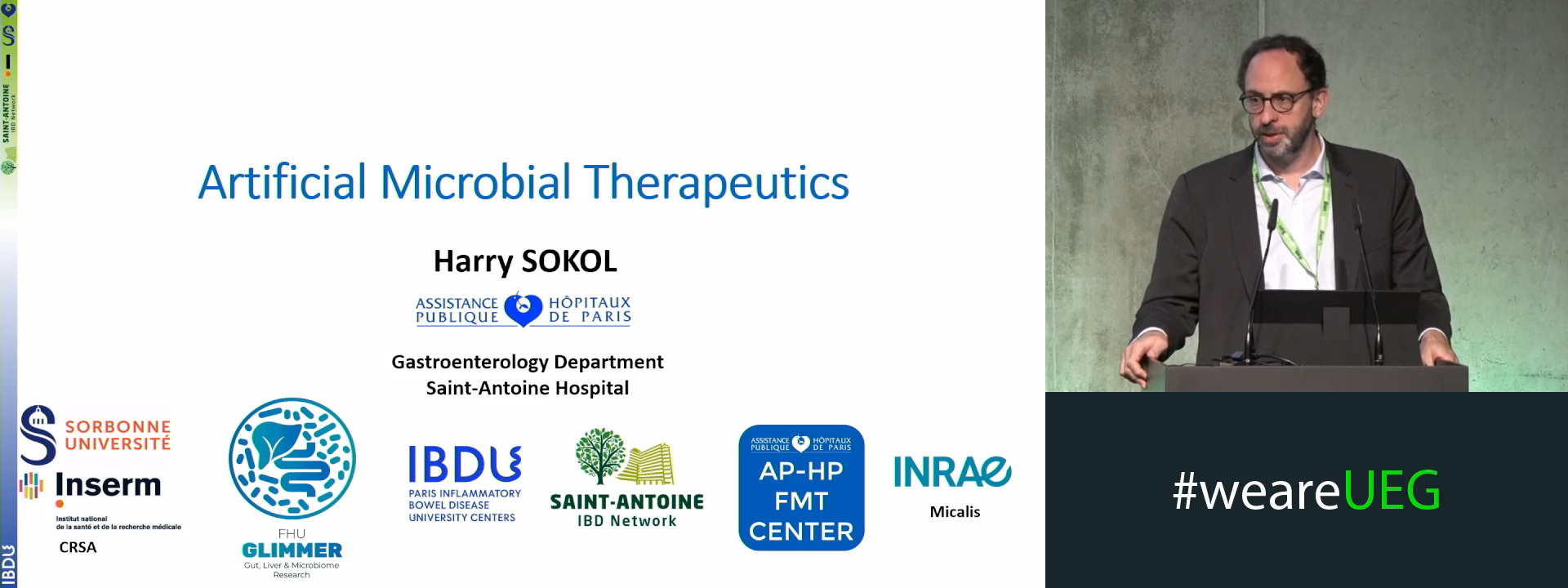
Artificial microbial therapeutics
1 Saint-Antoine Hospital, Paris, France
Event
Topics
Session
Citation
Published
Log in to access this content.
Free for all myUEG account holders. Your access level is set automatically based on your occupation. Medical professionals get full access to all content. If you are a non-medical user, you can only access UEG Week content from congresses you attended.
Not sure what you can access? Learn more about account types.
IN PATIENTS WITH GASTROESOPHAGEAL REFLUX DISEASE GERD-Q SCORE CORRELATES WITH METHYLBUTYRIC ACID, CAPROIC ACID AND ENANTIIC ACID IN STOOL SAMPLES
1 Federal Research Center of Nutrition and Biotechnology, Moscow, Russian Federation|||Russian Medical Academy of Continuing Professional Education, Moscow, Russian Federation
2 Federal Research Center of Nutrition and Biotechnology, Moscow, Russian Federation
Conference
Topics
Submission format
Citation
Published
Log in to access this content.
Free for all myUEG account holders. Your access level is set automatically based on your occupation. Medical professionals get full access to all content. If you are a non-medical user, you can only access UEG Week content from congresses you attended.
Not sure what you can access? Learn more about account types.
EFFICACY AND TOLERABILITY OF 1-L POLYETHYLENE GLYCOL PLUS ASCORBIC ACID WITH SENNA VERSUS 2-L POLYETHYLENE GLYCOL PLUS ASCORBIC ACID FOR BOWEL PREPARATION IN COLONOSCOPY: A PROSPECTIVE, RANDOMIZED, INVESTIGATOR-BLINDED TRIAL
Natsumi Maeda 1, Akira Higashimori 1, Masami Nakatani 2, Kagami Jinnai 2, Daiyu Kin 2, Naoko Sugita 2, Kenichi Morimoto 2, Eiji Sasaki 2, Takashi Fukuda 2, Tetsuo Arakawa 2, Yasuhiro Fujiwara 3
1 Osaka Metropolitan University Graduate School of Medicine, Osaka, Japan|||Minami Osaka Hospital, Osaka, Japan
2 Minami Osaka Hospital, Osaka, Japan
3 Osaka Metropolitan University Graduate School of Medicine, Osaka, Japan
Conference
Topics
Submission format
Citation
Published
Log in to access this content.
Free for all myUEG account holders. Your access level is set automatically based on your occupation. Medical professionals get full access to all content. If you are a non-medical user, you can only access UEG Week content from congresses you attended.
Not sure what you can access? Learn more about account types.
COMORBIDITIES AS A RISK FACTOR FOR RECURRENT CLOSTRIDIOIDES DIFFICILE INFECTION
1 Otto-von-Guericke University of Magdeburg, Magdeburg, Germany
2 Ludwig- Maximilians-University Munich, Munich, Germany
Conference
Topics
Submission format
Session