UEG's educational platform for gastroenterology education bringing recordings, courses, guidelines, and more together in one place.
Most popular content
Rate for better recommendations!
Your feedback helps us show you more of what you like and less of what you dislike!
Log in to access this content.
Free for all myUEG account holders. Your access level is set automatically based on your occupation. Medical professionals get full access to all content. If you are a non-medical user, you can only access UEG Week content from congresses you attended.
Not sure what you can access? Learn more about account types.

SCREENING FOR ARFID IN IRRITABLE BOWEL SYNDROME: CLINICALLY OR USING THE NIAS-FR QUESTIONNAIRE?
Fabien Wuestenberghs 1, Anne-Sophie Schmitt 1, Pauline Jouet 1, Ludovic ATTELLY 1, Mourad Benallaoua 1, Nicolas Ezratty 1, Jean-Jacques Raynaud 1, Robert Benamouzig 1, Jean Marc Sabate 1
1 APHP, Avicenne Hospital, Sorbonne Paris Nord University, Bobigny, France
Conference
Topics
Submission format
Session
Citation
Published
Log in to access this content.
Free for all myUEG account holders. Your access level is set automatically based on your occupation. Medical professionals get full access to all content. If you are a non-medical user, you can only access UEG Week content from congresses you attended.
Not sure what you can access? Learn more about account types.
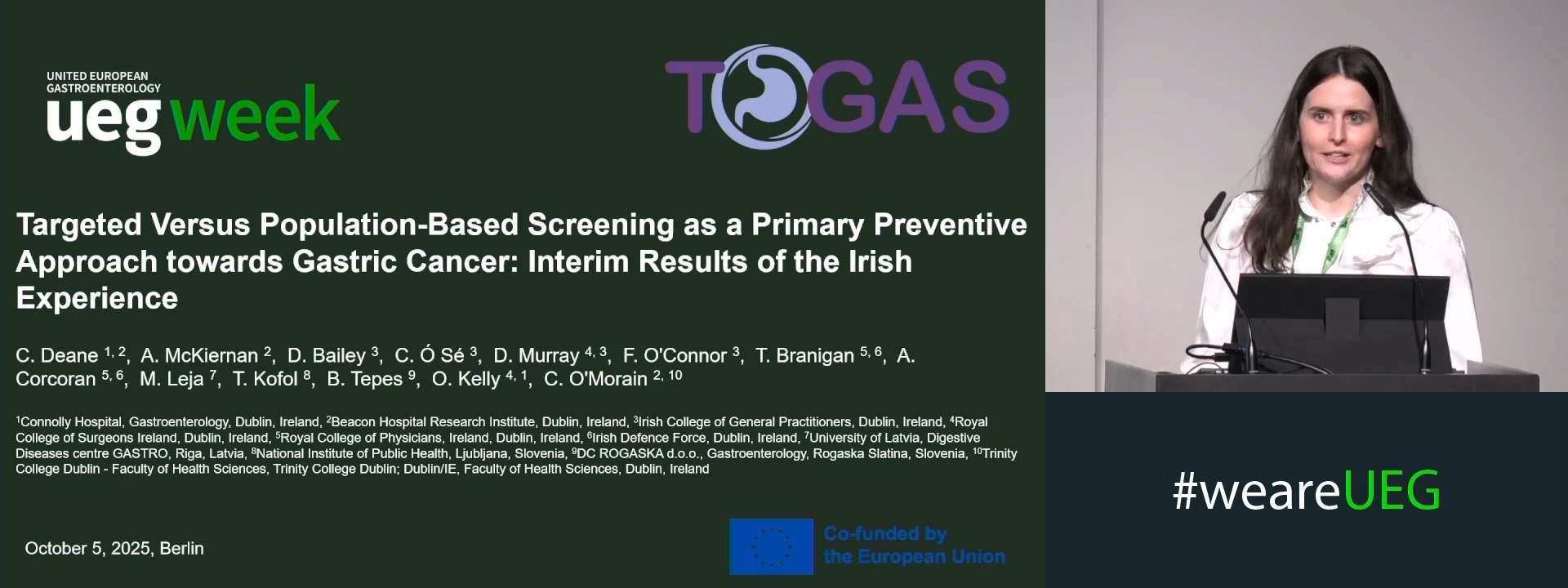
TARGETED VERSUS POPULATION-BASED SCREENING AS A PRIMARY PREVENTIVE APPROACH TOWARDS GASTRIC CANCER: INTERIM RESULTS OF THE IRISH EXPERIENCE
Charlene Deane 1, Ana McKiernan 2, Donal Bailey 3, Colm Ó Sé 3, Dean Murray 4, Fiona O'Connor 3, Tom Branigan 5, Anthony Corcoran 5, Marcis Leja 6, Tatjana kofol 7, Bojan Tepes 8, Orlaith Kelly 9, Colm O'Morain 10
1 Connolly Hospital, Dublin, Ireland|||Beacon Hospital Research Institute, Dublin, Ireland
2 Beacon Hospital Research Institute, Dublin, Ireland
3 Irish College of General Practitioners, Dublin, Ireland
4 Royal College of Surgeons Ireland, Dublin, Ireland|||Irish College of General Practitioners, Dublin, Ireland
5 Royal College of Physicians, Ireland, Dublin, Ireland|||Irish Defence Force, Dublin, Ireland
6 University of Latvia, Riga, Latvia
7 National Institute of Public Health, Ljubljana, Slovenia
8 DC ROGASKA d.o.o., Rogaska Slatina, Slovenia
9 Royal College of Surgeons Ireland, Dublin, Ireland|||Connolly Hospital, Dublin, Ireland
10 Beacon Hospital Research Institute, Dublin, Ireland|||Trinity College Dublin - Faculty of Health Sciences, Trinity College Dublin; Dublin/IE, Dublin, Ireland
Event
Submission format
Citation
Published
Log in to access this content.
Free for all myUEG account holders. Your access level is set automatically based on your occupation. Medical professionals get full access to all content. If you are a non-medical user, you can only access UEG Week content from congresses you attended.
Not sure what you can access? Learn more about account types.
EFFECT OF FERMENTABLE OLIGO-, DI-, MONOSACCHARIDES, AND POLYOLS ON FUNCTIONAL DYSPEPSIA SYMPTOMS, GASTROINTESTINAL VOLUMES AND GUT HORMONES: A DOUBLE-BLIND RANDOMIZED PILOT TRIAL
Bert Broeders 1, Karen Van den Houte 1, Lotte Van Lieshout 1, Karen Routhiaux 1, Florencia Carbone 2, Joran Toth 1, Annelies Verheyden 1, Frederik De Keyzer 3, Tim Vanuytsel 1, Jan Tack 4
1 KU Leuven, Leuven, Belgium
2 University of Leuven, Leuven, Belgium
3 Universitary Hospitals Leuven, Leuven, Belgium
4 University of Leuven, University Hospital Gasthuisberg, Leuven, Belgium
Conference
Topics
Submission format
Citation
Published
Log in to access this content.
Free for all myUEG account holders. Your access level is set automatically based on your occupation. Medical professionals get full access to all content. If you are a non-medical user, you can only access UEG Week content from congresses you attended.
Not sure what you can access? Learn more about account types.
STEPPING AWAY FROM OVERLY RESTRICTIVE DIETS: A SELF-INSTRUCTED FODMAP LOWERING DIET APPLICATION IMPROVES SYMPTOMS IN TERTIARY CARE PATIENTS WITH IBS
Karen Routhiaux 1, Lola Schaar 1, Manon Warnant 2, Tim Vanuytsel 3, Karen Van den Houte 1, Jan Tack 3
1 KU Leuven, Leuven, Belgium
2 University College Leuven Limburg (UCLL), Leuven, Belgium
3 UZ Leuven, Leuven, Belgium|||KU Leuven, Leuven, Belgium
Conference
Topics
Submission format
Citation
Published
Log in to access this content.
Free for all myUEG account holders. Your access level is set automatically based on your occupation. Medical professionals get full access to all content. If you are a non-medical user, you can only access UEG Week content from congresses you attended.
Not sure what you can access? Learn more about account types.
CONFOCAL LASER ENDOMICROSCOPY-BASED DIETS IN FUNCTIONAL DYSPEPSIA: RESULTS FROM A RANDOMIZED, DOUBLE-BLIND, SHAM-CONTROLLED, CROSS-OVER STUDY
Cedric Van de Bruaene 1, Jolien Schol 1, Lukas Balsiger 1, Karlien Raymenants 1, Karen Routhiaux 2, Karen Van den Houte 2, Joran Toth 2, Florencia Carbone 2, Ricard Farré 2, Tim Vanuytsel 1, Jan Tack 1
1 Katholieke Universiteit Leuven / Universitaire Ziekenhuizen Leuven Campus Gasthuisberg, Leuven, Belgium
2 Katholieke Universiteit Leuven, Leuven, Belgium
Conference
Topics
Submission format
Session
Citation
Published
Log in to access this content.
Free for all myUEG account holders. Your access level is set automatically based on your occupation. Medical professionals get full access to all content. If you are a non-medical user, you can only access UEG Week content from congresses you attended.
Not sure what you can access? Learn more about account types.
ATOPY AND OTHER (FOOD) HYPERSENSITIVITIES IN NON-CELIAC WHEAT SENSITIVITY: SHOULD WE RECLASSIFY THESE PATIENTS AS ‘ALLERGIC’? A RETROSPECTIVE CASE-CONTROL STUDY
Aurelio Seidita 1, Pasquale Mansueto 2, Maurizio Soresi 2, Diana Di Liberto 2, Marianna Lauricella 2, Giovanni Pratelli 2, Lydia Giannitrapani 2, Giorgia Cavallo 1, Francesco Faraci 1, Oriana Taibi 1, Laura Verona 1, Mirco Pistone 1, Giuseppe Mazzarella 3, Alessandra Camarca 3, Francesco Maurano 3, Antonio Carroccio 1
1 University of Palermo, Palermo, Italy|||“V. Cervello” Hospital, Ospedali Riuniti “Villa Sofia-Cervello”, Palermo, Italy
2 University of Palermo, Palermo, Italy
3 Institute of Food Sciences-CNR, Avellino, Italy
Conference
Topics
Submission format
Citation
Published
Log in to access this content.
Free for all myUEG account holders. Your access level is set automatically based on your occupation. Medical professionals get full access to all content. If you are a non-medical user, you can only access UEG Week content from congresses you attended.
Not sure what you can access? Learn more about account types.
EVALUATING THE QUALITY OF SOCIAL MEDIA CONTENT ON NONALCOHOLIC FATTY LIVER DISEASE: AN EXPERIENCE FROM A LOWER MIDDLE-INCOME COUNTRY
Madunil Niriella 1, Prathibha Wijesingha 1, Krishanni Prabagar 1, Dhanushi Ruwanthika Abeynayake 2, Hiruni Jayasena 3, Piyal Ranagana Herath 4, Anuratha Kajendran 5, Vithya Rishikesavan 6, Karthiha Balendran 7, Tiloka de Silva 8, Arjuna De Silva 1, Prof Janaka De Silva 1
1 Faculty of Medicine, University of Kelaniya, Ragama, Sri Lanka
2 Ambilipitiya District General Hospital, Ambilipitiya, Sri Lanka
3 Faculty of Medicine, Sir John Kotelawala Defence University, Dehiwala-Mount Lavinia, Sri Lanka
4 Pollonnaruwa Teaching Hospital, Pollonnaruwa, Sri Lanka
5 Jaffna National Hospital, Jaffna, Sri Lanka
6 Kaluthara Teaching Hospital, Kaluthara, Sri Lanka
7 Faculty of Medicine, University of Jaffna, Jaffna, Sri Lanka
8 Faculty of Business, University of Moratuwa, Katubedda, Sri Lanka
Conference
Topics
Submission format
Session