UEG's content platform for gastroenterology education bringing recordings, courses, guidelines, and more together in one place.
Trending on Gutflix
Rate for better recommendations!
Your feedback helps us show you more of what you like and less of what you dislike!
Log in to continue.
This content is part of Gutflix. Log in with your myUEG account, or create one free, to watch it.
Not sure what you can access? Learn more about account types.
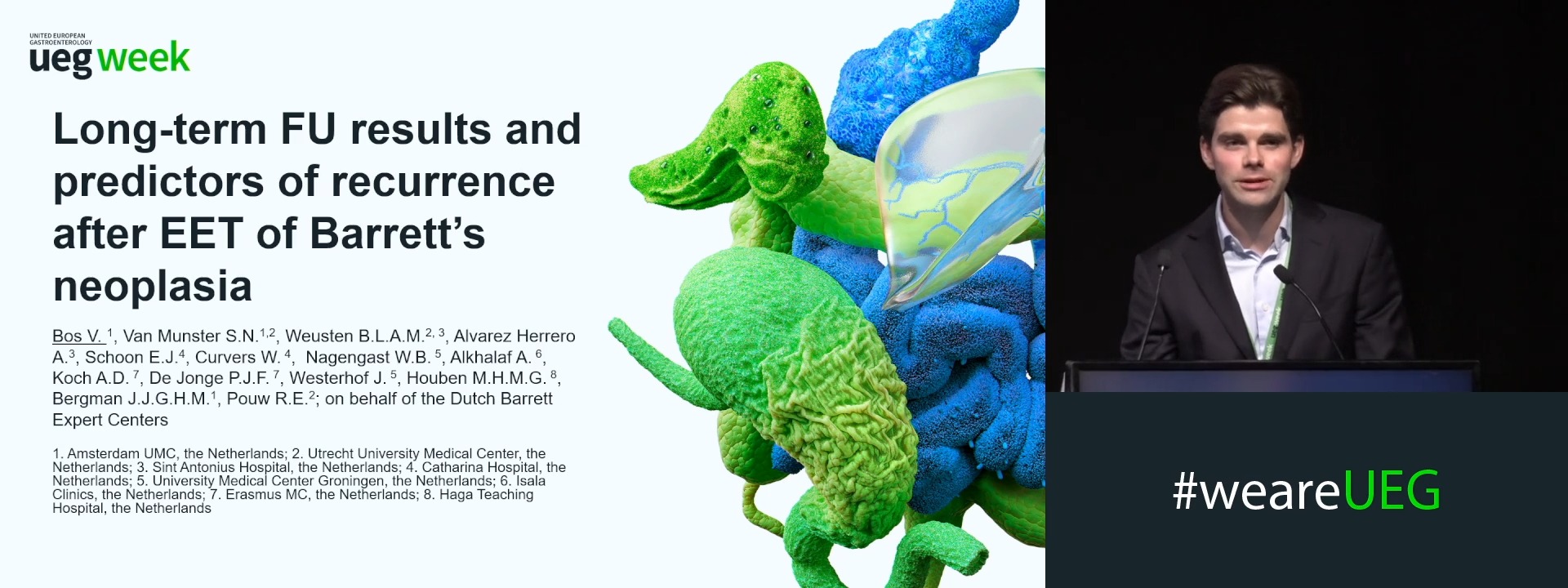
LOW RECURRENCE RATES AFTER ENDOSCOPIC ERADICATION THERAPY OF BARRETT'S NEOPLASIA: LONG-TERM FOLLOW-UP RESULTS FROM THE NATIONWIDE DUTCH BARRETT'S REGISTRY
Vincent Bos 1, Sanne van Munster 1, Bas L.A.M. Weusten 2,3, Lorenza Alvarez Herrero 2, Erik Jan Schoon 4, Wouter L. Curvers 4, Wouter B. Nagengast 5, Alaa Alkhalaf 6, Arjun D. Koch 7, Pieter Jan de Jonge 7, Jessie Westerhof 5, Martin Houben 8, Jacques J. Bergman 1, Roos E. Pouw 3
Affiliations
1 Amsterdam UMC, Amsterdam, Netherlands
2 St Antonius Hospital, Nieuwegein, Netherlands
3 UMC Utrecht, Utrecht, Netherlands
4 Catharina Hospital, Eindhoven, Netherlands
5 University Medical Center Groningen, Groningen, Netherlands
6 Isala, Zwolle, Netherlands
7 Erasmus MC - University Medical center, Rotterdam, Netherlands
8 Haga Teaching Hospital, The Hague, Netherlands
Log in to continue.
This content is part of Gutflix. Log in with your myUEG account, or create one free, to watch it.
Not sure what you can access? Learn more about account types.
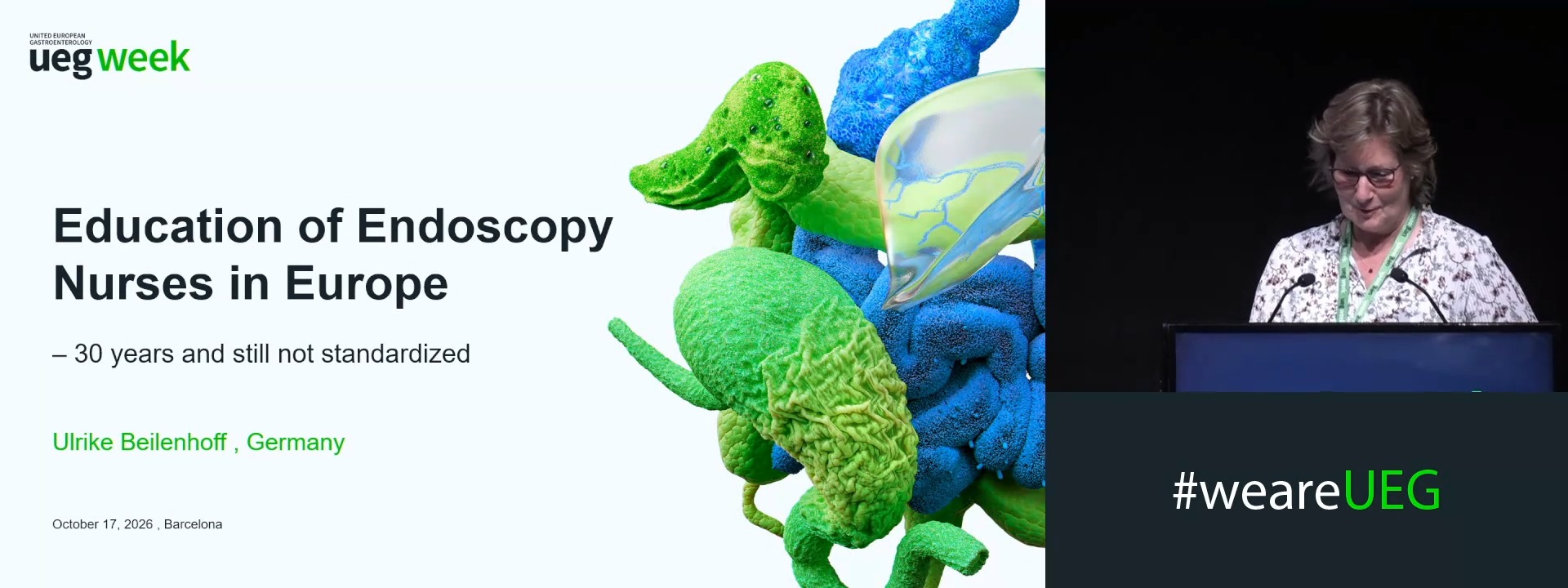
Education of endoscopy nurses in Europe – 30 years and still not standardised
Affiliations
1 ESGENA Scientific Secretary, Ulm, Germany
Log in to continue.
This content is part of Gutflix. Log in with your myUEG account, or create one free, to watch it.
Not sure what you can access? Learn more about account types.
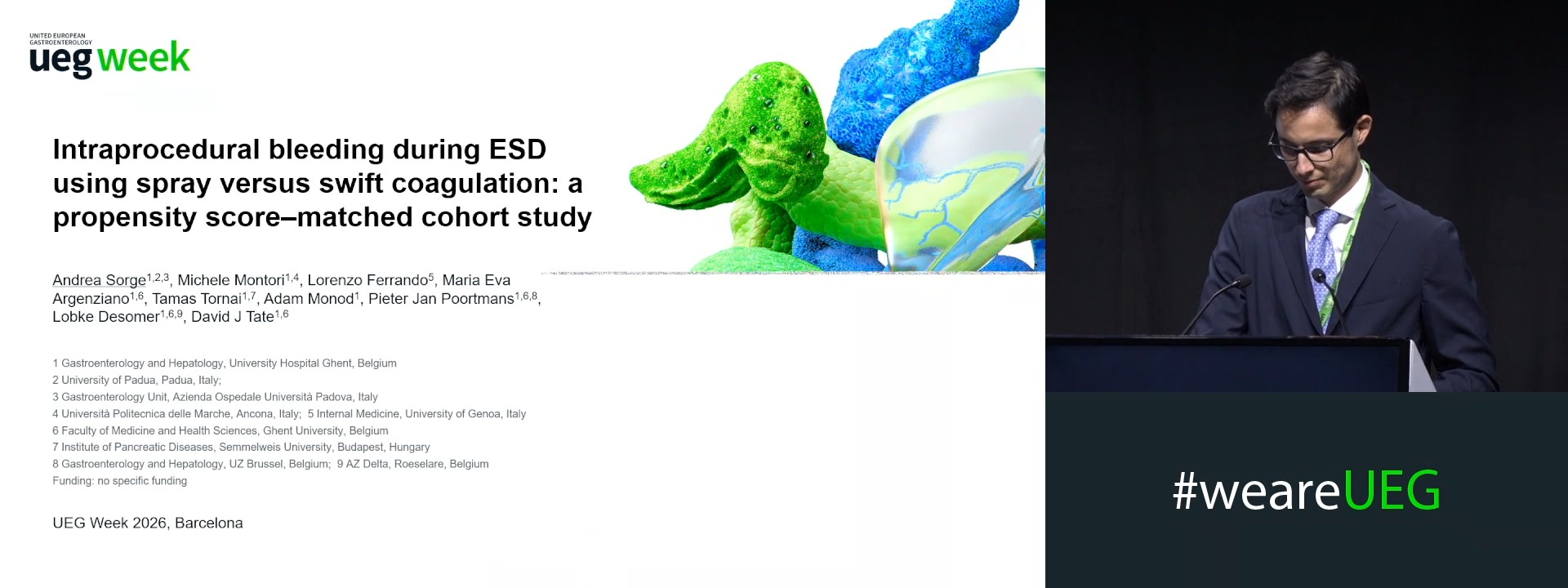
SPRAY COAGULATION REDUCES INTRAPROCEDURAL BLEEDING DURING ENDOSCOPIC SUBMUCOSAL DISSECTION COMPARED TO SWIFT COAGULATION: A PROPENSITY SCORE–MATCHED COHORT STUDY
Andrea Sorge 1,2, Michele Montori 2, Maria Eva Argenziano 2, Tamás Tornai 3, Adam Monod 2, Pieter Jan Poortmans 4, Lobke Desomer 5, David James Tate 6
Affiliations
1 University of Padua, Padua, Italy
2 University Hospital Ghent, Ghent, Belgium
3 Semmelweis University, Budapest, Hungary
4 University Hospital Ghent, University Hospital Brussels, Asse, Belgium
5 Az Delta, Drongen, Belgium
6 University Hospital Ghent, Gent, Belgium
Log in to continue.
This content is part of Gutflix. Log in with your myUEG account, or create one free, to watch it.
Not sure what you can access? Learn more about account types.
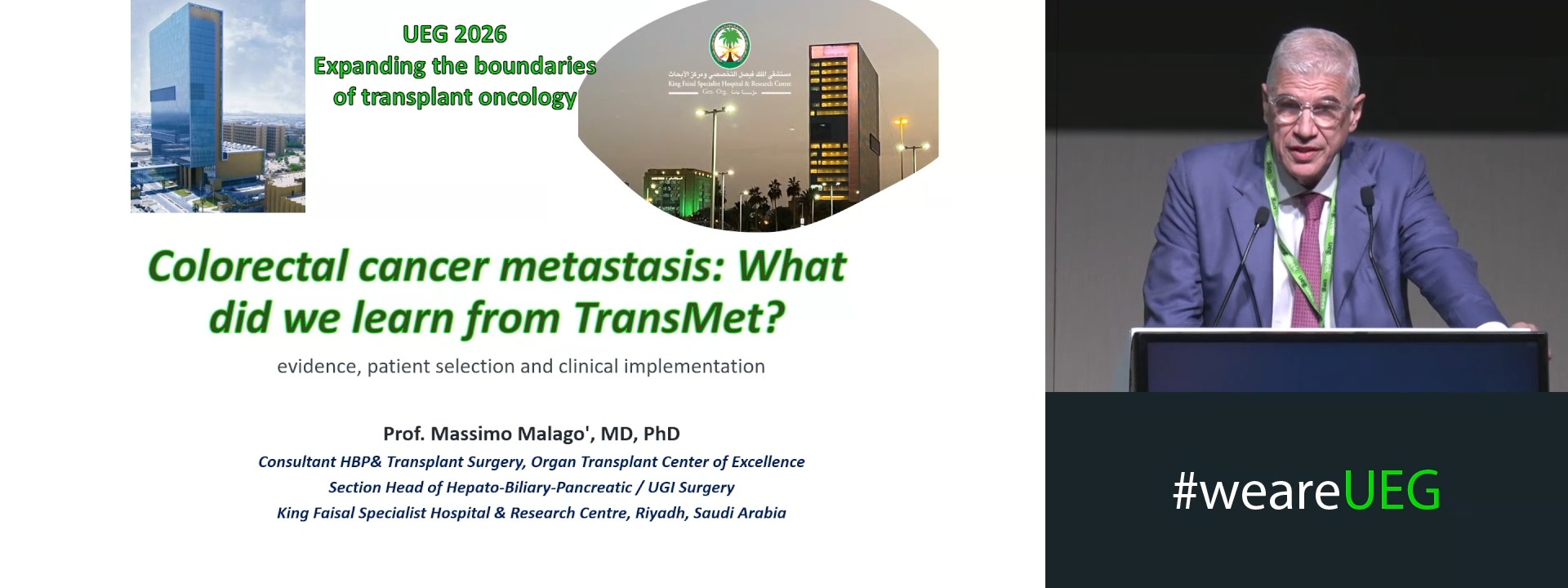
Colorectal cancer metastasis: What did we learn from TransMet?
Log in to continue.
This content is part of Gutflix. Log in with your myUEG account, or create one free, to watch it.
Not sure what you can access? Learn more about account types.
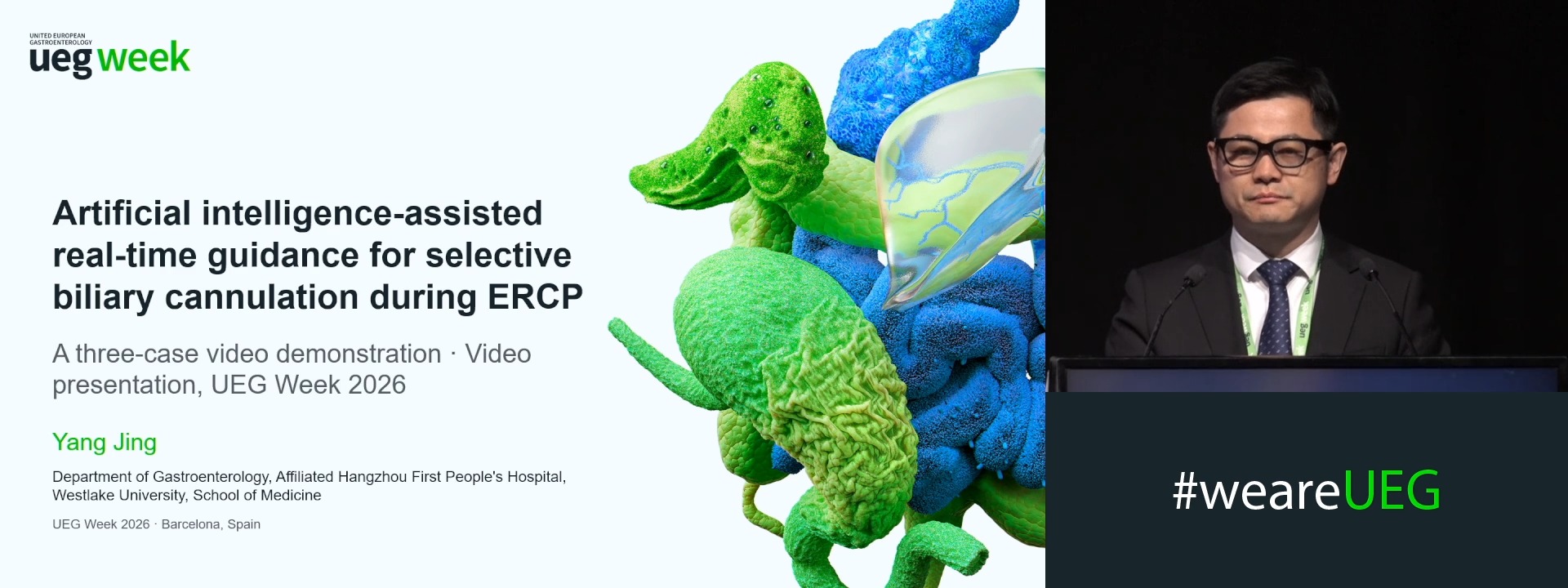
ARTIFICIAL INTELLIGENCE FOR PROCEDURAL GUIDANCE IN ERCP: A VIDEO DEMONSTRATION STUDY
Affiliations
1 Hangzhou First People's Hospital, Hangzhou, China
2 Affiliated Hangzhou First People's Hospital, School of Medicine, Westlake University, Hangzhou, China