UEG's content platform for gastroenterology education bringing recordings, courses, guidelines, and more together in one place.
Trending on Gutflix
Rate for better recommendations!
Your feedback helps us show you more of what you like and less of what you dislike!
Log in to continue.
This content is part of Gutflix. Log in with your myUEG account, or create one free, to watch it.
Not sure what you can access? Learn more about account types.
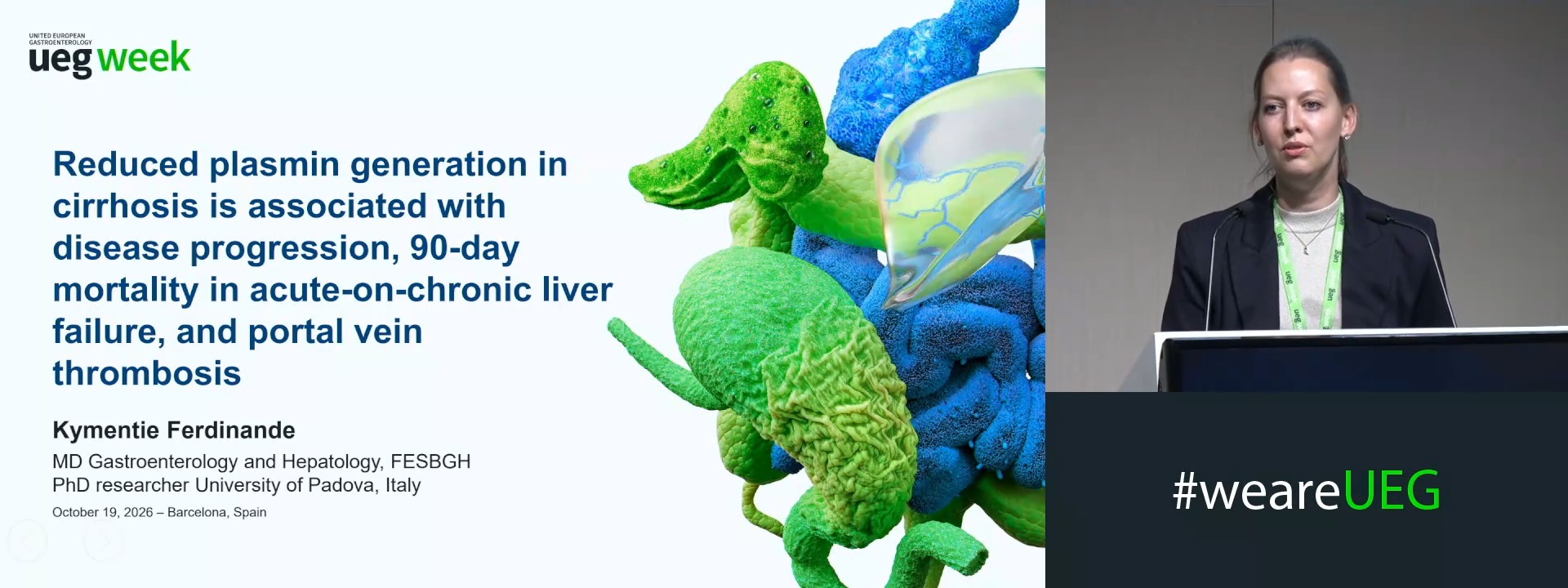
REDUCED PLASMIN GENERATION IN CIRRHOSIS IS ASSOCIATED WITH DISEASE PROGRESSION, 90-DAY MORTALITY IN ACUTE-ON-CHRONIC LIVER FAILURE, AND PORTAL VEIN THROMBOSIS
Kymentie Ferdinande 1, Eline van Gansewinkel 2, Alberto Zanetto 3, Jochen Decaestecker 4, Ruth Willems 2, Elena Campello 5, Charlotte De Vloo 4, Laurence Seynhaeve 4, Samia Tufaha 2, Cristiana Bulato 5, Francesco Paolo Russo 6, Elisa Pinto 3, Marco Senzolo 6, Judith de Vos-Geelen 7, Sarah Raevens 8, Anja Geerts 8, Xavier Verhelst 8, Matthijs Kramer 7, Mark Roest 2, Bas de Laat 2, Patrizia Burra 9, Paolo Simioni 5, Hans Van Vlierberghe 10, Dana Huskens 2, Katrien Devreese 8
Affiliations
1 Universita degli Studi di Padova, Wingene, Belgium
2 Synapse Research Institute, Maastricht, Netherlands
3 University of Padua, Padua, Italy
4 AZ Delta, Roeselare, Belgium
5 University of Padova, Padova, Italy
6 University Hospital Padova, Padova, Italy
7 Maastricht University Medical Center, Maastricht, Netherlands
8 Ghent University Hospital, Ghent, Belgium
9 University of Padua- Gastroenterology, Padova, Italy
10 Ghent University Hospital, Gent, Belgium