UEG's content platform for gastroenterology education bringing recordings, courses, guidelines, and more together in one place.
Trending on Gutflix
Rate for better recommendations!
Your feedback helps us show you more of what you like and less of what you dislike!
Log in to continue.
This content is part of Gutflix. Log in with your myUEG account, or create one free, to watch it.
Not sure what you can access? Learn more about account types.
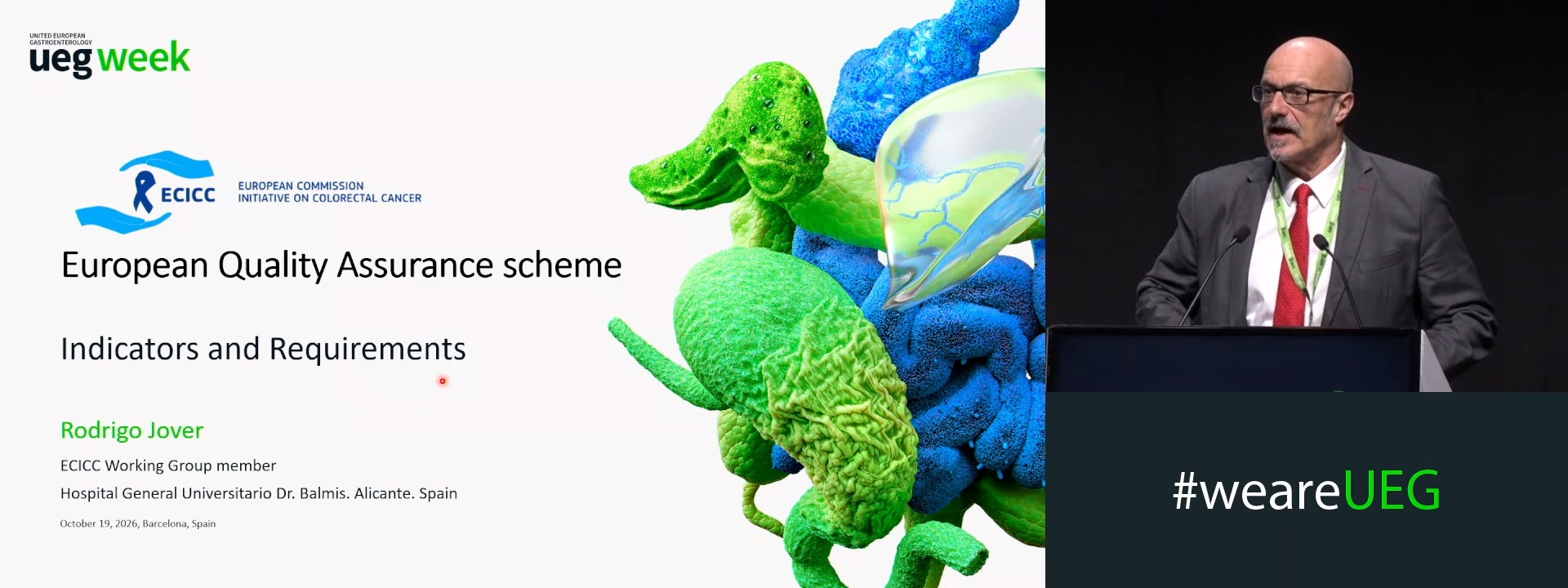
Quality assurance indicators and requirements
Affiliations
1 EC’s Joint Research Centre (JRC), Msida, Malta
Log in to continue.
This content is part of Gutflix. Log in with your myUEG account, or create one free, to watch it.
Not sure what you can access? Learn more about account types.
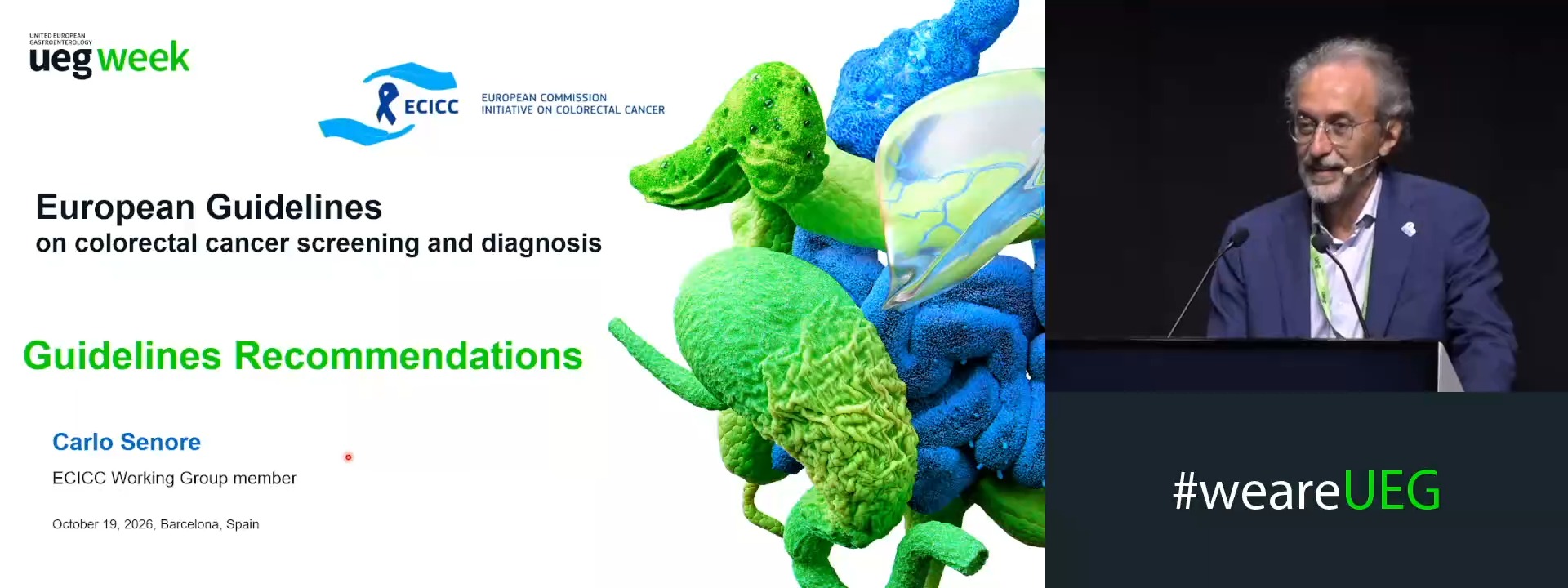
Guidelines recommendations
Affiliations
1 Humanitas University, Rome, Italy
Log in to continue.
This content is part of Gutflix. Log in with your myUEG account, or create one free, to watch it.
Not sure what you can access? Learn more about account types.
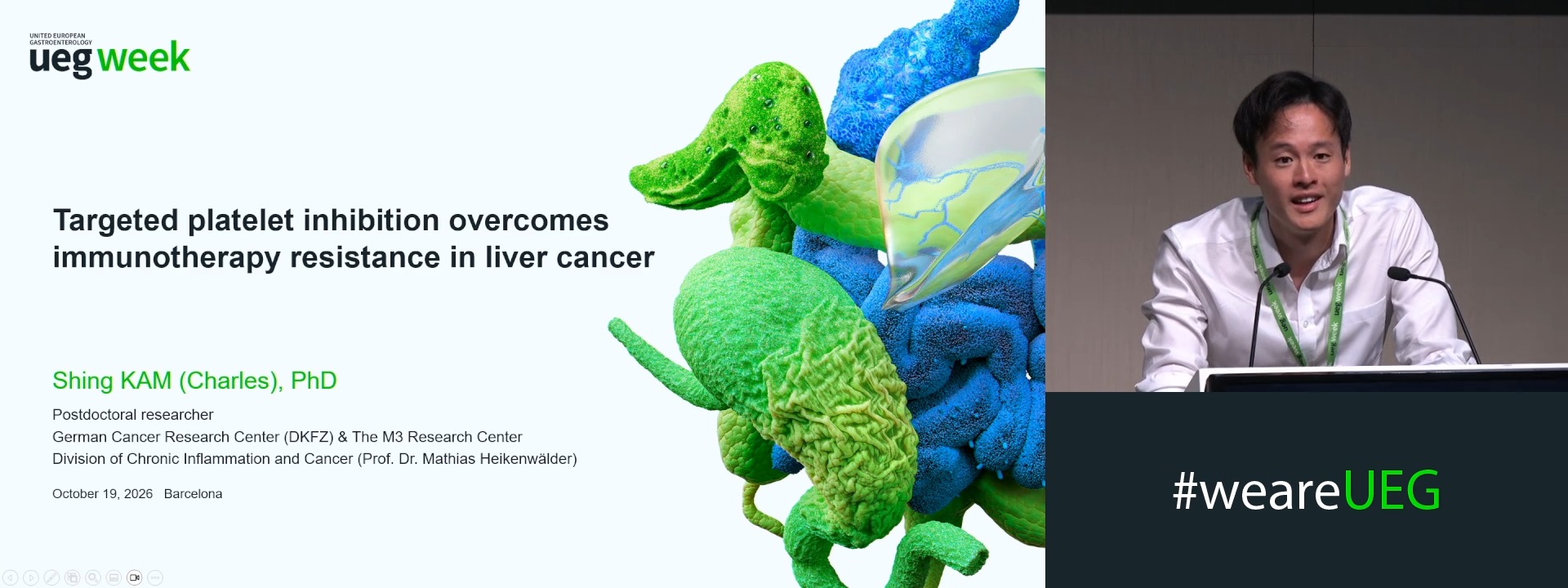
TARGETED PLATELET INHIBITION OVERCOMES IMMUNOTHERAPY RESISTANCE IN LIVER CANCER
Shing Kam 1, David Camell 2, Sainan Zhang 3, Erik Ramon Gil 4, Mara Caputo 5, Alaa Madi 3, Anna Vila-Escoda 2, Danijela Heide 6, Tabea Bieler 6, Sandra Prokosch 6, Ulrike Rothermel 6, Florian Müller 6, Sarah Flößer 6, Otsuka Masayuki 7, Thomas Longerich 8, Jan Böttcher 3, Valerie Chew 7, Donato Inverso 5, Jack Leslie 4, Derek Mann 4, Roser Pinyol 2, Bernhard Nieswandt 9, Pierluigi Ramadori 6, Josep Maria Llovet 10, Mathias Heikenwälder 1
Affiliations
1 The German Cancer Research Center (DKFZ) & M3-Research Center for Malignome, Metabolome and Microbiome, University of Tübingen, Heidelberg, Germany
2 Institut d'Investigacions Biomèdiques August Pi i Sunyer. (IDIBAPS), Universitat de Barcelona, Barcelona, Spain
3 M3-Research Center for Malignome, Metabolome and Microbiome, University of Tübingen, Tübingen, Germany
4 Newcastle University, Newcastle, United Kingdom
5 San Raffaele Scientific Institute & University, Milan, Italy
6 The German Cancer Research Center (DKFZ), Heidelberg, Germany
7 SingHealth-DukeNUS Academic Medical Centre, Singapore, Singapore
8 Department of Pathology, University Hospital Heidelberg, Heidelberg, Germany
9 Julius-Maximilians-Universität Würzburg, Würzburg, Germany
10 Mount Sinai School of Medicine, New York City, United States
Log in to continue.
This content is part of Gutflix. Log in with your myUEG account, or create one free, to watch it.
Not sure what you can access? Learn more about account types.
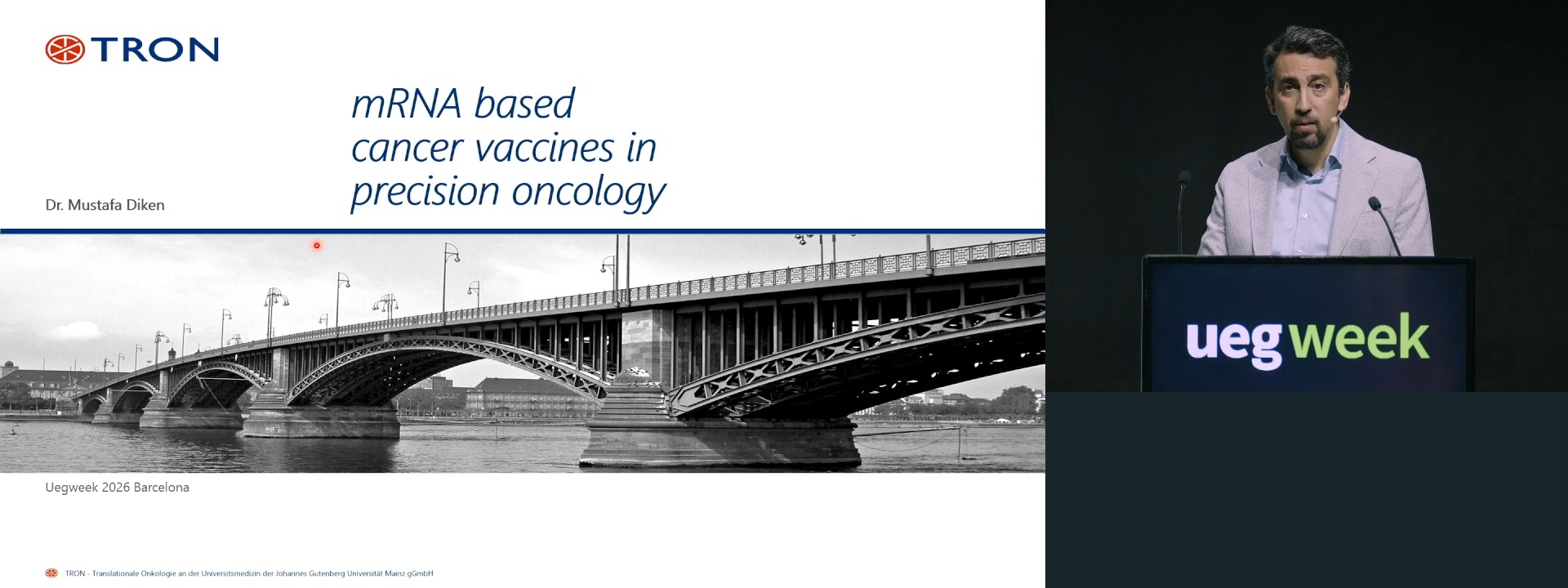
Coding the future: mRNA vaccines against gastrointestinal cancers
Affiliations
1 TRON - Translational Oncology at University Medical Center of Johannes Gutenberg University, Mainz, Germany
Log in to continue.
This content is part of Gutflix. Log in with your myUEG account, or create one free, to watch it.
Not sure what you can access? Learn more about account types.
Differential diagnosis and medical workup of fulminant liver failure
Affiliations
1 Klinikum rechts der Isar, München, Germany
Log in to continue.
This content is part of Gutflix. Log in with your myUEG account, or create one free, to watch it.
Not sure what you can access? Learn more about account types.
Advanced therapies: How should we sequence? How many is too many? A case-based perspective and state-of-the-art overview
Affiliations
1 John Radcliffe Hospital, Oxford, United Kingdom